
 Se connecter avec Facebook
 Se connecter avec Google
EvA - Aphanomyces risk assessment
The EvA tool enables you to quickly classify your plot as being at low or high risk, and thus guide you in your choices to preserve pea yield and plot health.
Aphanomyces is the most damaging telluric disease of peas. The EvA tool does not replace the Infectious Potential bioassay, but allows you to quickly classify your plot in a risk level and thus guide you in your choices to preserve pea yield and plot health.
Little information to fill in
The information you need to fill in is as follows: department, soil type, pea history and irrigation. These are few in number, but must be filled in very precisely.
A tool that can be used in most regions
The EvA tool was developed from a database containing information on 780 plots in the northern half of France, then validated on 120 plots, mainly in the Normandy and Centre-Val de Loire regions. This tool can be used in the Bourgogne-Franche-Comté, Bretagne, Centre-Val de Loire, Grand Est, Hauts-de-France, Île-de-France, Normandie, Nouvelle-Aquitaine and Pays de la Loire regions.
Points of attention
At present, only the effect of a winter or spring pea crop on the evolution of a soil's Infectious Potential is known. The effect of other susceptible legumes has not yet been taken into account in this tool, for lack of data. Consequently, for plots that have received one or more susceptible legumes other than pea as a main, intermediate, associated or companion crop, the risk may be underestimated. Only the bioassay can be used to estimate the risk in these plots*.
*Susceptible legumes: lentil, alfalfa, chickling vetch, certain species/varieties of vetch (Access the test) "

[TO COME] Sunflower seeding rate
The "sunflower sowing density" decision-support tool can be used to assess the number of seeds to be sown to reach the defined emergence density target.
The OAD advice takes into account the plot's water constraints and climatic zone.

Camelina: choice of plot for summer catch crop
To maximize the chances of success for camelina as a summer catch crop, it's essential to think in terms of crop succession. Camelina should therefore be planted as soon as the main crop is planted.
To maximize the chances of success for camelina as a summer catch crop, it's essential to think in terms of crop succession. Camelina should therefore be planted as soon as the main crop is planted.
Selection criteria
- Main crop harvested early (winter barley, winter peas, etc.)
- Choose legumes to avoid fertilization
- Avoid plots with a spring herbicide program at risk
- Choose plots free of weeds
After which main crop?
The first criterion is to choose an early-harvested preceding crop, enabling camelina to be planted between June 20 and July 10, to guarantee a harvest before the end of October. The main candidate crops are winter peas and winter barley, but other early-harvested crops may also be suitable: canning peas, garlic, onions, etc.
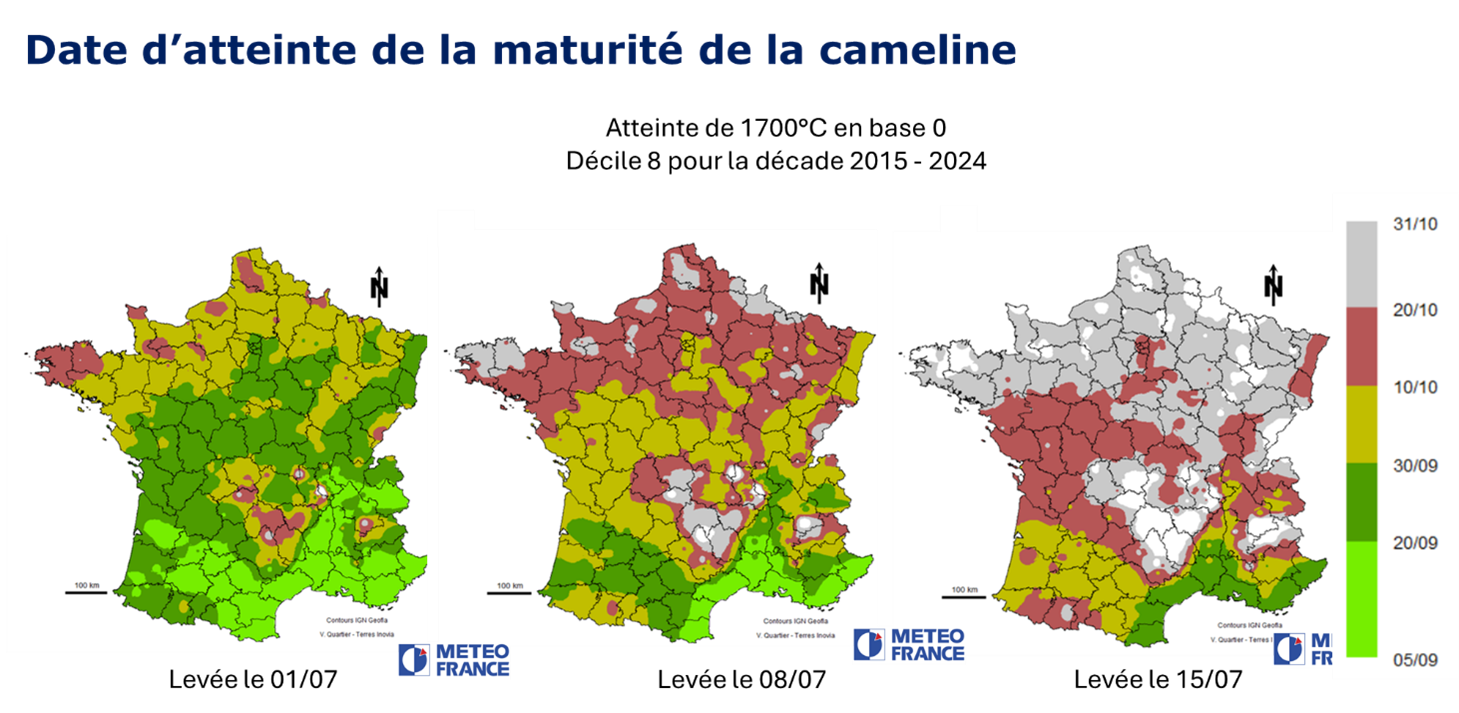
The map below illustrates the importance of sowing early, showing the date at which maturity is reached for very short-cycle varieties according to different emergence dates. For example, for an emergence on July 1, camelina reaches maturity before October 10 throughout France, whereas for an emergence on July 8, it reaches maturity after October 10 in the northern part of France, and for an emergence on July 15, it reaches maturity after October 20 in almost the northern half of France.
Planting camelina after a legume (e.g. winter peas) is particularly interesting, as it allows you to limit or even do without nitrogen fertilization, thus reducing the ITK's operating costs.
Focus on main crop herbicide program
Camelina grown as a summer catch crop is sensitive to the persistence of certain herbicides, mainly those in group 2(ALS1 inhibitors) with herbicides from the sulfonylurea family such as metsulfuron, mesosulfuron, etc., as well as imazamox (applied to winter peas). It also appears to be sensitive to group 14 herbicides (PPO2 inhibitors such as bifenox) and group 32 herbicides (solanesyl diphosphate synthase inhibitors, includingaclonifen, applied to winter peas).
There is therefore a risk of phytotoxicity (leaf discoloration, foot loss, etc.) for camelina when these herbicides are applied in spring to the main crop, a risk that is all the greater in dry conditions, when applied late and when there is little or no tillage between the harvest of the main crop and the planting of camelina. Despite this, the effects of these herbicides can vary according to a number of factors (rainfall, soil type, tillage, date and dose of application, etc.) and are still poorly understood and quantified.
Weed pressure on the plot
Camelina is a well-established crop that competes well with weeds. In spite of this, weed pressure remains one of the main limiting factors for camelina as a summer catch crop, so it's vital to use every possible means to manage weeds effectively.
We recommend choosing a weed-free plot at sowing time. If weeds are present when the main crop is harvested and you wish to direct seed, a glyphosate pass may be useful to manage weeds before seeding.
1ALS: acetolactate synthase
2PPO: protoporphyrinogen oxidase

Camelina editions
Cameline - Cultivation Guide 2024
Our other articles
Varieties available for camelina
The range of varieties on offer is not very well developed, and seeds are sometimes hard to come by, particularly in the organic sector. However, in view of the growing interest in camelina on the part of industrialists, particularly in catch crops for biofuel production, some seed companies are now taking an interest.
The range of varieties on offer is not very well developed, and seeds are sometimes hard to come by, particularly in the organic sector. However, in view of the growing interest in camelina on the part of industrialists, particularly in catch crops for biofuel production, some seed companies are now taking an interest.
For example, Bayer recently acquired camelina germplasm from the Canadian company Smart Earth Camelina, in order to diversify into the biofuels sector.
A major challenge in breeding varieties suitable for catch crops is to develop very short-cycle varieties.
There are winter varieties and spring varieties (but in areas where the climate is mild - winter temperatures do not exceed -10°C - spring varieties can also be planted in autumn). Recent breeding efforts have focused on spring-type varieties.
Here is a non-exhaustive list of existing varieties:
Variety | Seed company | Registration year | Type | Comments |
VERA | Camelina Company* | 2019 | Spring | Suitable for catch crop |
ALBA | Camelina Company* | 2019 | Spring |
|
CAMARES | Panam |
| Spring |
|
MELINA | Panam |
| Spring |
|
ARCADIA | Panam |
| Spring |
|
CELINE | A2P | 1998 | Spring |
|
EPONA | A2P | 1998 | Winter |
|
CALENA | Saatbau | 1996 | Spring |
|
OM | Sanctum Mediterranean | 2014 | Spring |
|
LUC | DANISCO SEEDS SA | 1995 | Spring |
|
CAMELATE | Lidea |
| Spring | Suitable for intercropping (late flowering) |
CAMELIA | Lidea |
| Spring | Suitable for intercropping |

Camelina editions
Cameline - Cultivation Guide 2024
Our other articles
[COMING SOON] When to sow to harvest sunflowers
Estimate the sunflower harvesting period, according to your location, based on your choice of variety and your planned sowing date.
This tool will tell you how much risk you are taking at harvest, depending on your sowing date and criteria.
This tool is designed for sunflower as a main crop, not as a catch crop. It is based on frequent climatic data and does not incorporate weather data for the current season.

[COMING SOON] Calculating the economic margin for sunflowers
The sunflower margin calculator is designed to help you estimate the annual gross margin in €/ha for your sunflower crop.
The sunflower margin calculator is designed to help you estimate the annual gross margin in €/ha for your sunflower crop. This calculation can help you identify margins for progress in management to improve the margin of this crop. This tool does not take into account the precedent and rotation effects that can occur when you introduce sunflower into a crop succession (quality of precedent, better balance between summer and spring crops and winter crops for better weed management).

How camelina fits into cropping systems
Adapted to a wide range of soil and climate conditions, camelina is grown throughout France. It can be easily integrated into a variety of cropping systems, in both conventional and organic farming.
Adapted to a wide range of soil and climate conditions, camelina is grown throughout France. It can be easily integrated into a variety of cropping systems, in both conventional and organic farming.
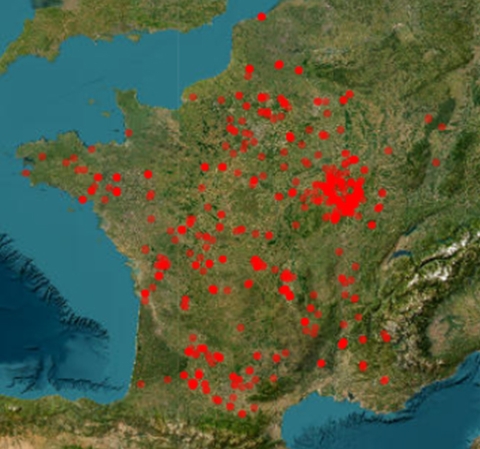
A particularity of camelina is its very short cycle length, which also makes it suitable for intercropping.
Camelina as a main crop
Pure cultivation
Camelina can be grown pure as a main crop, with winter and spring varieties. In areas with mild climates (winter temperatures not exceeding -10°C), spring varieties can also be planted in autumn.
As a main crop, the proportion of organically-produced camelina is particularly high, thanks to its hardiness and resistance to pests and diseases, and to the opportunities for using the oil for human consumption.
In some countries of the southern Mediterranean basin, camelina is grown on so-called "marginal" land with low potential, which it valorizes well.
In combination
Camelina lends itself well to crop combinations, particularly in organic farming. The lentil-camel association is widely practiced, with camelina acting as a staking plant, thus limiting the risk of lentil lodging.
What's more, if planting conditions are favorable, camelina develops rapidly and is highly competitive with weeds at the rosette stage, in contrast to the generally slow initial development of legumes, which contributes to better weed control. Other camelina-legume combinations mentioned in the literature are camelina combined with pea, lupin or chickpea.
There are also references to camelina combined with barley or wheat, but these refer to competition between the two species and associated yield losses (M. Leclère's thesis on camelina insertion in Picardie).
Intercropping
The length of camelina's cycle, around 3 months for short-cycle varieties, means that it can be grown as a catch crop. Recent changes in the regulatory framework open up major market opportunities for intercropped camelina, such as sustainable fuel for aviation.
Summer intercropping
While camelina adapts well to a wide range of soil and climate conditions, a number of conditions must be met to maximize its chances of success in summer intercropping: sufficient rainfall during the planting period (late June - early July), few days of high temperature (35°C - 40°C) during flowering, and a sufficient temperature sum (1700°J base 0) to reach maturity before mid-October. These criteria exclude areas very far north and south of France.
To maximize chances of success, camelina in summer intercropping should be planted after an early-harvested preceding crop, such as barley or winter peas.
Winter intercropping
Camelina can also be intercropped in winter, before a late-sown spring crop such as sunflower or sorghum. The challenge for this type of succession is to harvest the camelina early enough, so as not to delay the sowing of the following crop too much and impact its yield potential.


Our other articles
The agronomic benefits of camelina
Camelina (Camelina sativa) is a cruciferous plant (Brassicaceae) native to Europe and Southwest Asia. It has historically been cultivated in Europe, notably in France, where the first traces date back to the Bronze Age, for the production of vegetable oil and fodder.
Camelina (Camelina sativa) is a cruciferous plant (Brassicaceae) native to Europe and Southwest Asia. It has historically been cultivated in Europe, notably in France, where the first traces date back to the Bronze Age, for the production of vegetable oil and fodder.
It was widely cultivated until the early 20th century, producing an oil used in soaps and paints, before gradually disappearing in the face of competition from more productive oilseed crops such as rapeseed. At the time, the solid residues obtained after oil extraction were used as a feed supplement for livestock or as fertilizer; the stalks were used to make brooms.
Today, it is making a comeback on the European agricultural scene, and is attracting interest from a wide range of players, both farmers and manufacturers, thanks to its agronomic advantages and the new outlets it opens up.
Good adaptation to soil and climate conditions
Camelina has one major advantage: it adapts to a wide range of soil and climate conditions, and is particularly well suited to low-potential soils. It is often presented as a hardy crop, thanks to its low input requirements and resistance to drought and high temperatures. It is also fairly tolerant of pests and resistant to lodging. Camelina requires little fertilizer or pesticide, so its introduction into cropping systems has both economic and environmental benefits.
No special equipment required, but some adjustments are necessary
What's more, it doesn't require any special equipment, making it easy to introduce to farms. Nevertheless, due to its small seed size (PMG ≈ 1-1.5g), the planting and harvesting phases require adjustments and special attention.
A short-cycle crop
An interesting feature of camelina is the length of its cycle, which varies according to variety and sowing period, from 90 to 250 days (1700 to 1900 degrees day at base 0°C, depending on variety). Camelina can therefore be grown as a main crop, in association with lentils, for example, or as a catch crop for short-cycle varieties (link to page on how to insert camelina into the SoC).
An asset for organic farming
Its low input requirements, combined with its strong competitive power - provided it emerges regularly and evenly - mean that it has a place in organic farming rotations (link to organic farming page). Some farmers even report that it has an "allelopathic" effect, i.e. that it can naturally inhibit the growth of other undesirable plants around it. To our knowledge, this has not yet been demonstrated in the field.
Conclusion
All these advantages make it a crop that can be easily integrated into a variety of cropping systems in France and around the world, in both organic and conventional farming, as a main crop or as a catch crop.

Camelina editions
Cameline - Cultivation Guide 2024
Our other articles
Weeding camelina
Myvar
Consult and choose your oilseed and protein crop varieties.