
Automatically generated translation
General Information
Camelina has good competitive ability, which allows it to effectively compete with weeds, provided that establishment is successful and emergence is uniform and sufficient.
However, given the limited number of registered herbicides effective against both grasses and broadleaf weeds, it is recommended to plant it in a clean field that is free of weeds at the time of sowing.
It is also advisable to avoid situations with high weed pressure, particularly in the presence of resistant grasses or highly invasive species, such as ragweed (Ambrosia artemisiifolia).
Weed Management for Camelina in Summer Intercropping
Weed Pressure
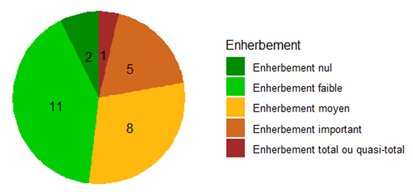
In 2024, an agronomic monitoring study was conducted on camelina plots planted as a summer cover crop. The graph below shows significant to complete weed coverage on approximately one-quarter of the observed areas. The main weed species identified are:
- Crop volunteers: barley and peas
- Annual dicots: goosefoot, mercury, bindweed, barnyard grass, ragweed, etc.
- Perennials: thistles
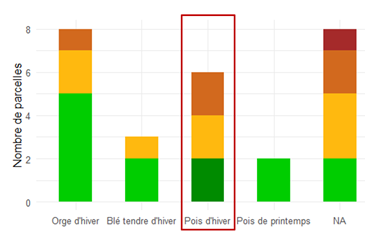
The graph below illustrates the level of weed infestation observed in camelina plots planted as summer cover crops, depending on the type of preceding crop. It highlights that weed control is more challenging following a winter pea crop, particularly due to the significant presence of pea regrowth and dicotyledonous weeds.
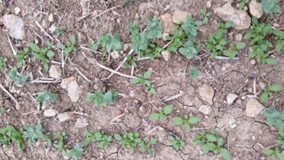
Weed pressure represents one of the main limiting factors identified in the monitoring of plots in 2024; weed control is therefore a central challenge for ensuring the success of the crop.
Weed Management Strategies
First and foremost, it is important to select a plot with a low risk of weed infestation, as control options are limited in summer intercropping. To minimize the risk of weed infestation in plots, it is important to choose appropriate crop rotations, alternating spring and winter crops.
Beyond plot selection, it is important to sow camelina on clean soil. If weeds are present at harvest time, they can be managed through stubble cultivation or a full-spectrum herbicide application in the case of direct-seeded camelina.
Finally, there are a few registered herbicides available for chemical weed control in the crop.
Below is a non-exhaustive list of authorized active ingredients (source: ephy-Anses and phytosanitary index):
| Active ingredients | Application rate | AMM dose | Product (*) | Application | Application stage |
| clothidim | 240 g/l | 0.5 L/ha | Centurion 240 EC | Post-emergence | 2 leaves to 6–8 leaves |
| quizalofop-p-ethyl + clethodim | 70 g/L + 140 g/L | 0.8 L/ha | Vesuve Max | Post-emergence | 2–6–8 weeks |
| clopyralid | 100 g/L | 1.25 L/ha | Lontrel 100 | Post-emergence | 2 to 6–8 leaves |
| metazachlor | 500 g/L | 1.5 L/ha | Rapsan 500 SC | Pre-emergence or early post-emergence | |
| quinmerac + metazachlor | 100 g/L + 400 g/L | 1.87 L/ha | Rapsan TDI | Pre-emergence | 00 to 08 |
In fields previously planted with winter cereals, if there is heavy infestation of volunteer plants after camelina establishment, herbicide treatment is essential. The treatment must be carried out using a specific graminicide based on clethodim or quizalofop-P-ethyl, which must be applied before the camelina enters the active growth stage (beginning of elongation) to ensure optimal selectivity and maximum efficacy.
Important note: The table above lists herbicides registered for use on camelina, not those whose selectivity toward camelina has been demonstrated. There are concerns regarding phytotoxicity with clopyralid- and metazachlor-based herbicides; Terres Inovia is currently conducting research on the selectivity of these herbicides to identify suitable options.
If a herbicide is used during the growing season, regardless of the product used, it must be applied before stem elongation begins in order to minimize the risk of phytotoxicity.
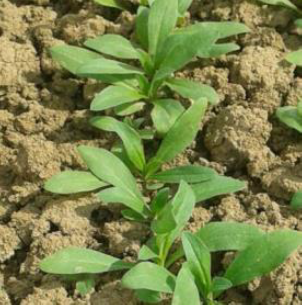
In summer catchcrops, mechanical weeding during the growing season is not appropriate.
Weed Management for Camelina as a Main Crop
Choosing the right crop rotation is a key strategy for weed management: alternating between winter and spring crops helps keep weed pressure low on the field.
As a primary spring crop, camelina can be sown late due to its relatively short growing cycle. This provides the opportunity to perform multiple false sowings in the spring, thereby reducing the weed population. Late sowing of camelina, which can be done as late as May, also helps avoid much of the spring weed flora and creates a true break in the rotation. Regarding in-field control methods, the table below provides a non-exhaustive list of authorized active ingredients (source: ephy-Anses and the phytosanitary index).
| Active ingredients | Application rate | AMM dose | Product (*) | Positioning | Application stage |
| clothidim | 240 g/l | 0.5 L/ha | Centurion 240 EC | Post-emergence | 2 leaves to 6–8 leaves |
| quizalofop-p-ethyl + clethodim | 70 g/L + 140 g/L | 0.8 L/ha | Vesuve Max | Post-emergence | 2–6–8 weeks |
| clopyralid | 100 g/L | 0.2 L/ha | Lontrel 100 | Post-emergence | 2–6–8 weeks |
| clomazone + dmta-p + metazachlor | 40 g/L – 200 g/L – 200 g/L | 2.5 L | Polar | Pre-emergence | Stage 00 to 09 |
| dmta-p + quinmerac | 333 g/l = 167 g/l | 1.5 L/ha | Solanis | Post-emergence | 2–8 weeks |
| metazachlor | 500 g/L | 1.5 L/ha | Rapsan 500 SC | Pre-emergence or early post-emergence | |
| quinmerac + metazachlor | 100 g/L + 400 g/L | 1.87 L/ha | Rapsan TDI | Pre-emergence | 00 to 08 |
Please note: The table below lists herbicides approved for use on camelina, not herbicides that have been demonstrated to be selective for camelina.
If a herbicide is used during the growing season, regardless of the product used, it must be applied before stem elongation begins in order to minimize the risk of phytotoxicity.
Regarding mechanical weeding, only a single pass with a blind harrow is recommended in the main crop. After emergence, the use of this tool is not recommended due to the high risk of uprooting the plants.
Our other articles
-
Rapeseed
Tournesol
Féverole d'hiver
Féverole de printemps
Soja
Pois d'hiver
Pois de printemps
Lentille
Pois chiche
Lin d'hiver
Lin de printemps
Lupin d'hiver
Lupin de printemps
Cameline
Chanvre
Implantation
Récolte
Ravageurs
Choix variétal
Watch the recordings of the Terres Inovia 2026 webinars
-
Rapeseed
Tournesol
Pois d'hiver
Pois de printemps
Soja
Féverole d'hiver
Féverole de printemps
Lentille
Pois chiche
Lin d'hiver
Lin de printemps
Lupin d'hiver
Lupin de printemps
Cameline
Chanvre
Diversifier son système de culture
Syppre Berry and Picardie Platforms: Terres Inovia Shares Its Latest Results
Training courses for camelina
Mastering the cultivation of camelina
Sur devis
Production of edible oil through a short supply chain
Sur devis
Optimization of the crushing and mechanical extraction of oil- and protein-rich seeds
Sur devis
Publications on camelina