
Automatically generated translation
Generally speaking, camelina is a crop with low susceptibility to disease. However, some diseases can occasionally be observed, although to date their harmfulness remains relatively low and does not require any fungal intervention in vegetation.
Whether grown as a main crop or as a summer catch crop, camelina shows the same behavior in the face of these diseases and parasites.
Cruciferous clubroot (Plasmodiophora brassicae)
Camelina can be affected by clubroot, a disease caused by the pathogen Plasmodiophora brassicae. This is a telluric disease with a host range extending to most species of the Brassicaceae family, including crops such as rape, turnip, cabbage and mustard.
Hernia can also infect certain weeds belonging to this family, such as ravenella, shepherd's purse or sanvia, all of which are potential reservoirs for its spread. Contamination occurs via mobile spores in the soil which, thanks to free water, penetrate the absorbent hairs of camelina roots and induce infection.
The main symptoms visible on the aerial parts are a temporary wilting of the foliage, particularly on hot days, and a slowdown in growth.
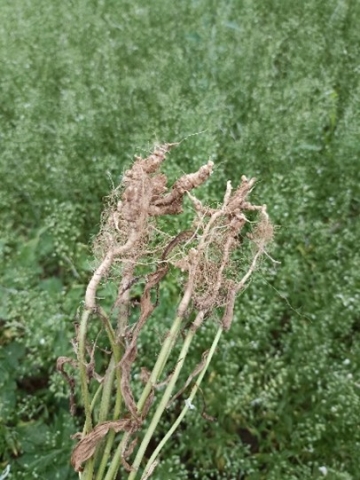
When affected plants are pulled up, the roots show characteristic deformations and swellings known as galls. These galls are responsible for the aerial symptoms, as they interfere with the absorption of water and nutrients from the soil. Initially firm and white on the inside, they gradually turn brown before cracking.
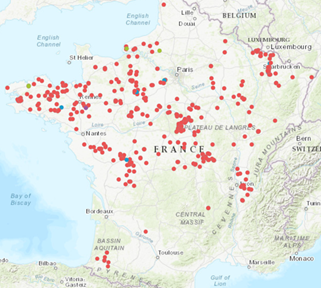
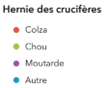
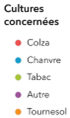
There are currently no effective chemical control methods. The development of the disease is favored by poor drainage of the plot, as well as by the absence of liming on acid soils. Once established, the disease persists in the soil, with spores remaining viable for up to 15 years. We therefore strongly advise against planting camelina on a plot known to be contaminated by this pathogen. Below is a map showing plots infected by clubroot, as reported online on the Terres Inovia website. https://www.terresinovia.fr/-/enquete-hernie-des-cruciferes
Downy mildew (Peronospora camelinae)
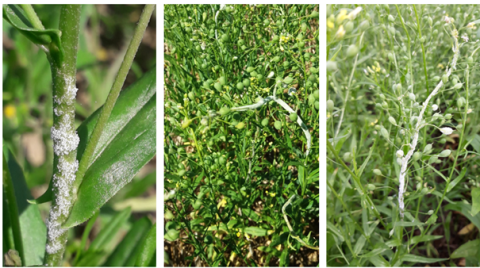
Mainly grown as a summer catch crop, camelina can be affected by mildew at the end of the cycle. This is the foliar disease most frequently observed on this crop, although its severity generally remains low and does not justify fungicide intervention.
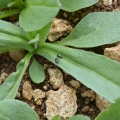
Infection can be either localized or systemic. Symptoms observed on camelina include grayish-white mycelial growth on the underside of leaves, stems and siliques. Heavily affected plants may show distorted, twisted or bent growth.
The development of mildew is favored by temperatures between 15 and 23°C, combined with rainy spells generating high humidity, an essential condition for the spread of the disease.
White or albugo rust (Albugo candida)
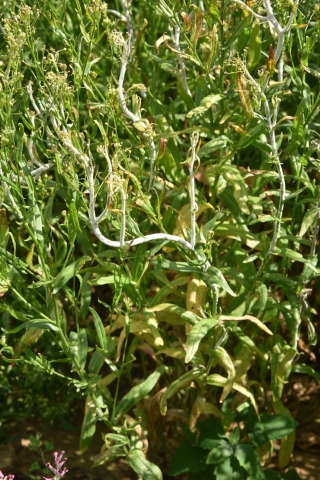
White rust symptoms on camelina are similar to those observed on other crucifers. They take the form of white, powdery pustules, containing sporangia (reproductive structures), on the underside of leaves. At a more advanced stage, hypertrophied siliques or deformed inflorescences can also be observed.
Optimum development of the disease occurs between 10 and 18°C, with relative humidity above 90%.
It can be confused with mildew. However, it is possible to differentiate the two diseases by their symptoms: in the case of white rust, pustules are larger, well-defined and clearly visible, while mildew manifests itself through more diffuse spots and a more "powdery" appearance, linked to the presence of mycelium.
On camelina, mildew is observed more frequently than white rust.
Other secondary diseases
Other diseases have been observed on camelina, but their harmfulness is so low as to warrant no intervention in the crop. These include sclerotinia(Sclerotinia sclerotiorum), botrytis(Botrytis cinerea) and alternaria(Alternaria brassicae).
Rough broomrape (Phelipanche ramosa)
Orchardgrass is a non-chlorophyllous parasitic plant, present as seeds in the soil. They can only germinate in the presence of molecules emitted by the roots of certain plants, before attaching themselves to the latter.
It is capable of parasitizing many plant species, both winter and spring crops (rapeseed, hemp, tobacco, melon, sunflower, tomato...as well as camelina) and weeds (ammi majus, bedstraw, geraniums, erodium, cauliflower...).
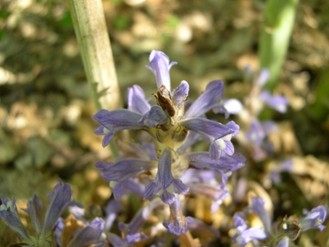
Orchardgrass is highly invasive.
- It is capable of producing thousands of tiny seeds (0.2-0.3 mm) per plant, easily spread by wind, animals, farm machinery and so on.
- Seeds can live up to 10 years in the soil, and are resistant to passage through the digestive tract of animals.
- It has a very broad host spectrum (crops, weeds) and can synchronize its cycle with that of its host.
- It thrives in a wide range of pedoclimatic conditions.
Chemical or biocontrol methods are not currently authorized in France, and/or are ineffective in providing protection against stunted broomrape.
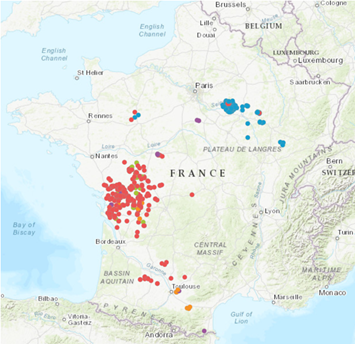
We therefore strongly advise against planting camelina on a plot known to be infested with stalked broomrape. Below, a map showing plots infected by stalked broomrape, identified following declarations made online on the Terres Inovia website. https://www.terresinovia.fr/web/guest/-/enquete-de-surveillance-orobanche-rameuse-participer-et-visualiser-les-zones-a-risque
Our other articles

-
Rapeseed
Tournesol
Féverole d'hiver
Féverole de printemps
Soja
Pois d'hiver
Pois de printemps
Lentille
Pois chiche
Lin d'hiver
Lin de printemps
Lupin d'hiver
Lupin de printemps
Cameline
Chanvre
Implantation
Récolte
Ravageurs
Choix variétal
Watch the recordings of the Terres Inovia 2026 webinars
-
Rapeseed
Tournesol
Pois d'hiver
Pois de printemps
Soja
Féverole d'hiver
Féverole de printemps
Lentille
Pois chiche
Lin d'hiver
Lin de printemps
Lupin d'hiver
Lupin de printemps
Cameline
Chanvre
Diversifier son système de culture
Syppre Berry and Picardie Platforms: Terres Inovia Shares Its Latest Results
Camelina editions