
Automatically generated translation
General
Flea beetles and whiteflies are the two main insects likely to be observed on the crop.
However, in most situations, their presence is limited to minor damage, with no significant impact on camelina development. Also of note is the possible presence of slugs, which can cause damage at the start of the cycle.
Flea beetle
Camelina can be attacked by crucifer flea beetles, or small flea beetles(Phyllotreta spp.). This small, black or bicolored beetle (black with a longitudinal yellow stripe on each elytron) measures between 2 and 2.5 mm and is characterized by its swollen hind legs, which enable it to jump.
Damage takes the form of numerous circular bites about 1 mm in diameter, with or without holes, on the cotyledons and leaf blades.
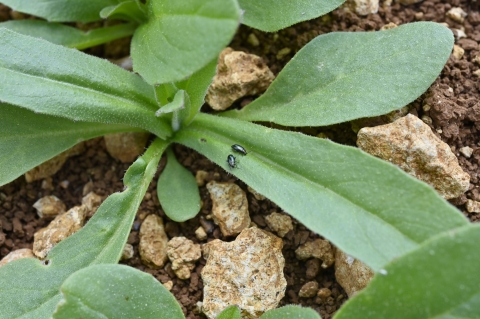
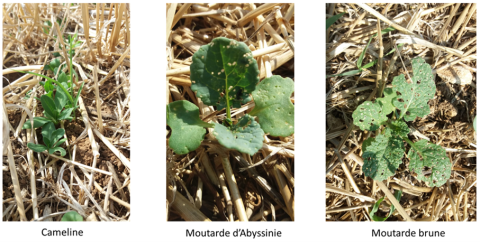
Although camelina belongs to the Brassicaceae family, it is much less attractive to flea beetles than rapeseed or mustard. So, barring exceptional situations, whether as a main crop or as a summer cover crop, no chemical intervention is generally necessary.
Leaf beetles
Adult crucifer beetles(Brassicogethes sp.) measure between 1.5 and 2.5 mm. They are flattened and shiny black with a metallic sheen, sometimes tinged with green. Their antennae are black, while their legs, which are short and often barely visible from the back, are black or reddish depending on the species.
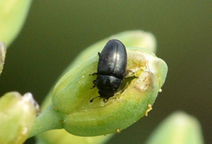
Meligethes can only be found on camelina grown as a main crop. Only adults are responsible for damage. They perforate flower buds in search of pollen, notably damaging the pistil.
These perforations can lead to floral deformation, or even flower abortion in the case of early and sustained attacks. However, as soon as the first flowers appear, the level of damage diminishes sharply.
Overall, damage remains limited and has no significant impact on yield, as camelina is not very attractive to this insect. Therefore, except in exceptional situations, no chemical intervention is required.
Slugs
Slugs can be a nuisance during crop emergence. Their activity depends more on surface moisture conditions than on the population density present in the plot.
Hollow or cloddy soils, as well as those containing undecomposed crop residues, provide a particularly favorable environment for their development.
In the absence of tillage, as is often the case when camelina is planted as a summer catch crop, slug activity can be significant in wet conditions.
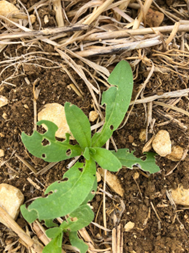
If slugs are present, and if the climate maintains a certain surface coolness at the time of sowing, it is advisable to apply a preventive slug-killer in the field, just after sowing.
Our other articles

-
Rapeseed
Tournesol
Féverole d'hiver
Féverole de printemps
Soja
Pois d'hiver
Pois de printemps
Lentille
Pois chiche
Lin d'hiver
Lin de printemps
Lupin d'hiver
Lupin de printemps
Cameline
Chanvre
Implantation
Récolte
Ravageurs
Choix variétal
Watch the recordings of the Terres Inovia 2026 webinars
-
Rapeseed
Tournesol
Pois d'hiver
Pois de printemps
Soja
Féverole d'hiver
Féverole de printemps
Lentille
Pois chiche
Lin d'hiver
Lin de printemps
Lupin d'hiver
Lupin de printemps
Cameline
Chanvre
Diversifier son système de culture
Syppre Berry and Picardie Platforms: Terres Inovia Shares Its Latest Results
Camelina editions