News

Filtres

Most rapeseed crops are currently at the E to F1 growth stages. Milder weather could reignite flea beetle activity, as the first flowers are now visible in nearly two-thirds of the fields.
Following an early and nearly widespread arrival of the pest in late February, threats persist in fields with slow growth or in sheltered areas (valleys, wooded edges)
This year, flea beetle larvae are weakening the crop and reducing its resilience. Weevil pressure frequently exacerbates the situation.
Many fields have already been treated against weevils, but a follow-up treatment may be warranted as long as flowering has not clearly begun. Conversely, on healthy rapeseed that has passed the E-F1 stage, the risk of damage quickly becomes negligible, making insecticide treatment unnecessary.
At this time, treatments must remain strictly targeted at plots with confirmed risk, using solutions based on tau-fluvalinate or etofenprox. Apply under favorable conditions (sufficient humidity, limited wind, avoid hot hours) with a water volume > 200 L/ha and strictly outside foraging periods, in accordance with current regulations.

Jean Lieven - j.lieven@terresinovia.fr

With flower buds appearing very early this year, some farmers are wondering about the impact of late nitrogen application in the form of a nitrogen solution.  

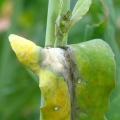
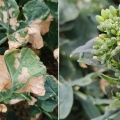
The burns observed are mainly due to a contact effect: fertilizer droplets deposited on the plant parts become concentrated as the water evaporates. The increase in salt concentration can then cause dehydration and tissue necrosis. Recent leaves and especially flower buds, whose tissues are young and poorly protected by a cuticle, are particularly sensitive. In addition, the microcavities present in the buds can retain the droplets and prolong contact with the solution.

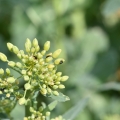
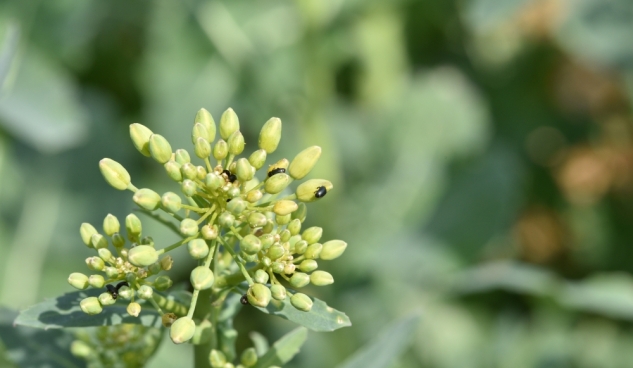
The risk increases when the buds are clearly visible and exposed on the inflorescences (progression from stage D1 to E), and as soon as the first flowers appear (stage F1). Sensitivity increases with the proportion of buds exposed to the droplets. Weather conditions also play an important role: hot, sunny, dry, or windy weather promotes rapid evaporation and increases the concentration of the solution.

In most situations, the impact on yield remains limited, unless the crop is already very fragile. Rapeseed has a strong compensatory capacity, thanks to the gradual development of its yield components (seeds/m² and TGW).

In practice, if no other form of fertilizer is available, it is preferable to apply nitrogen, even in liquid form, at a stage close to E-F1, rather than not applying any at all. Nitrogen solution should preferably be applied during rainfall, which will limit burning.

Jean Lieven - j.lieven@terresinovia.fr
Elodie Tourton - e.tourton@terresinovia.fr
Julien Charbonnaud - j.charbonnaud@terresinovia.fr
Thomas Mear - t.mear@terresinovia.fr 

Thanks to the recent exceptionally warm and sunny days, meligèthes have sometimes made a sudden appearance in colza fields. With weather conditions expected to be favorable (or even very favorable) for the arrival of insects - meligèthes and weevils - we advise caution and regular monitoring for at least the next 15 days. Weakened plots (flea beetle larvae, wet soils in February, low biomass, etc.) are the most at risk.

Overall, the colza plots are now in the sensitive stage for meligèthes: stage D1, D2 for the most part, stage E for the earliest. The F1 stage could be reached before March 20-25 in the earliest situations.

Articles that may interest you: