
Automatically generated translation
General
Although camelina has a low risk of shattering at maturity, it is particularly sensitive to post-ripening losses: its seeds are highly susceptible to shattering during cutting, to breakage during threshing, and to direct losses in the field.
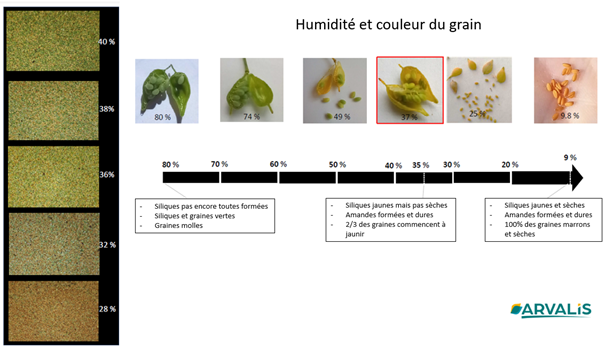
Camelina reaches maturity when the siliques change color from lemon-yellow to brownish. At this stage, seed moisture is generally between 8 and 10%. They detach easily from their shells under light manual pressure.
At this stage, it is crucial to intervene quickly, and harvesting should ideally be carried out within 7 to 10 days to limit dehiscence losses.
To guarantee good seed conservation and optimal storage conditions, humidity at harvest must not exceed 9%.
In the presence of fresh impurities (green matter), we recommend pre-sorting within 24 hours of harvesting, to limit temperature rise and reduce overall batch humidity.
If, after sorting, humidity remains above 9%, drying is necessary to avoid risks of deterioration (heating, fungal development, etc.).
Please note: under a contract with SAIPOL, the impurity content must not exceed 2%.
The graph below illustrates the evolution of seed moisture as a function of color.
Setting up the combine harvester
As camelina is a small-seed crop, it is essential to adapt combine settings and forward speed (ideally between 3 and 4 km/h) to limit losses.
Main recommended settings:
- Cutterbar: adjust the height just below the lowest siliques to minimize losses at the base.
- Reel: moderate speed, between 600 and 700 rpm, to limit silique breakage.
- Thresher / concave: initial spacing of 15 to 20 mm. Start with a setting similar to that used for cereals. If unthreshed whole siliques are found in the hopper, slightly increase the beater speed or reduce the spacing between beater and concave.
- Sieves :
- Lower sieve: as closed as possible.
- Upper sieve: initial opening 20%, to be adjusted according to sorting quality and throughput.
- Sieves :
- Ventilation: very low air flow to avoid losses, as camelina seeds are very light.
A combine adjustment guide published by SAIPOL with recommendations from Nicolas Thibaud is available on request.
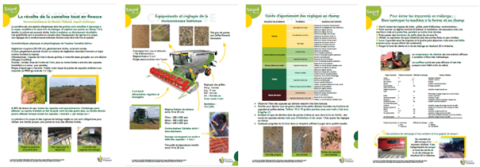
A video is also available:
Mowing - swathing
Swathing mainly concerns camelina crops grown as summer catch crops. At maturity, the crop is generally upright, which makes swathing much easier. Before mowing, it is imperative to ensure that the weather conditions over the next few days will be dry, in order to guarantee proper drying of the swath and avoid any delay in harvest recovery.
In fact, swathing should ideally take place 4 to 6 days after mowing, to avoid increasing losses and degrading seed quality.
This practice has three main objectives:
- Bring forward the harvest date, with an estimated gain of around 10 days in October;
- To improve harvest quality, by enabling faster drying of the seeds in the swath;
- Reduce weed infestation at the end of the cycle.
The plot is ready to be swathed when around 75% of siliques have turned yellow, corresponding to a seed moisture level of around 30%, generally reached 2 to 3 weeks after the last flower.
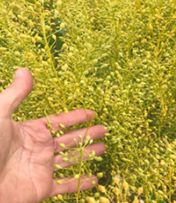
The cutting height should be just below the lowest siliques (i.e. between 15 and 20 cm) to ensure good aeration of the swath.
It is strongly recommended not to turn the swath, in order to limit ginning losses.
The swath is then harvested using a combine harvester, around 4 to 6 days after mowing, once drying conditions are optimal.
Our other articles

-
Rapeseed
Tournesol
Féverole d'hiver
Féverole de printemps
Soja
Pois d'hiver
Pois de printemps
Lentille
Pois chiche
Lin d'hiver
Lin de printemps
Lupin d'hiver
Lupin de printemps
Cameline
Chanvre
Implantation
Récolte
Ravageurs
Choix variétal
Watch the recordings of the Terres Inovia 2026 webinars
-
Rapeseed
Tournesol
Pois d'hiver
Pois de printemps
Soja
Féverole d'hiver
Féverole de printemps
Lentille
Pois chiche
Lin d'hiver
Lin de printemps
Lupin d'hiver
Lupin de printemps
Cameline
Chanvre
Diversifier son système de culture
Syppre Berry and Picardie Platforms: Terres Inovia Shares Its Latest Results
Camelina editions