
Automatically generated translation
Camelina (Camelina sativa) is a cruciferous plant (Brassicaceae) native to Europe and Southwest Asia. It has historically been cultivated in Europe, notably in France, where the first traces date back to the Bronze Age, for the production of vegetable oil and fodder.
It was widely cultivated until the early 20th century, producing an oil used in soaps and paints, before gradually disappearing in the face of competition from more productive oilseed crops such as rapeseed. At the time, the solid residues obtained after oil extraction were used as a feed supplement for livestock or as fertilizer; the stalks were used to make brooms.
Today, it is making a comeback on the European agricultural scene, and is attracting interest from a wide range of players, both farmers and manufacturers, thanks to its agronomic advantages and the new outlets it opens up.
Good adaptation to soil and climate conditions
Camelina has one major advantage: it adapts to a wide range of soil and climate conditions, and is particularly well suited to low-potential soils. It is often presented as a hardy crop, thanks to its low input requirements and resistance to drought and high temperatures. It is also fairly tolerant of pests and resistant to lodging. Camelina requires little fertilizer or pesticide, so its introduction into cropping systems has both economic and environmental benefits.
No special equipment required, but some adjustments are necessary
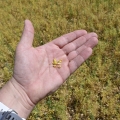
What's more, it doesn't require any special equipment, making it easy to introduce to farms. Nevertheless, due to its small seed size (PMG ≈ 1-1.5g), the planting and harvesting phases require adjustments and special attention.
A short-cycle crop
An interesting feature of camelina is the length of its cycle, which varies according to variety and sowing period, from 90 to 250 days (1700 to 1900 degrees day at base 0°C, depending on variety). Camelina can therefore be grown as a main crop, in association with lentils, for example, or as a catch crop for short-cycle varieties (link to page on how to insert camelina into the SoC).
An asset for organic farming
Its low input requirements, combined with its strong competitive power - provided it emerges regularly and evenly - mean that it has a place in organic farming rotations (link to organic farming page). Some farmers even report that it has an "allelopathic" effect, i.e. that it can naturally inhibit the growth of other undesirable plants around it. To our knowledge, this has not yet been demonstrated in the field.
Conclusion
All these advantages make it a crop that can be easily integrated into a variety of cropping systems in France and around the world, in both organic and conventional farming, as a main crop or as a catch crop.
Our other articles

-
Rapeseed
Tournesol
Féverole d'hiver
Féverole de printemps
Soja
Pois d'hiver
Pois de printemps
Lentille
Pois chiche
Lin d'hiver
Lin de printemps
Lupin d'hiver
Lupin de printemps
Cameline
Chanvre
Implantation
Récolte
Ravageurs
Choix variétal
Watch the recordings of the Terres Inovia 2026 webinars
-
Rapeseed
Tournesol
Pois d'hiver
Pois de printemps
Soja
Féverole d'hiver
Féverole de printemps
Lentille
Pois chiche
Lin d'hiver
Lin de printemps
Lupin d'hiver
Lupin de printemps
Cameline
Chanvre
Diversifier son système de culture
Syppre Berry and Picardie Platforms: Terres Inovia Shares Its Latest Results
Camelina editions