
Automatically generated translation
To maximize the chances of success for camelina as a summer catch crop, it's essential to think in terms of crop succession. Camelina should therefore be planted as soon as the main crop is planted.
Selection criteria
- Main crop harvested early (winter barley, winter peas, etc.)
- Choose legumes to avoid fertilization
- Avoid plots with a spring herbicide program at risk
- Choose plots free of weeds
After which main crop?
The first criterion is to choose an early-harvested preceding crop, enabling camelina to be planted between June 20 and July 10, to guarantee a harvest before the end of October. The main candidate crops are winter peas and winter barley, but other early-harvested crops may also be suitable: canning peas, garlic, onions, etc.
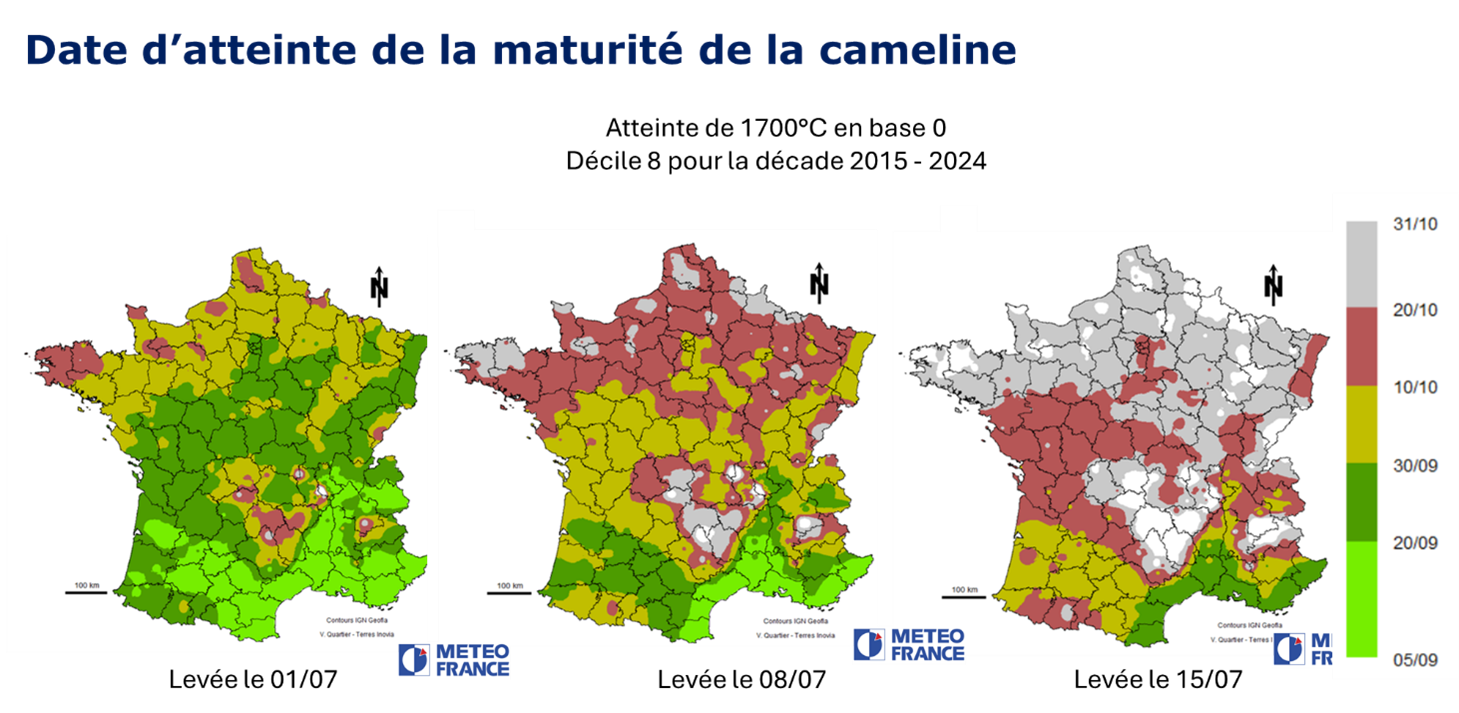
The map below illustrates the importance of sowing early, showing the date at which maturity is reached for very short-cycle varieties according to different emergence dates. For example, for an emergence on July 1, camelina reaches maturity before October 10 throughout France, whereas for an emergence on July 8, it reaches maturity after October 10 in the northern part of France, and for an emergence on July 15, it reaches maturity after October 20 in almost the northern half of France.
Planting camelina after a legume (e.g. winter peas) is particularly interesting, as it allows you to limit or even do without nitrogen fertilization, thus reducing the ITK's operating costs.
Focus on main crop herbicide program
Camelina grown as a summer catch crop is sensitive to the persistence of certain herbicides, mainly those in group 2(ALS1 inhibitors) with herbicides from the sulfonylurea family such as metsulfuron, mesosulfuron, etc., as well as imazamox (applied to winter peas). It also appears to be sensitive to group 14 herbicides (PPO2 inhibitors such as bifenox) and group 32 herbicides (solanesyl diphosphate synthase inhibitors, includingaclonifen, applied to winter peas).
There is therefore a risk of phytotoxicity (leaf discoloration, foot loss, etc.) for camelina when these herbicides are applied in spring to the main crop, a risk that is all the greater in dry conditions, when applied late and when there is little or no tillage between the harvest of the main crop and the planting of camelina. Despite this, the effects of these herbicides can vary according to a number of factors (rainfall, soil type, tillage, date and dose of application, etc.) and are still poorly understood and quantified.
Weed pressure on the plot
Camelina is a well-established crop that competes well with weeds. In spite of this, weed pressure remains one of the main limiting factors for camelina as a summer catch crop, so it's vital to use every possible means to manage weeds effectively.
We recommend choosing a weed-free plot at sowing time. If weeds are present when the main crop is harvested and you wish to direct seed, a glyphosate pass may be useful to manage weeds before seeding.
1ALS: acetolactate synthase
2PPO: protoporphyrinogen oxidase
Our other articles
Camelina editions