
 Se connecter avec Facebook
 Se connecter avec Google

The agronomic benefits of camelina
Camelina (Camelina sativa) is a cruciferous plant (Brassicaceae) native to Europe and Southwest Asia. It has historically been cultivated in Europe, notably in France, where the first traces date back to the Bronze Age, for the production of vegetable oil and fodder.
Camelina (Camelina sativa) is a cruciferous plant (Brassicaceae) native to Europe and Southwest Asia. It has historically been cultivated in Europe, notably in France, where the first traces date back to the Bronze Age, for the production of vegetable oil and fodder.
It was widely cultivated until the early 20th century, producing an oil used in soaps and paints, before gradually disappearing in the face of competition from more productive oilseed crops such as rapeseed. At the time, the solid residues obtained after oil extraction were used as a feed supplement for livestock or as fertilizer; the stalks were used to make brooms.
Today, it is making a comeback on the European agricultural scene, and is attracting interest from a wide range of players, both farmers and manufacturers, thanks to its agronomic advantages and the new outlets it opens up.
Good adaptation to soil and climate conditions
Camelina has one major advantage: it adapts to a wide range of soil and climate conditions, and is particularly well suited to low-potential soils. It is often presented as a hardy crop, thanks to its low input requirements and resistance to drought and high temperatures. It is also fairly tolerant of pests and resistant to lodging. Camelina requires little fertilizer or pesticide, so its introduction into cropping systems has both economic and environmental benefits.
No special equipment required, but some adjustments are necessary
What's more, it doesn't require any special equipment, making it easy to introduce to farms. Nevertheless, due to its small seed size (PMG ≈ 1-1.5g), the planting and harvesting phases require adjustments and special attention.
A short-cycle crop
An interesting feature of camelina is the length of its cycle, which varies according to variety and sowing period, from 90 to 250 days (1700 to 1900 degrees day at base 0°C, depending on variety). Camelina can therefore be grown as a main crop, in association with lentils, for example, or as a catch crop for short-cycle varieties (link to page on how to insert camelina into the SoC).
An asset for organic farming
Its low input requirements, combined with its strong competitive power - provided it emerges regularly and evenly - mean that it has a place in organic farming rotations (link to organic farming page). Some farmers even report that it has an "allelopathic" effect, i.e. that it can naturally inhibit the growth of other undesirable plants around it. To our knowledge, this has not yet been demonstrated in the field.
Conclusion
All these advantages make it a crop that can be easily integrated into a variety of cropping systems in France and around the world, in both organic and conventional farming, as a main crop or as a catch crop.

Camelina editions
Cameline - Cultivation Guide 2024
Our other articles
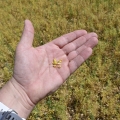
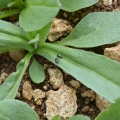
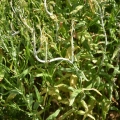
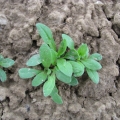
Weeding camelina
Cameline
Native to Northern Europe and Central Asia, camelina is a cruciferous plant (Brassicaceae) that has long been cultivated in France. It requires few inputs and is not very demanding. A short-cycle crop, it can be grown as a main crop or as a catch crop. Its strong competitive power means that it has a place in organic rotations.
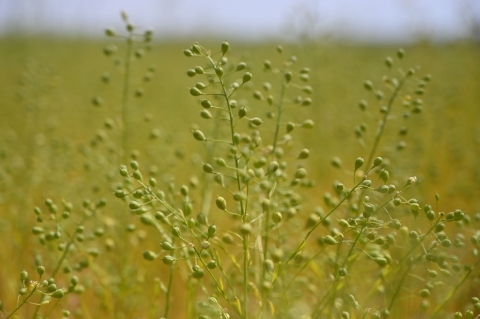
Projects
Every year, Terres Inovia participates in or coordinates several national, European and international calls for projects on various themes.
-
Colza
Tournesol
Pois de printemps
Pois d'hiver
Pois chiche
Lentille
Soja
Chanvre
Féverole d'hiver
Féverole de printemps
Lin d'hiver
Lin de printemps
Lupin d'hiver
Lupin de printemps
Cameline
Biodiversité
Herbi1&NoPhy
Experimenting with agroecological systems for pesticide use as a last resort
Project sheet
Towards carbon neutrality with farms
Lorem ipsum dolor sit amet, consectetur adipiscing elit. Sed non risus. Suspendisse lectus tortor, dignissim sit amet, adipiscing nec, ultricies sed, dolor. Cras elementum ultrices diam. Maecenas ligula massa, varius a, semper congue, euismod non, mi. Proin porttitor, orci nec nonummy molestie,…Events
Upcoming Lupin events
-
Colza
Tournesol
Pois chiche
Lin d'hiver
Lin de printemps
Pois d'hiver
Pois de printemps
Lentille
Soja
Chanvre
Féverole d'hiver
Féverole de printemps
Lupin d'hiver
Lupin de printemps
Cameline
Maladies
Cultural assets
Diversifier son système de culture
Gérer son système de culture
Terres Inovia Technical Meeting 2026 - Blois (41)
Training
Develop your skills with lupin training courses designed and run by Terres Inovia experts
Mastering camelina cultivation
Sur devis

Short-circuit production of edible oil
Sur devis
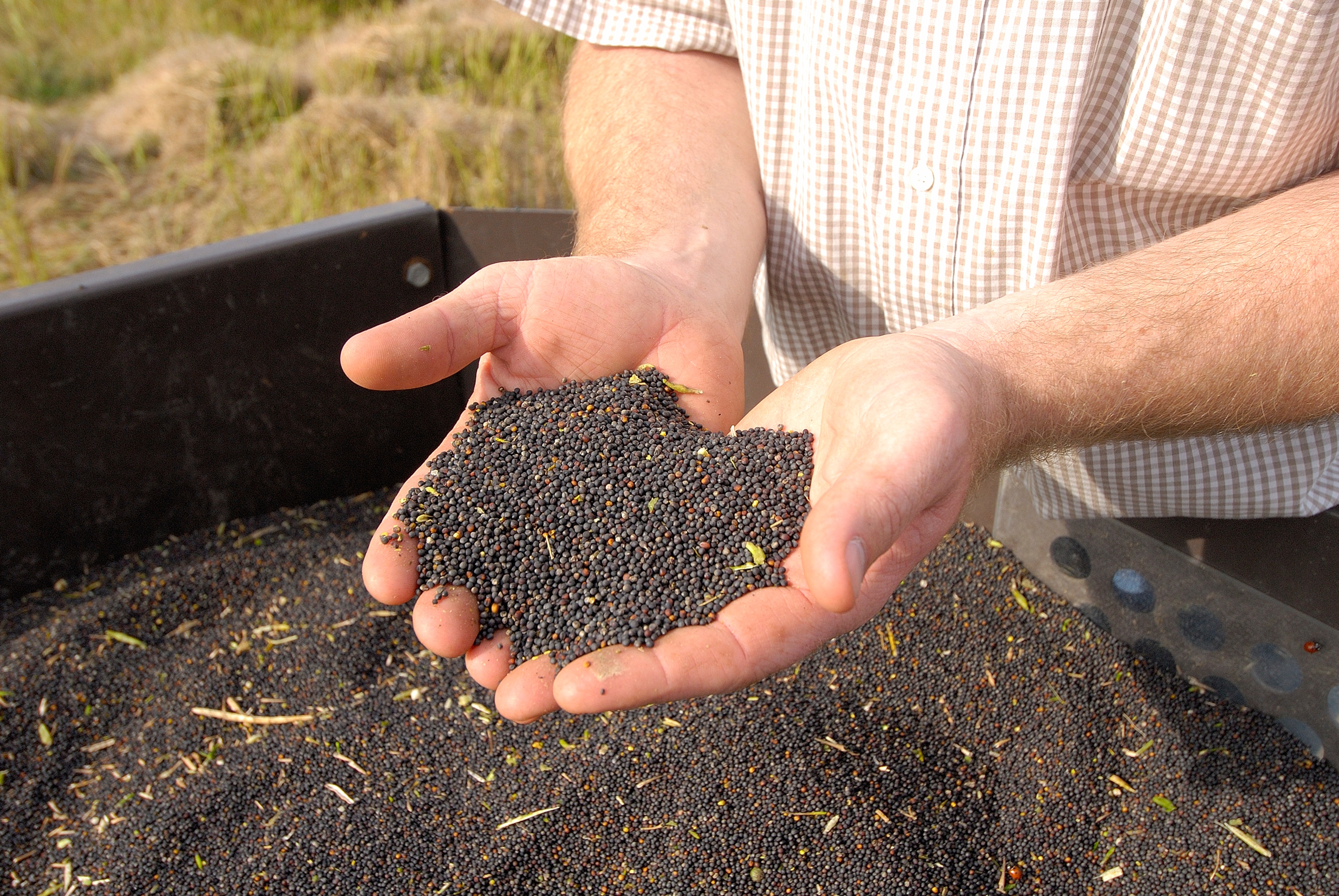
Optimization of crushing and mechanical extraction of oil-protein seeds
Sur devis
Editions
To help you, Terres Inovia provides several technical publications on lupins.

Acta Phytosanitary Index 2024 (all crops)
Weed control in cereal and oilseed systems
Services
Fatty acids ISO s/seeds
Method used: NF EN ISO 17059 - NF EN ISO 12966-4Fungal strain on culture medium
Supply of mycelial growth on culture medium for the fungal species described below.Price: from…Pathological diagnosis on plant material
Diagnosis by macroscopic and microscopic observation, supplemented if necessary by molecular…Weeds: characterization of sensitivity to ALS inhibitors
Research by molecular analysis (sequencing) of mutations in the acetolactate synthase gene…
Have a question? Please contact us!
If you have any questions or thoughts about our research, initiatives or projects, please don't hesitate to write to us.
Log in to contact your regional contact
If you do not wish to create an account, please use the contact form.
Other crops
test
The benefits

Short cycle
Camelina has a short cycle (around 150 days)

Highly adaptable
The crop can be grown as a catch crop or as a main crop.
Key figures
in summer catch crops (assumption: direct sowing after peas, yield 8q/ha for a SAF outlet), added to the margin of the main crop
Our technical advice
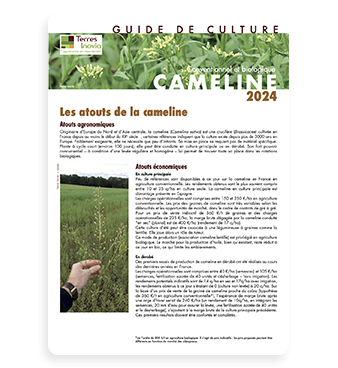
Download guide
This guide to growing camelina presents possible economic results for both main and catch crops, in conventional and organic farming, as well as for direct seeding. Indicative margins for rotations with or without back-cropped camelina are presented.
Weeds: characterization of sensitivity to ALS inhibitors
Research by molecular analysis (sequencing) of mutations in the acetolactate synthase gene conferring resistance to ALS-inhibiting herbicides in weed populations (wild sunflower, ragweed, ammi majus, poppy, orobanche ramosa, orobanche cumana, geranium dissectum, geranium columbinum, geranium rotundifolium, sanve, ravenelle).
For each population (1 population = 1 sampling site on a given date), 5 plants are analyzed. The results are transmitted in the form of a report.
These services may be of interest to you
Building a localized supply chain
Terres Inovia can help you build a new, regionalized industry.From strategy to field…Oilseed impurities
Method used: in-house methodOilseed impurities ISO
Method used: NF EN ISO 658Water content ISO oilseeds
Method used: NF EN ISO 665Would you like a quote?
Would you like to know more about this service or receive a quote? Send us your request!