
Harvesting camelina
Although camelina has a low risk of shattering at maturity, it is particularly sensitive to post-ripening losses: its seeds are highly susceptible to shattering during cutting, to breakage during threshing, and to direct losses in the field.
General
Although camelina has a low risk of shattering at maturity, it is particularly sensitive to post-ripening losses: its seeds are highly susceptible to shattering during cutting, to breakage during threshing, and to direct losses in the field.
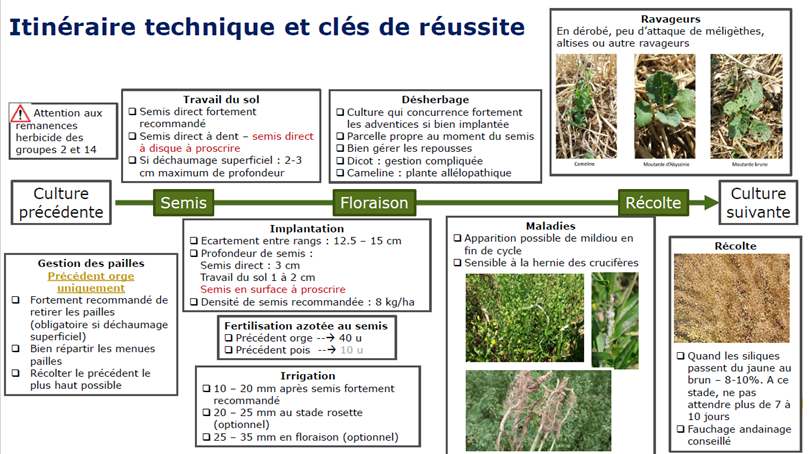
Camelina reaches maturity when the siliques change color from lemon-yellow to brownish. At this stage, seed moisture is generally between 8 and 10%. They detach easily from their shells under light manual pressure.
At this stage, it is crucial to intervene quickly, and harvesting should ideally be carried out within 7 to 10 days to limit dehiscence losses.
To guarantee good seed conservation and optimal storage conditions, humidity at harvest must not exceed 9%.
In the presence of fresh impurities (green matter), we recommend pre-sorting within 24 hours of harvesting, to limit temperature rise and reduce overall batch humidity.
If, after sorting, humidity remains above 9%, drying is necessary to avoid risks of deterioration (heating, fungal development, etc.).
Please note: under a contract with SAIPOL, the impurity content must not exceed 2%.
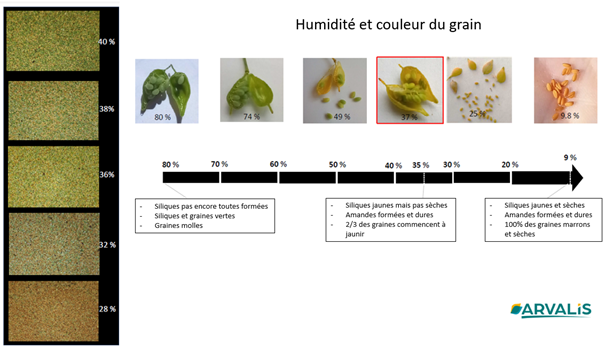
The graph below illustrates the evolution of seed moisture as a function of color.
Setting up the combine harvester
As camelina is a small-seed crop, it is essential to adapt combine settings and forward speed (ideally between 3 and 4 km/h) to limit losses.
Main recommended settings:
- Cutterbar: adjust the height just below the lowest siliques to minimize losses at the base.
- Reel: moderate speed, between 600 and 700 rpm, to limit silique breakage.
- Thresher / concave: initial spacing of 15 to 20 mm. Start with a setting similar to that used for cereals. If unthreshed whole siliques are found in the hopper, slightly increase the beater speed or reduce the spacing between beater and concave.
- Sieves :
- Lower sieve: as closed as possible.
- Upper sieve: initial opening 20%, to be adjusted according to sorting quality and throughput.
- Sieves :
- Ventilation: very low air flow to avoid losses, as camelina seeds are very light.
A combine adjustment guide published by SAIPOL with recommendations from Nicolas Thibaud is available on request.
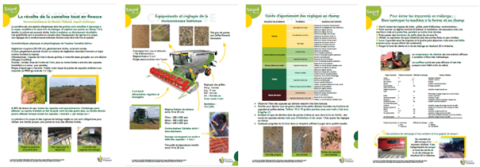
A video is also available:
Mowing - swathing
Swathing mainly concerns camelina crops grown as summer catch crops. At maturity, the crop is generally upright, which makes swathing much easier. Before mowing, it is imperative to ensure that the weather conditions over the next few days will be dry, in order to guarantee proper drying of the swath and avoid any delay in harvest recovery.
In fact, swathing should ideally take place 4 to 6 days after mowing, to avoid increasing losses and degrading seed quality.
This practice has three main objectives:
- Bring forward the harvest date, with an estimated gain of around 10 days in October;
- To improve harvest quality, by enabling faster drying of the seeds in the swath;
- Reduce weed infestation at the end of the cycle.
The plot is ready to be swathed when around 75% of siliques have turned yellow, corresponding to a seed moisture level of around 30%, generally reached 2 to 3 weeks after the last flower.
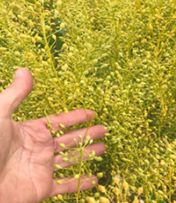
The cutting height should be just below the lowest siliques (i.e. between 15 and 20 cm) to ensure good aeration of the swath.
It is strongly recommended not to turn the swath, in order to limit ginning losses.
The swath is then harvested using a combine harvester, around 4 to 6 days after mowing, once drying conditions are optimal.

Camelina editions
Cameline - Cultivation Guide 2024
Our other articles
Weeding camelina
Camelina nutrition
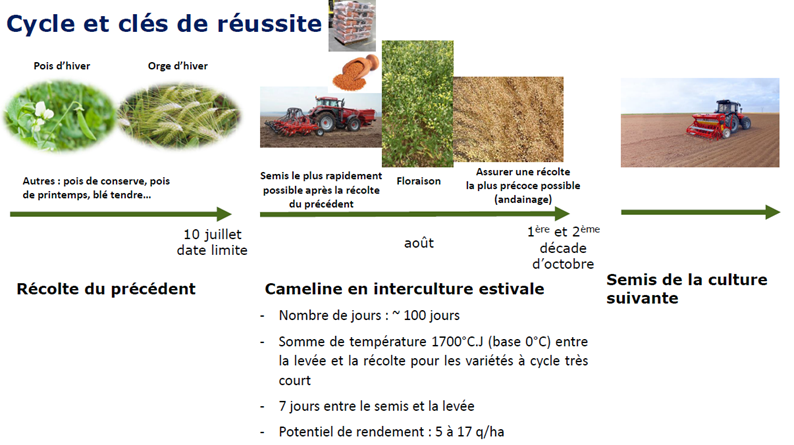
Keys to success with camelina in catch crops
Louis-Marie Allard, Terres Inovia development engineer for the North and East zone, explains the basics of successful summer cover crops with camelina.
Louis-Marie Allard, Terres Inovia development engineer for the North and East zone, explains the basics of successful summer cover crops with camelina.

Camelina editions
Cameline - Cultivation Guide 2024
Our other articles
Outlets for camelina
Camelina is an oilseed crop whose seeds are characterized by an original fatty acid profile and high protein content. These properties make it ideal for a wide range of uses.
Camelina is an oilseed crop whose seeds are characterized by an original fatty acid profile and high protein content. These properties make it ideal for a wide range of uses.
To date, its main uses have been in the production of oil for human consumption and the recovery of oilcake for animal feed. However, there is growing interest in applications in cosmetics, green chemistry and the formulation of technical specialties. What's more, a French industry is currently developing around camelina grown in intercropping, specifically geared towards the production of sustainable aviation fuels.
| Oil content (%MS) | 28-49% |
| Of which a-linolenic (ω-3 precursor) | 28-50% |
| Of which linoleic (ω-6 precursor) | 15-23% |
| Ratio ω-3/ω-6 | 1.3-2.6 |
| Protein (% DM) | 24.1-35.7% |
A new chain for the production of sustainable aviation fuels
A particularity of camelina is its short cycle - the camelina cycle can be completed in around 3 months - which makes it ideal for intercropping.
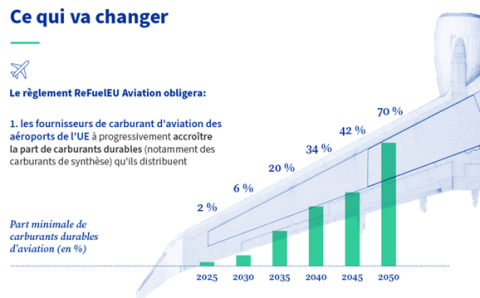
Furthermore, to decarbonize the aviation sector as part of the implementation of the European climate law, the European Union adopted the RefuelEU Aviation regulation in 2024. This regulation sets significant targets for the incorporation of biofuels by 2050.
Moreover, recent developments in the Renewable Energy Directive II (RED II) have classified intercrop feedstocks as "advanced biofuels"(Annex 9A of RED II), making them eligible for the production ofaviation biofuel.
Thus, intercrop crops such as camelina represent one of the ways of achieving the objectives of integrating biofuels into aviation, which suggests that there will be considerable demand for them in the years to come.
What's more, camelina's low input requirements make it possible to adopt a technical itinerary with low greenhouse gas emissions, a necessity for its conversion into biofuel. Saipol, a subsidiary of the Avril Group, is working on the development of a camelina production chain based on intercropping.
Human food
Camelina oil belongs to the family of oils rich in omega-3 fatty acids, behind flax but ahead of hemp, walnut and rapeseed. Thanks to its high omega-3 content and optimal ω-3/ω-6 ratio, it offers interesting nutritional qualities for rebalancing our diets, which are currently too rich in omega-6 compared to omega-3.
What's more, its richness in antioxidants such as vitamin E ensures good stability and limits oxidation, compared with other omega-3-rich oils. It is mainly consumed for seasoning, but can also be used in the formulation of dietary supplements (authorized in 2019 by the Direction Générale de la Concurrence, de la Consommation et de la Répression des Fraudes - DGCCRF).
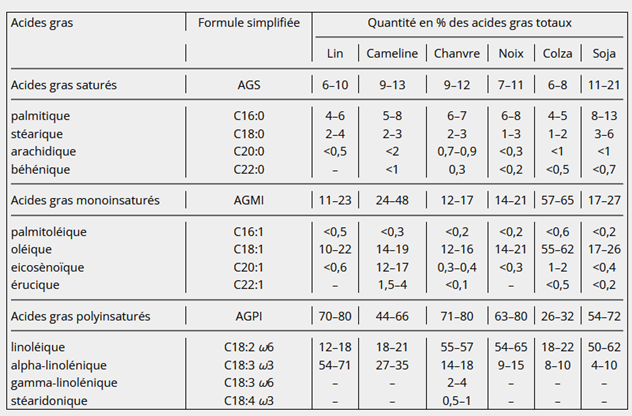
Figure 2. fatty acid compositions of flax and hemp oils compared with those of other vegetable oils in the alpha-linolenic family (camelina, walnut, rapeseed and soybean). Morin et al. 2015, OCL
The human food market currently mainly concerns organically produced camelina, and remains a relatively undeveloped market.
Cosmetics
Camelina oil is also used in the formulation of cosmetic products, notably for its high antioxidant content.
Other outlets
Research and industry are exploring a variety of applications for camelina oil and meal, such as the formulation of bioplastics, adhesive agents, biopesticides, bioherbicides, biostimulants, etc. The Carina project, for example, is exploring the valorization of camelina and Abyssinian mustard (brassicata carinata) for the formulation of biopesticides and biostimulants.
Animal feed
Camelina meal has a high protein content of around 45%, making it an interesting ingredient to include in animal feed rations.

Camelina editions
Peas - Growing guide 2025 - Ref 680/25
Chickpea - Growing guide 2023 - Ref 652/23
Lentil - Growing guide 2023
Our other articles
The agronomic benefits of camelina
Camelina (Camelina sativa) is a cruciferous plant (Brassicaceae) native to Europe and Southwest Asia. It has historically been cultivated in Europe, notably in France, where the first traces date back to the Bronze Age, for the production of vegetable oil and fodder.
Camelina (Camelina sativa) is a cruciferous plant (Brassicaceae) native to Europe and Southwest Asia. It has historically been cultivated in Europe, notably in France, where the first traces date back to the Bronze Age, for the production of vegetable oil and fodder.
It was widely cultivated until the early 20th century, producing an oil used in soaps and paints, before gradually disappearing in the face of competition from more productive oilseed crops such as rapeseed. At the time, the solid residues obtained after oil extraction were used as a feed supplement for livestock or as fertilizer; the stalks were used to make brooms.
Today, it is making a comeback on the European agricultural scene, and is attracting interest from a wide range of players, both farmers and manufacturers, thanks to its agronomic advantages and the new outlets it opens up.
Good adaptation to soil and climate conditions
Camelina has one major advantage: it adapts to a wide range of soil and climate conditions, and is particularly well suited to low-potential soils. It is often presented as a hardy crop, thanks to its low input requirements and resistance to drought and high temperatures. It is also fairly tolerant of pests and resistant to lodging. Camelina requires little fertilizer or pesticide, so its introduction into cropping systems has both economic and environmental benefits.
No special equipment required, but some adjustments are necessary
What's more, it doesn't require any special equipment, making it easy to introduce to farms. Nevertheless, due to its small seed size (PMG ≈ 1-1.5g), the planting and harvesting phases require adjustments and special attention.
A short-cycle crop
An interesting feature of camelina is the length of its cycle, which varies according to variety and sowing period, from 90 to 250 days (1700 to 1900 degrees day at base 0°C, depending on variety). Camelina can therefore be grown as a main crop, in association with lentils, for example, or as a catch crop for short-cycle varieties (link to page on how to insert camelina into the SoC).
An asset for organic farming
Its low input requirements, combined with its strong competitive power - provided it emerges regularly and evenly - mean that it has a place in organic farming rotations (link to organic farming page). Some farmers even report that it has an "allelopathic" effect, i.e. that it can naturally inhibit the growth of other undesirable plants around it. To our knowledge, this has not yet been demonstrated in the field.
Conclusion
All these advantages make it a crop that can be easily integrated into a variety of cropping systems in France and around the world, in both organic and conventional farming, as a main crop or as a catch crop.

Camelina editions