
Automatically generated translation
Camelina requires very little fertilizer. Its powerful taproot system enables it to extract the nutrients it needs for growth from deep within the soil. Fertilization management differs according to how camelina is grown
Fertilization management for camelina as a main crop
Nitrogen nutrition
Nitrogen dose trials have been carried out. Camelina yield increases with nitrogen fertilization, until it reaches a plateau (see graph below - source: Malhi et al., 2013, Canada). This yield increase is explained by improvements in several components: the number of plants per square meter, the number of branches, the number of siliques per plant, as well as the number of seeds per silique. On the other hand, thousand kernel weight (MGW) does not seem to be affected (source: Agegnehu et al.1996, USA).
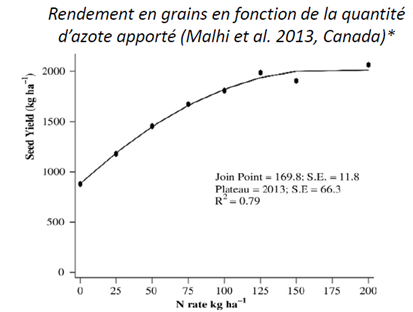
The optimum dose of nitrogen to be applied is between 80 and 100 units per hectare, depending on residues, corresponding to the economic optimum. For spring camelina, nitrogen can be applied in a single application just after sowing. However, it is possible to split the application according to the following recommendations: 30% of the dose at sowing, then the remainder at the rosette stage. For winter camelina, the application should be made when vegetation resumes before bolting.
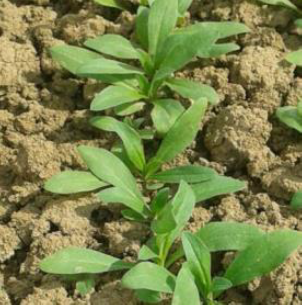
In addition, the use of a sulfur fertilizer is recommended to ensure an application of 12 to 24 units of sulfur per hectare (source: Camelina Company).
Beware of excess nitrogen, which makes the crop more susceptible to disease, particularly albugo, and can accentuate the risk of lodging.
As nitrogen fertilization increases, so does the nitrogen content of the plant and the protein concentration of the seed. On the other hand, oil content and nitrogen use efficiency decrease (source: Malhi et al., 2013, Canada).
Concerning fatty acid composition, oleic and linoleic acid percentages increase with nitrogen dose, while linolenic acid percentage decreases. The concentration of iron (Fe) and zinc (Zn) in the seeds also decreases (source: Magdalena Czarnik et al., 2027, University of Rzeszów, Poland).
Phosphorus and potash
Camelina has moderate phosphorus and potassium requirements. Inputs should be rationed throughout the rotation, based on soil analysis results. In a well-supplied soil, we recommend applying 40 units per hectare of phosphorus and 40 units per hectare of potash. These fertilizations can be carried out at any time during the intercropping period preceding camelina planting, or directly at sowing time.
Fertilization management for camelina in summer intercropping
Camelina is a cruciferous plant. It needs nitrogen from the start of its cycle to express its full potential right up to harvest.
Managing nitrogen fertilization depends on the previous crop. In the case of cereals, 40 units of nitrogen per hectare must be applied at sowing. It is strongly recommended to apply this fertilizer locally. No additional nitrogen should be applied during vegetation. Excessive nitrogen applications could lengthen the vegetative phase of camelina, delaying maturity.
Where peas are grown before camelina, the nitrogen residue is generally sufficient to ensure good camelina development. Therefore, nitrogen is not essential. However, an optional fertilization of 10 units of nitrogen per hectare at sowing can be considered.
No background fertilization is required.
Our other articles

-
Rapeseed
Tournesol
Féverole d'hiver
Féverole de printemps
Soja
Pois d'hiver
Pois de printemps
Lentille
Pois chiche
Lin d'hiver
Lin de printemps
Lupin d'hiver
Lupin de printemps
Cameline
Chanvre
Implantation
Récolte
Ravageurs
Choix variétal
Watch the recordings of the Terres Inovia 2026 webinars
-
Rapeseed
Tournesol
Pois d'hiver
Pois de printemps
Soja
Féverole d'hiver
Féverole de printemps
Lentille
Pois chiche
Lin d'hiver
Lin de printemps
Lupin d'hiver
Lupin de printemps
Cameline
Chanvre
Diversifier son système de culture
Syppre Berry and Picardie Platforms: Terres Inovia Shares Its Latest Results
Camelina editions