
Propyzamide: conditions are favourable
The sharp drop in temperatures combined with satisfactory soil humidity in the North-East zone means that propyzamide can now be applied to manage grassy weeds in rapeseed crops.
Propyzamide (KERB FLO and generic products) is an essential herbicide molecule for managing weeds in rape plots heavily infested with grasses, particularly when these are resistant to other active ingredients. Propyzamide has a systemic root action on ryegrass, vulpine, cereal regrowth (especially wheat), bromegrass, wild oats (especially winter wild oats), bluegrass, vulpie and bentgrass.
Good usage practices
Certain application conditions are essential to optimize efficacy and preserve the molecule's durability:
- Only one application of propyzamide at 750 g/ha per season, from early November to late December on rapeseed.
- Do not apply to water-saturated soil, to avoid run-off and reduced efficacy.
- Aim for application on cool, moist soil. Efficacy depends on soil humidity. Temperatures below 10°C are strongly recommended to ensure persistence of action.
Experimental results show that the application of propyzamide-based products is not very sensitive to biomass, and this should not call into question the optimum period. Due to the foliar broadleaf control action of aminopyralid, IELO / YAGO / BIWIX / DITOP products must be applied within a rain-free period. Applications made too late (beyond November) will lack broadleaf control efficacy.
Mixing herbicide + insecticide: how to proceed?
It's always tempting to save a pass by combining herbicide and insecticide. But this is sometimes a bad economy.
First of all, it's important to consider the need for insecticides. As a reminder, the indicative risk threshold is 5 larvae per plant for well-developed colza and 2 to 3 larvae per plant for small colza or poorly established colza with nitrogen hunger.
In areas with strong resistance to pyrethroids (SKDR sector), the MINECTO GOLD + propyzamide mixture is strongly discouraged by the Institute for accounting and efficacy reasons. MINECTO GOLD must be combined with an oily adjuvant (such as ACTIROB). The presence of oil causes propyzamide to flocculate, greatly reducing its effectiveness. Furthermore, Minecto Gold should be applied when temperatures are mild and larvae are active, to maximize its effectiveness. Propyzamide, on the other hand, is applied in cold weather.
Similarly, in sectors not affected by strong resistance and still using pyrethroids to control flea beetle larvae, it is often preferable to carry out the interventions separately. Indeed, even if in practice the propyzamide + pyrethroid mixture is still possible, the optimum conditions for applying the insecticide (mild temperatures) differ from those for the herbicide (cool temperatures).
Pests of camelina
Flea beetles and whiteflies are the two main insects likely to be observed on the crop.
General
Flea beetles and whiteflies are the two main insects likely to be observed on the crop.
However, in most situations, their presence is limited to minor damage, with no significant impact on camelina development. Also of note is the possible presence of slugs, which can cause damage at the start of the cycle.
Flea beetle
Camelina can be attacked by crucifer flea beetles, or small flea beetles(Phyllotreta spp.). This small, black or bicolored beetle (black with a longitudinal yellow stripe on each elytron) measures between 2 and 2.5 mm and is characterized by its swollen hind legs, which enable it to jump.
Damage takes the form of numerous circular bites about 1 mm in diameter, with or without holes, on the cotyledons and leaf blades.
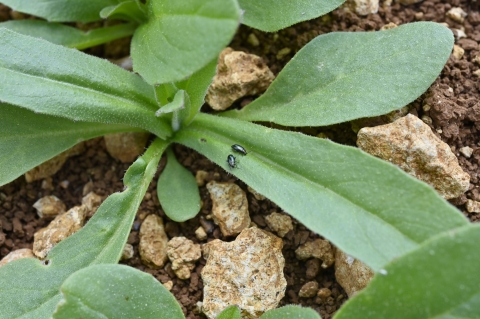
Although camelina belongs to the Brassicaceae family, it is much less attractive to flea beetles than rapeseed or mustard. So, barring exceptional situations, whether as a main crop or as a summer cover crop, no chemical intervention is generally necessary.
Leaf beetles
Adult crucifer beetles(Brassicogethes sp.) measure between 1.5 and 2.5 mm. They are flattened and shiny black with a metallic sheen, sometimes tinged with green. Their antennae are black, while their legs, which are short and often barely visible from the back, are black or reddish depending on the species.
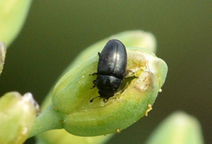
Meligethes can only be found on camelina grown as a main crop. Only adults are responsible for damage. They perforate flower buds in search of pollen, notably damaging the pistil.
These perforations can lead to floral deformation, or even flower abortion in the case of early and sustained attacks. However, as soon as the first flowers appear, the level of damage diminishes sharply.
Overall, damage remains limited and has no significant impact on yield, as camelina is not very attractive to this insect. Therefore, except in exceptional situations, no chemical intervention is required.
Slugs
Slugs can be a nuisance during crop emergence. Their activity depends more on surface moisture conditions than on the population density present in the plot.
Hollow or cloddy soils, as well as those containing undecomposed crop residues, provide a particularly favorable environment for their development.
In the absence of tillage, as is often the case when camelina is planted as a summer catch crop, slug activity can be significant in wet conditions.
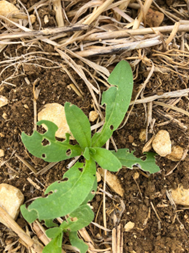
If slugs are present, and if the climate maintains a certain surface coolness at the time of sowing, it is advisable to apply a preventive slug-killer in the field, just after sowing.

Camelina editions
Cameline - Cultivation Guide 2024
Our other articles
Weeding camelina
Camelina nutrition
Diseases and plant pests of camelina
Generally speaking, camelina is not very susceptible to disease. However, some diseases can occasionally be observed, although to date their harmfulness remains relatively low and does not require any fungal intervention in vegetation.
Generally speaking, camelina is a crop with low susceptibility to disease. However, some diseases can occasionally be observed, although to date their harmfulness remains relatively low and does not require any fungal intervention in vegetation.
Whether grown as a main crop or as a summer catch crop, camelina shows the same behavior in the face of these diseases and parasites.
Cruciferous clubroot (Plasmodiophora brassicae)
Camelina can be affected by clubroot, a disease caused by the pathogen Plasmodiophora brassicae. This is a telluric disease with a host range extending to most species of the Brassicaceae family, including crops such as rape, turnip, cabbage and mustard.
Hernia can also infect certain weeds belonging to this family, such as ravenella, shepherd's purse or sanvia, all of which are potential reservoirs for its spread. Contamination occurs via mobile spores in the soil which, thanks to free water, penetrate the absorbent hairs of camelina roots and induce infection.
The main symptoms visible on the aerial parts are a temporary wilting of the foliage, particularly on hot days, and a slowdown in growth.
When affected plants are pulled up, the roots show characteristic deformations and swellings known as galls. These galls are responsible for the aerial symptoms, as they interfere with the absorption of water and nutrients from the soil. Initially firm and white on the inside, they gradually turn brown before cracking.
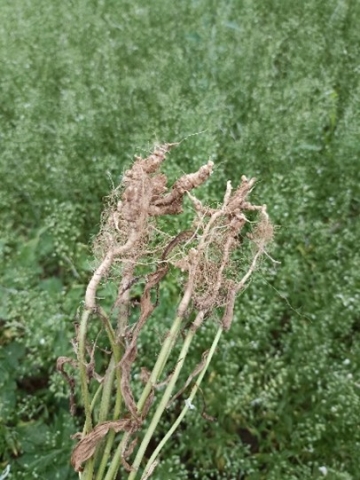
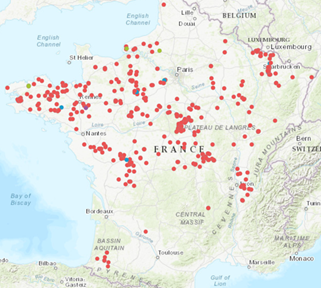
There are currently no effective chemical control methods. The development of the disease is favored by poor drainage of the plot, as well as by the absence of liming on acid soils. Once established, the disease persists in the soil, with spores remaining viable for up to 15 years. We therefore strongly advise against planting camelina on a plot known to be contaminated by this pathogen. Below is a map showing plots infected by clubroot, as reported online on the Terres Inovia website. https://www.terresinovia.fr/-/enquete-hernie-des-cruciferes
Downy mildew (Peronospora camelinae)
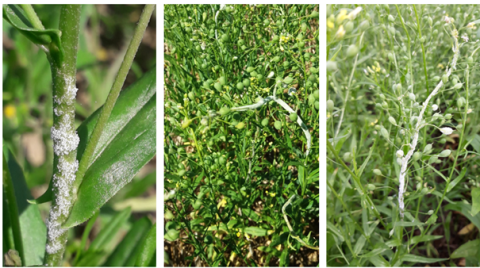
Mainly grown as a summer catch crop, camelina can be affected by mildew at the end of the cycle. This is the foliar disease most frequently observed on this crop, although its severity generally remains low and does not justify fungicide intervention.
Infection can be either localized or systemic. Symptoms observed on camelina include grayish-white mycelial growth on the underside of leaves, stems and siliques. Heavily affected plants may show distorted, twisted or bent growth.
The development of mildew is favored by temperatures between 15 and 23°C, combined with rainy spells generating high humidity, an essential condition for the spread of the disease.
White or albugo rust (Albugo candida)
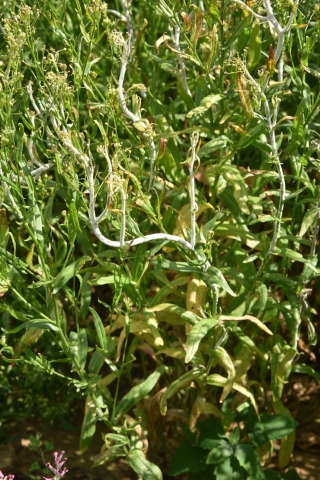
White rust symptoms on camelina are similar to those observed on other crucifers. They take the form of white, powdery pustules, containing sporangia (reproductive structures), on the underside of leaves. At a more advanced stage, hypertrophied siliques or deformed inflorescences can also be observed.
Optimum development of the disease occurs between 10 and 18°C, with relative humidity above 90%.
It can be confused with mildew. However, it is possible to differentiate the two diseases by their symptoms: in the case of white rust, pustules are larger, well-defined and clearly visible, while mildew manifests itself through more diffuse spots and a more "powdery" appearance, linked to the presence of mycelium.
On camelina, mildew is observed more frequently than white rust.
Other secondary diseases
Other diseases have been observed on camelina, but their harmfulness is so low as to warrant no intervention in the crop. These include sclerotinia(Sclerotinia sclerotiorum), botrytis(Botrytis cinerea) and alternaria(Alternaria brassicae).
Rough broomrape (Phelipanche ramosa)
Orchardgrass is a non-chlorophyllous parasitic plant, present as seeds in the soil. They can only germinate in the presence of molecules emitted by the roots of certain plants, before attaching themselves to the latter.
It is capable of parasitizing many plant species, both winter and spring crops (rapeseed, hemp, tobacco, melon, sunflower, tomato...as well as camelina) and weeds (ammi majus, bedstraw, geraniums, erodium, cauliflower...).
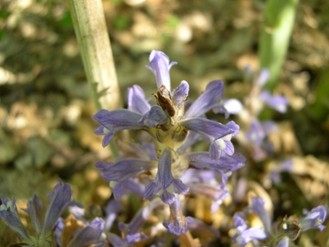
Orchardgrass is highly invasive.
- It is capable of producing thousands of tiny seeds (0.2-0.3 mm) per plant, easily spread by wind, animals, farm machinery and so on.
- Seeds can live up to 10 years in the soil, and are resistant to passage through the digestive tract of animals.
- It has a very broad host spectrum (crops, weeds) and can synchronize its cycle with that of its host.
- It thrives in a wide range of pedoclimatic conditions.
Chemical or biocontrol methods are not currently authorized in France, and/or are ineffective in providing protection against stunted broomrape.
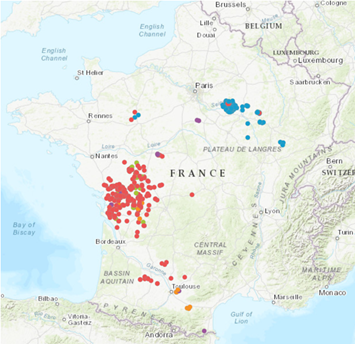
We therefore strongly advise against planting camelina on a plot known to be infested with stalked broomrape. Below, a map showing plots infected by stalked broomrape, identified following declarations made online on the Terres Inovia website. https://www.terresinovia.fr/web/guest/-/enquete-de-surveillance-orobanche-rameuse-participer-et-visualiser-les-zones-a-risque

Camelina editions
Cameline - Cultivation Guide 2024
Our other articles
Estimating the risk of terminal bud weevils
This tool can be used to assess the risk of terminal bud weevil at plot level.
The tool is used in parallel with, and in addition to, the information provided by monitoring yellow vials ideally positioned in a network (BSV type).
This tool can be used to classify a plot into a global risk level. The overall risk combines an agronomic risk and a risk linked to the weevil's historical harmfulness in the département.
This decision rule is available in API format. Log on to the API-Agro platform or contact us for more information.

Risk estimate for flea beetle larvae
This tool makes it possible to estimate a risk linked to the agronomic situation of the plot, as well as a risk linked to larvae pressure.
- Risk assessment for flea beetle larvae should be carried out from the second half of November, and repeated during the winter if conditions are mild.
- The harmfulness of this pest depends on insect pressure and rapeseed growth dynamics.
The tool's integrated decision rule combines these two aspects, making it possible to estimate a risk linked to the plot's agronomic situation, as well as a risk linked to larval pressure.
The tool is not a substitute for field observation, which remains essential for any decision-making process.
The overall risk estimate is associated with a recommendation: whether or not to intervene, and which insecticide to use, depending on the insecticide resistance situation in the département.
This decision rule is available in API format. Log on to the API-Agro platform or contact us for more information.

The agronomic benefits of camelina
Camelina (Camelina sativa) is a cruciferous plant (Brassicaceae) native to Europe and Southwest Asia. It has historically been cultivated in Europe, notably in France, where the first traces date back to the Bronze Age, for the production of vegetable oil and fodder.
Camelina (Camelina sativa) is a cruciferous plant (Brassicaceae) native to Europe and Southwest Asia. It has historically been cultivated in Europe, notably in France, where the first traces date back to the Bronze Age, for the production of vegetable oil and fodder.
It was widely cultivated until the early 20th century, producing an oil used in soaps and paints, before gradually disappearing in the face of competition from more productive oilseed crops such as rapeseed. At the time, the solid residues obtained after oil extraction were used as a feed supplement for livestock or as fertilizer; the stalks were used to make brooms.
Today, it is making a comeback on the European agricultural scene, and is attracting interest from a wide range of players, both farmers and manufacturers, thanks to its agronomic advantages and the new outlets it opens up.
Good adaptation to soil and climate conditions
Camelina has one major advantage: it adapts to a wide range of soil and climate conditions, and is particularly well suited to low-potential soils. It is often presented as a hardy crop, thanks to its low input requirements and resistance to drought and high temperatures. It is also fairly tolerant of pests and resistant to lodging. Camelina requires little fertilizer or pesticide, so its introduction into cropping systems has both economic and environmental benefits.
No special equipment required, but some adjustments are necessary
What's more, it doesn't require any special equipment, making it easy to introduce to farms. Nevertheless, due to its small seed size (PMG ≈ 1-1.5g), the planting and harvesting phases require adjustments and special attention.
A short-cycle crop
An interesting feature of camelina is the length of its cycle, which varies according to variety and sowing period, from 90 to 250 days (1700 to 1900 degrees day at base 0°C, depending on variety). Camelina can therefore be grown as a main crop, in association with lentils, for example, or as a catch crop for short-cycle varieties (link to page on how to insert camelina into the SoC).
An asset for organic farming
Its low input requirements, combined with its strong competitive power - provided it emerges regularly and evenly - mean that it has a place in organic farming rotations (link to organic farming page). Some farmers even report that it has an "allelopathic" effect, i.e. that it can naturally inhibit the growth of other undesirable plants around it. To our knowledge, this has not yet been demonstrated in the field.
Conclusion
All these advantages make it a crop that can be easily integrated into a variety of cropping systems in France and around the world, in both organic and conventional farming, as a main crop or as a catch crop.

Camelina editions