
 Se connecter avec Facebook
 Se connecter avec Google
Pests of camelina
Flea beetles and whiteflies are the two main insects likely to be observed on the crop.
General
Flea beetles and whiteflies are the two main insects likely to be observed on the crop.
However, in most situations, their presence is limited to minor damage, with no significant impact on camelina development. Also of note is the possible presence of slugs, which can cause damage at the start of the cycle.
Flea beetle
Camelina can be attacked by crucifer flea beetles, or small flea beetles(Phyllotreta spp.). This small, black or bicolored beetle (black with a longitudinal yellow stripe on each elytron) measures between 2 and 2.5 mm and is characterized by its swollen hind legs, which enable it to jump.
Damage takes the form of numerous circular bites about 1 mm in diameter, with or without holes, on the cotyledons and leaf blades.
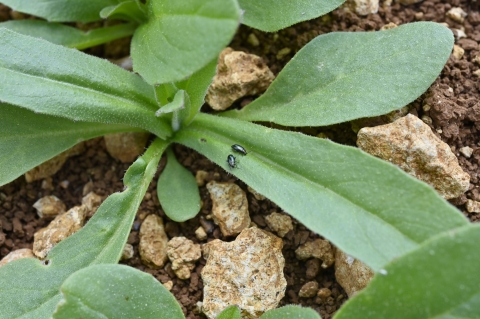
Although camelina belongs to the Brassicaceae family, it is much less attractive to flea beetles than rapeseed or mustard. So, barring exceptional situations, whether as a main crop or as a summer cover crop, no chemical intervention is generally necessary.
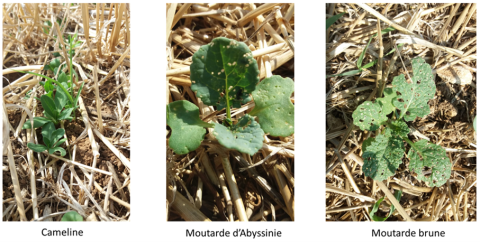
Leaf beetles
Adult crucifer beetles(Brassicogethes sp.) measure between 1.5 and 2.5 mm. They are flattened and shiny black with a metallic sheen, sometimes tinged with green. Their antennae are black, while their legs, which are short and often barely visible from the back, are black or reddish depending on the species.
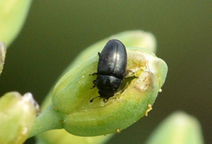
Meligethes can only be found on camelina grown as a main crop. Only adults are responsible for damage. They perforate flower buds in search of pollen, notably damaging the pistil.
These perforations can lead to floral deformation, or even flower abortion in the case of early and sustained attacks. However, as soon as the first flowers appear, the level of damage diminishes sharply.
Overall, damage remains limited and has no significant impact on yield, as camelina is not very attractive to this insect. Therefore, except in exceptional situations, no chemical intervention is required.
Slugs
Slugs can be a nuisance during crop emergence. Their activity depends more on surface moisture conditions than on the population density present in the plot.
Hollow or cloddy soils, as well as those containing undecomposed crop residues, provide a particularly favorable environment for their development.
In the absence of tillage, as is often the case when camelina is planted as a summer catch crop, slug activity can be significant in wet conditions.
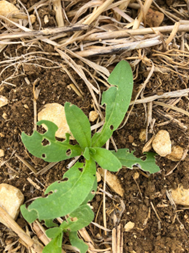
If slugs are present, and if the climate maintains a certain surface coolness at the time of sowing, it is advisable to apply a preventive slug-killer in the field, just after sowing.

Camelina editions
Cameline - Cultivation Guide 2024
Our other articles
Weeding camelina
Camelina nutrition
Estimating the risk of terminal bud weevils
This tool can be used to assess the risk of terminal bud weevil at plot level.
The tool is used in parallel with, and in addition to, the information provided by monitoring yellow vials ideally positioned in a network (BSV type).
This tool can be used to classify a plot into a global risk level. The overall risk combines an agronomic risk and a risk linked to the weevil's historical harmfulness in the département.
This decision rule is available in API format. Log on to the API-Agro platform or contact us for more information.

Estimated risk from adult flea beetles
The purpose of this tool is to estimate the risk associated with foliar feeding by adult crucifer flea beetles and winter flea beetles.
This tool has been built by integrating trial results and the expertise of Terres Inovia collaborators.
The final risk assessment is given here as an indication. It is the responsibility of the user (farmer, technician) to use this risk assessment for the reasoning of any phytosanitary intervention.
This decision rule is available in API format. Log on to the API-Agro platform or contact us for more information.

Risk estimate for flea beetle larvae
This tool makes it possible to estimate a risk linked to the agronomic situation of the plot, as well as a risk linked to larvae pressure.
- Risk assessment for flea beetle larvae should be carried out from the second half of November, and repeated during the winter if conditions are mild.
- The harmfulness of this pest depends on insect pressure and rapeseed growth dynamics.
The tool's integrated decision rule combines these two aspects, making it possible to estimate a risk linked to the plot's agronomic situation, as well as a risk linked to larval pressure.
The tool is not a substitute for field observation, which remains essential for any decision-making process.
The overall risk estimate is associated with a recommendation: whether or not to intervene, and which insecticide to use, depending on the insecticide resistance situation in the département.
This decision rule is available in API format. Log on to the API-Agro platform or contact us for more information.

[COMING SOON] Predicting pest flights
Provide information on the statistical probability of catching a fish in a cuvette
The tool displays :
- In graphic form: the evolution of the daily probability of capture up to D+7, for a given commune
- In map form: probability levels over the whole territory, for a given date (up to D+7).
The alert threshold is defined by the model's algorithms. Above this threshold, the probability of capturing the pest increases significantly.
The rapeseed stem weevil flight prediction tool was developed thanks to the Produire project of the Cap Protéines program, and received support from the French Ministry of Agriculture and Food Sovereignty as part of the recovery plan.
The terminal bud weevil flight prediction tool was developed thanks to the Adaptacol² project and received support from the Casdar.