
 Se connecter avec Facebook
 Se connecter avec Google

KIT Petals - Rapeseed sclerotinia
Supply of a Petal KIT consisting of 10 Petri dishes containing a culture medium for detecting the presence of sclerotinia on rapeseed flowers. This kit can be used to determine the percentage of flowers contaminated at the start of flowering. This percentage is a good indicator of sclerotinia risk.
Price list
| Quantity | Price kit/unit (€) |
| Per unit | 27 € |
| From 5 to 9 kits | 26 € |
| From 10 to 19 kits | 25 € |
| 20 kits and more | 24 € |

Our other services
Building a localized supply chain
Terres Inovia can help you build a new, regionalized industry.From strategy to field…Oilseed impurities
Method used: in-house methodOilseed impurities ISO
Method used: NF EN ISO 658Water content ISO oilseeds
Method used: NF EN ISO 665Do you have a question?
Would you like to know more about this service or receive a quote? Send us your request!
ImageIT (Yara)
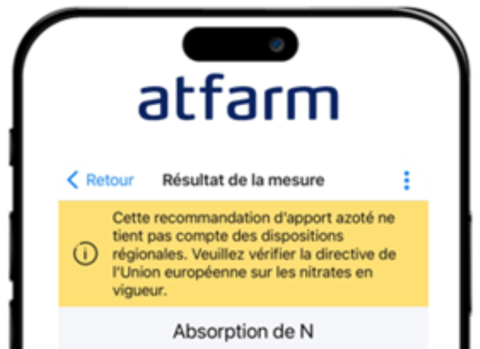
ImageIT is a feature integrated into the Atfarm mobile application that evaluates the biomass and nitrogen uptake of your rapeseed crops at the start and end of winter. Developed by Yara in partnership with Terres Inovia, ImageIT uses digital photo analysis technology.
Assessing biomass and nitrogen uptake by rapeseed crops
ImageIT has been designed to partially replace tedious biomass weighing. ImageIT estimates the amount of nitrogen absorbed by the crop based on the coverage index, the green pixel rate and an assessment of senescent leaves. ImageIT's technology is based on comprehensive image analysis, canopy pixel classification, background noise filtering and canopy pixel enumeration.
Using the Atfarm application, ImageIT transforms your smartphone camera into a nitrogen nutrition management tool. Biomass and nitrogen uptake can be reliably assessed from your phone, much more easily and quickly than traditional biomass weighing at the start and end of winter.
Download the free Atfarm application and start using Image IT today!


STAR
CASDAR Connaissances AAP 2024 operated by FranceAgriMer
780,000 (including public salaries - INRAE)
40 months Non NationalLes enjeux
Accélérer l’innovation et l’adaptation des systèmes de productions agricoles est nécessaire dans un contexte de mutations accélérées par le changement climatique et la montée des enjeux environnementaux. C’est particulièrement vrai pour le développement des biosolutions (biocontrôle et biostimulants) dont l’efficacité sur le terrain est parfois partielle et variable selon leurs conditions d’utilisation.
Pour définir leur domaine d’utilisation, il est important de décrire finement les conditions de mises en œuvre des produits (sol, climat, itinéraires techniques…) et de mettre en commun des données issues de situations de production variées. Afin de répondre à cet enjeu, les partenaires du projet mettent en commun leur expertise en matière de formalisation et de déploiement de bonnes pratiques de gestion des données, des métadonnées et de leurs descripteurs.
Les objectifs
Le projet STAR est au croisement de trois filières : la vigne, les grandes cultures oléoprotéagineuses et le maraîchage.
Il a pour objectif de lever les freins à un partage et une mutualisation des données expérimentales (collectées par des expérimentateurs selon des protocoles définis sur des dispositifs contrôlés) et techniques (c’est-à-dire les données décrivant les itinéraires techniques mis en œuvre sur l’exploitation). Pour cela, les techniques du Web-sémantique seront mobilisées afin de proposer des standards visant à uniformiser et rendre interopérables les différentes sources de données permettant de décrire de façon exhaustive les contextes de réalisation et les résultats des expérimentations.
Les résultats attendus
- Proposer des modèles de données adaptables associés à des vocabulaires contrôlés pour obtenir des données interopérables (thésaurus de variables…)
- Co-construire avec les expérimentateurs des outils simples et pratiques à mettre en œuvre pour explorer, enrichir, valider et produire des jeux de données complets et standardisés
- Mener des actions de diffusion, sensibilisation, de formation et d’accompagnement des acteurs
*Les signes s’entendent espaces compris (dans révision-statistiques)
Le rôle de Terres Inovia

Partenaire
Sur la tâche 1 : acculturation aux formats informatiques et aux outils du web-sémantique, contribution à la mise en place de modèles de données et de variables, production d’un thésaurus de variables
Sur la tâche 2 : mise au point et codage d’outils d’analyse de la conformité des données, production de rapports standard et d’outils de datavisualisation, mise au point de codes d’accès à des ressources communes (données météo., pédologiques…).
Sur la tâche 3 : contribution à la diffusion des bonnes pratiques et des livrables opérationnels produits : production d’outils de vulgarisation (tutoriels…), mise en place de webinaires et de formations
Réalisations et retombées
- Bonnes pratiques et modèles partagés avec les communautés scientifiques et techniques
- Codes informatiques d’analyse et de validation de jeux de données (fonctions, packages…)
- Formations et outils d’accompagnement (tutoriels, aides en ligne…)
- Communications scientifiques et techniques en open-data : data-paper, articles scientifiques (Computer and Electronics in Agriculture, Revue Ouverte d’Intelligence
- Artificielle), actes de colloques (Plate-Forme Intelligence Artificielle PFIA)
- Séminaire envisagé en fin de projet
Do you have a question?
Contact our specialist who will respond promptly to your request.
These projects may be of interest to you
Here are some other projects dealing with the same themes.
-
Colza
Tournesol
Pois de printemps
Pois d'hiver
Pois chiche
Lentille
Soja
Chanvre
Féverole d'hiver
Féverole de printemps
Lin d'hiver
Lin de printemps
Lupin d'hiver
Lupin de printemps
Cameline
Biodiversité
Herbi1&NoPhy
Experimenting with agroecological systems for pesticide use as a last resort
Ricin
Towards a better understanding of the factors affecting the successful establishment of intermediate crops
SOYSTAINABLE
Promoting high-quality, protein-rich soybean production that is locally adapted and resilient to climate change.
Frédéric Salvi f.salvi@terresinovia.fr
01 septembre 2024 Agir pour la transition agroécologique French Institute of Vine and Wine (IFV) En cours NonEstimating the risk of terminal bud weevils
This tool can be used to assess the risk of terminal bud weevil at plot level.
The tool is used in parallel with, and in addition to, the information provided by monitoring yellow vials ideally positioned in a network (BSV type).
This tool can be used to classify a plot into a global risk level. The overall risk combines an agronomic risk and a risk linked to the weevil's historical harmfulness in the département.
This decision rule is available in API format. Log on to the API-Agro platform or contact us for more information.
Spring rapeseed regulator
This tool estimates your rapeseed's risk of lodging in spring, and tells you whether or not to apply a growth regulator.
This tool estimates your rapeseed's risk of lodging in spring, and tells you whether or not to apply a growth regulator, depending on the variety of rapeseed, its susceptibility to lodging, the stand density, the amount of nitrogen available, and whether or not fall elongation has occurred.
This decision rule is available in API format. Log on to the API-Agro platform or contact us for more information.

Autumn rapeseed regulator
This tool estimates the risk of autumn elongation in rapeseed and tells you whether or not to apply a growth regulator.
This tool estimates the risk of autumn elongation in rapeseed and indicates whether or not to apply a growth regulator, depending on the earliness of the six-leaf stage, the susceptibility of the variety to elongation, density, available nitrogen and the size of the rapeseed.
This decision rule is available in API format. Log on to the API-Agro platform or contact us for more information.

Réglette azote colza® (Rape nitrogen chart)
The tool calculates the amount of nitrogen to be applied per hectare, and displays additional recommendations for application.

Estimated risk from adult flea beetles
The purpose of this tool is to estimate the risk associated with foliar feeding by adult crucifer flea beetles and winter flea beetles.
This tool has been built by integrating trial results and the expertise of Terres Inovia collaborators.
The final risk assessment is given here as an indication. It is the responsibility of the user (farmer, technician) to use this risk assessment for the reasoning of any phytosanitary intervention.
This decision rule is available in API format. Log on to the API-Agro platform or contact us for more information.

Risk estimate for flea beetle larvae
This tool makes it possible to estimate a risk linked to the agronomic situation of the plot, as well as a risk linked to larvae pressure.
- Risk assessment for flea beetle larvae should be carried out from the second half of November, and repeated during the winter if conditions are mild.
- The harmfulness of this pest depends on insect pressure and rapeseed growth dynamics.
The tool's integrated decision rule combines these two aspects, making it possible to estimate a risk linked to the plot's agronomic situation, as well as a risk linked to larval pressure.
The tool is not a substitute for field observation, which remains essential for any decision-making process.
The overall risk estimate is associated with a recommendation: whether or not to intervene, and which insecticide to use, depending on the insecticide resistance situation in the département.
This decision rule is available in API format. Log on to the API-Agro platform or contact us for more information.

[COMING SOON] Predicting pest flights
Provide information on the statistical probability of catching a fish in a cuvette
The tool displays :
- In graphic form: the evolution of the daily probability of capture up to D+7, for a given commune
- In map form: probability levels over the whole territory, for a given date (up to D+7).
The alert threshold is defined by the model's algorithms. Above this threshold, the probability of capturing the pest increases significantly.
The rapeseed stem weevil flight prediction tool was developed thanks to the Produire project of the Cap Protéines program, and received support from the French Ministry of Agriculture and Food Sovereignty as part of the recovery plan.
The terminal bud weevil flight prediction tool was developed thanks to the Adaptacol² project and received support from the Casdar.