
Camelina planting
Whether as a main crop or as a summer catch crop, successful sowing is the key to success.
Whether as a main crop or as a summer catch crop, successful sowing is the key to success.
General
The small size of the seed, with a GMP ranging from 0.7 to 1.8 g, represents a challenge for successful planting. Soil cultivation and sowing methods must provide a seedbed conducive to good contact between seed and soil, while limiting the impact of residues from the previous crop.
Summer intercropping with camelina
The success of camelina in summer intercropping depends largely on its rapid establishment. This crucial stage requires rapid, uniform and vigorous emergence. Everything must be done to ensure that the cycle is completed as quickly as possible, so that harvesting can take place at an acceptable date, maximizing the chances of harvesting camelina under favorable climatic conditions and having no impact on the following crop.
To maximize the chances of early emergence, it is crucial to choose a suitable crop precedent, enabling harvesting before July 10, the latest date for sowing camelina. The optimum sowing date is before the beginning of July. The most suitable crops are protein or canning peas and winter barley.
Previous pea crop
Sowing should be carried out as soon as possible after harvesting the previous crop, ideally within 24 to 48 hours, to take advantage of any remaining soil moisture.
Direct sowing with tines is strongly recommended. In the case of shallow stubble ploughing, do not go deeper than 3 cm to maintain soil moisture.
Seeding depth :
- Direct seeding: seed 3 cm deep
- Tilled seeding: seed 1-2 cm deep
- Surface seeding: not recommended
Regarding sowing density, we recommend sowing at 8 kg/ha with a row spacing of 12.5 - 15 cm, to aim for a stand of around 200 plants/m2.
If you have irrigation, we strongly recommend applying 10-20 mm just after sowing to boost emergence.
Previous winter barley
The only difference between winter barley and peas concerns harvesting, which should be carried out as high up as possible (between 25 and 30 cm).
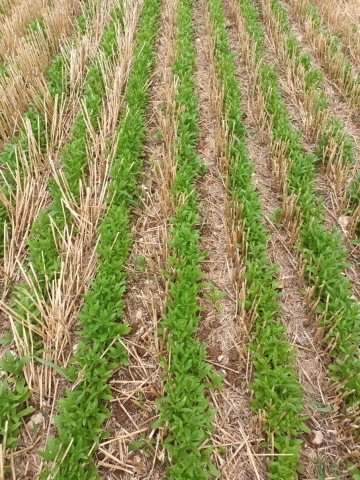
It is important to remove the straw, as it can consume nitrogen as it decomposes, and adversely affect sowing quality by disturbing contact between the seed and the soil.
Straw should also be evenly distributed over the entire surface.
All other recommendations for planting remain identical to those applied to previous peas.
Planting camelina as a main crop
Sowing should be carried out in well-aerated, uncompacted soil. Due to the small size of its seeds, camelina requires particularly careful, fine and well-reconsolidated seedbed preparation. Tillage should aim for a homogeneous profile, with no marked areas of compaction, and a surface area comparable to that required for rapeseed sowing.
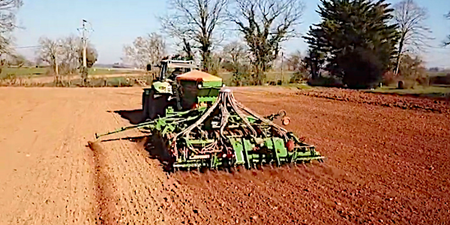
For spring camelina, the soil should be worked when it is well drained. To reduce the risk of soil compaction, we recommend reducing the number of tractor passes as much as possible, and favouring the use of combined implements. Rolling prior to sowing can be considered to even out the seedbed and ensure good contact between the seed and the soil, a condition favorable to successful germination.
Sowing takes place between late March and early April, using a cereal drill with a narrow row spacing (12.5 to 15 cm). The recommended sowing density is 5 kg/ha, aiming for a minimum population of 200 plants/m². Sowing depth should be between 1 and 1.5 cm. If required, seeds can be mixed with sand or semolina to facilitate even distribution.

Camelina editions
Cameline - Cultivation Guide 2024
Our other articles
How camelina fits into cropping systems
Adapted to a wide range of soil and climate conditions, camelina is grown throughout France. It can be easily integrated into a variety of cropping systems, in both conventional and organic farming.
Adapted to a wide range of soil and climate conditions, camelina is grown throughout France. It can be easily integrated into a variety of cropping systems, in both conventional and organic farming.
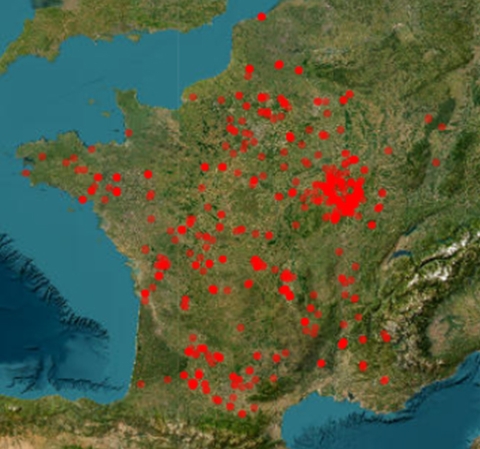
A particularity of camelina is its very short cycle length, which also makes it suitable for intercropping.
Camelina as the main crop
Pure cultivation
Camelina can be grown pure as a main crop, with winter and spring varieties. In areas with mild climates (winter temperatures not exceeding -10°C), spring varieties can also be planted in autumn.
As a main crop, the proportion of organically-produced camelina is particularly high, thanks to its hardiness and resistance to pests and diseases, and to the opportunities for using the oil for human consumption.
In some countries of the southern Mediterranean basin, camelina is grown on so-called "marginal" land with low potential, which it valorizes well.
In combination
Camelina lends itself well to crop combinations, particularly in organic farming. The lentil-camel association is widely practiced, with camelina acting as a staking plant, thus limiting the risk of lentil lodging.
What's more, if planting conditions are favorable, camelina develops rapidly and is highly competitive with weeds at the rosette stage, in contrast to the generally slow initial development of legumes, which contributes to better weed control. Other camelina-legume combinations mentioned in the literature are camelina combined with pea, lupin or chickpea.
There are also references to camelina combined with barley or wheat, but these refer to competition between the two species and associated yield losses (M. Leclère's thesis on camelina insertion in Picardie).
Intercropping
The length of camelina's cycle, around 3 months for short-cycle varieties, means that it can be grown as a catch crop. Recent changes in the regulatory framework open up major market opportunities for intercropped camelina, such as sustainable fuel for aviation.
Summer intercropping
While camelina adapts well to a wide range of soil and climate conditions, a number of conditions must be met to maximize its chances of success in summer intercropping: sufficient rainfall during the planting period (late June - early July), few days of high temperature (35°C - 40°C) during flowering, and a sufficient temperature sum (1700°J base 0) to reach maturity before mid-October. These criteria exclude areas very far north and south of France.
To maximize the chances of success, camelina in summer intercropping should be planted after an early-harvested preceding crop, such as barley or winter peas.
Winter intercropping
Camelina can also be intercropped in winter, before a late-sown spring crop such as sunflower or sorghum. The challenge for this type of succession is to harvest the camelina early enough, so as not to delay the sowing of the following crop too much and impact its yield potential.

