
 Se connecter avec Facebook
 Se connecter avec Google
EvA - Aphanomyces risk assessment
The EvA tool enables you to quickly classify your plot as being at low or high risk, and thus guide you in your choices to preserve pea yield and plot health.
Aphanomyces is the most damaging telluric disease of peas. The EvA tool does not replace the Infectious Potential bioassay, but allows you to quickly classify your plot in a risk level and thus guide you in your choices to preserve pea yield and plot health.
Little information to fill in
The information you need to fill in is as follows: department, soil type, pea history and irrigation. These are few in number, but must be filled in very precisely.
A tool that can be used in most regions
The EvA tool was developed from a database containing information on 780 plots in the northern half of France, then validated on 120 plots, mainly in the Normandy and Centre-Val de Loire regions. This tool can be used in the Bourgogne-Franche-Comté, Bretagne, Centre-Val de Loire, Grand Est, Hauts-de-France, Île-de-France, Normandie, Nouvelle-Aquitaine and Pays de la Loire regions.
Points of attention
At present, only the effect of a winter or spring pea crop on the evolution of a soil's Infectious Potential is known. The effect of other susceptible legumes has not yet been taken into account in this tool, for lack of data. Consequently, for plots that have received one or more susceptible legumes other than pea as a main, intermediate, associated or companion crop, the risk may be underestimated. Only the bioassay can be used to estimate the risk in these plots*.
*Susceptible legumes: lentil, alfalfa, chickling vetch, certain species/varieties of vetch (Access the test) "

Estimating the risk of terminal bud weevils
This tool can be used to assess the risk of terminal bud weevil at plot level.
The tool is used in parallel with, and in addition to, the information provided by monitoring yellow vials ideally positioned in a network (BSV type).
This tool can be used to classify a plot into a global risk level. The overall risk combines an agronomic risk and a risk linked to the weevil's historical harmfulness in the département.
This decision rule is available in API format. Log on to the API-Agro platform or contact us for more information.

Spring rapeseed regulator
This tool estimates your rapeseed's risk of lodging in spring, and tells you whether or not to apply a growth regulator.
This tool estimates your rapeseed's risk of lodging in spring, and tells you whether or not to apply a growth regulator, depending on the variety of rapeseed, its susceptibility to lodging, the stand density, the amount of nitrogen available, and whether or not fall elongation has occurred.
This decision rule is available in API format. Log on to the API-Agro platform or contact us for more information.

Autumn rapeseed regulator
This tool estimates the risk of autumn elongation in rapeseed and tells you whether or not to apply a growth regulator.
This tool estimates the risk of autumn elongation in rapeseed and indicates whether or not to apply a growth regulator, depending on the earliness of the six-leaf stage, the susceptibility of the variety to elongation, density, available nitrogen and the size of the rapeseed.
This decision rule is available in API format. Log on to the API-Agro platform or contact us for more information.

[TO COME] Sunflower seeding rate
The "sunflower sowing density" decision-support tool can be used to assess the number of seeds to be sown to reach the defined emergence density target.
The OAD advice takes into account the plot's water constraints and climatic zone.

Tour de plaine tournesol
With Tour de Plaine, Terres Inovia accompanies you to each sunflower plot to establish a health diagnosis and give you the right advice for your next sunflower crop.
This connected application also works in the absence of a telephone network.
Your health check in 5 steps:
- I locate my plot
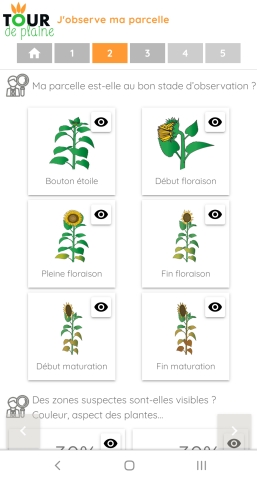
- I observe my plot
- I observe plants
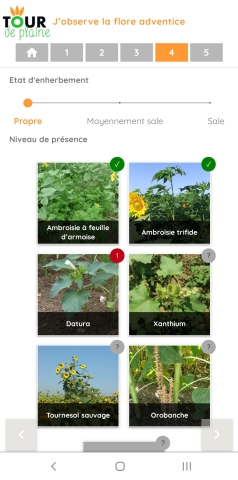
- I observe weed flora
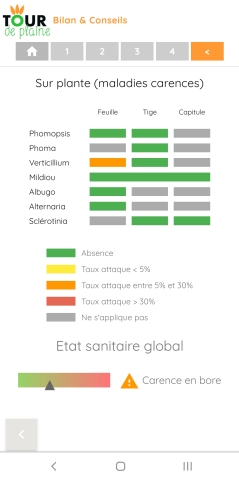
- Terres Inovia's assessment and advice

[COMING SOON] When to sow to harvest sunflowers
Estimate the sunflower harvesting period, according to your location, based on your choice of variety and your planned sowing date.
This tool will tell you how much risk you are taking at harvest, depending on your sowing date and criteria.
This tool is designed for sunflower as a main crop, not as a catch crop. It is based on frequent climatic data and does not incorporate weather data for the current season.
Réglette azote colza® (Rape nitrogen chart)
The tool calculates the amount of nitrogen to be applied per hectare, and displays additional recommendations for application.
The dose depends on a dozen or so inputs: department, soil type, yield objective, rapeseed weight, organic inputs on the plot (regular or specific to the current season). It is also asked whether the rapeseed is planted after a pea, and whether it is associated with a leguminous cover crop.
Based on these elements, the tool calculates the quantity of nitrogen to be applied per hectare, and displays additional recommendations for implementation. It also provides a detailed PDF report, which can be sent to you by e-mail.
This decision rule is available in API format. Connect to the API-Agro platform or contact us for more information.

[COMING SOON] Calculating the economic margin for sunflowers
The sunflower margin calculator is designed to help you estimate the annual gross margin in €/ha for your sunflower crop.
The sunflower margin calculator is designed to help you estimate the annual gross margin in €/ha for your sunflower crop. This calculation can help you identify margins for progress in management to improve the margin of this crop. This tool does not take into account the precedent and rotation effects that can occur when you introduce sunflower into a crop succession (quality of precedent, better balance between summer and spring crops and winter crops for better weed management).

Estimated risk from adult flea beetles
The purpose of this tool is to estimate the risk associated with foliar feeding by adult crucifer flea beetles and winter flea beetles.
This tool has been built by integrating trial results and the expertise of Terres Inovia collaborators.
The final risk assessment is given here as an indication. It is the responsibility of the user (farmer, technician) to use this risk assessment for the reasoning of any phytosanitary intervention.
This decision rule is available in API format. Log on to the API-Agro platform or contact us for more information.