Dare to use cover crops in your cropping systems
Direct seeding under plant cover (DMCS) combines the cessation of tillage with the establishment of permanent soil cover. Today, this is the most advanced form of conservation agriculture.
The agronomic benefits of these techniques are major, but only become real and lasting once farmers have mastered the system. Providing participants with the keys to the success of this system is the major challenge of this course.
Program:
Theoretical part (distance learning):
- Typology of plant cover crops (annual and permanent): species, associations, agronomic benefits
- Use and presentation of the ACACIA tool
- Construction of a coherent SDCV technical itinerary
- Rationalization of rotations
- Establishing, maintaining and regulating cover crops
- Nutrition, weed, pest and disease management
- Crop associations and agronomic performance
- Economic and environmental analysis of SDCV practices
Field part (either in Baziège (31) or in Nièvre (58)):
- Visit to SDCV plots
- Soil profile and interpretation
- Exchange of practices
At the end of the course, participants will be able to :
- Explain the agronomic functioning of a direct seeding system under permanent cover
- Identify the plant species that can be used according to their objective and the local soil and climate context
- Develop a permanent soil cover strategy adapted to their cropping system;
- Master the key factors for a successful transition to direct seeding under permanent cover (rotation, fertility, cover crop management, pest management, etc.).
- Evaluate the economic and environmental impact of using direct seeding under cover.
Hybrid format:
- Distance learning theory (2 half-days): Technical inputs, case studies, interactive quizzes.
- Field practice (1 day): Analysis of plots, interpretation of soil profiles, exchanges with practicing farmers.
Active methods: Presentations, debates, questions and answers, practical work.
Evaluation: Quiz, Q&A, individual satisfaction survey, self-assessment.
Theoretical support: Lectures, presentations, written material given to participants.
Management tool: Use and presentation for choosing and managing plant cover crops.
Plot visits: Observation and analysis of soil profiles in real-life situations.
Exchange of practices: Feedback and discussion between participants and trainers.
Farmers in a transition phase or wishing to optimize their practices; Agricultural technicians and advisors (cooperatives, chambers of agriculture, agri-supply companies); Agricultural high school teachers and agro-ecology trainers. Quiz, Q&A, individual satisfaction survey, self-positioning
If you have any requests for adaptations to help you succeed in your course, please contact the Disability Advisor:
Christel CARO
Tel: 01 30 79 95 09
Mail: formation@terresinovia.fr
Aucun 960€ TTC 5 https://public.dendreo.com/4rsx27tf4npws6tp4zAwc/media/mfb238dlgvr2c8btgjsAgsldgznhc8zAmz1xs8sp4r7f3mrrljgg37lyhb8f3ytk4nx2spj5hjrxms5blfwgc7sfl1xA35cymzx2g7lzgqzw4pj8 4 Jours Michael GELOEN 90 Inter-company and intra-companyHow camelina fits into cropping systems
Adapted to a wide range of soil and climate conditions, camelina is grown throughout France. It can be easily integrated into a variety of cropping systems, in both conventional and organic farming.
Adapted to a wide range of soil and climate conditions, camelina is grown throughout France. It can be easily integrated into a variety of cropping systems, in both conventional and organic farming.
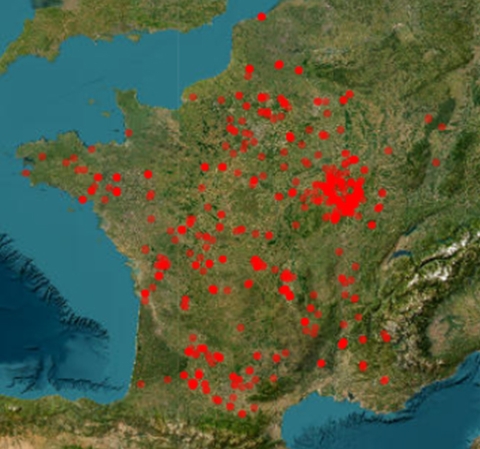
A particularity of camelina is its very short cycle length, which also makes it suitable for intercropping.
Camelina as the main crop
Pure cultivation
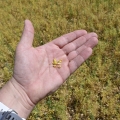
Camelina can be grown pure as a main crop, with winter and spring varieties. In areas with mild climates (winter temperatures not exceeding -10°C), spring varieties can also be planted in autumn.
As a main crop, the proportion of organically-produced camelina is particularly high, thanks to its hardiness and resistance to pests and diseases, and to the opportunities for using the oil for human consumption.
In some countries of the southern Mediterranean basin, camelina is grown on so-called "marginal" land with low potential, which it valorizes well.
In combination
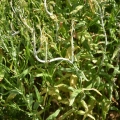
Camelina lends itself well to crop combinations, particularly in organic farming. The lentil-camel association is widely practiced, with camelina acting as a staking plant, thus limiting the risk of lentil lodging.
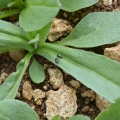
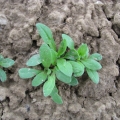
What's more, if planting conditions are favorable, camelina develops rapidly and is highly competitive with weeds at the rosette stage, in contrast to the generally slow initial development of legumes, which contributes to better weed control. Other camelina-legume combinations mentioned in the literature are camelina combined with pea, lupin or chickpea.
There are also references to camelina combined with barley or wheat, but these refer to competition between the two species and associated yield losses (M. Leclère's thesis on camelina insertion in Picardie).
Intercropping
The length of camelina's cycle, around 3 months for short-cycle varieties, means that it can be grown as a catch crop. Recent changes in the regulatory framework open up major market opportunities for intercropped camelina, such as sustainable fuel for aviation.
Summer intercropping
While camelina adapts well to a wide range of soil and climate conditions, a number of conditions must be met to maximize its chances of success in summer intercropping: sufficient rainfall during the planting period (late June - early July), few days of high temperature (35°C - 40°C) during flowering, and a sufficient temperature sum (1700°J base 0) to reach maturity before mid-October. These criteria exclude areas very far north and south of France.
To maximize the chances of success, camelina in summer intercropping should be planted after an early-harvested preceding crop, such as barley or winter peas.
Winter intercropping
Camelina can also be intercropped in winter, before a late-sown spring crop such as sunflower or sorghum. The challenge for this type of succession is to harvest the camelina early enough, so as not to delay the sowing of the following crop too much and impact its yield potential.