
All you need to know about sunflower phomopsis
Sunflower phomopsis is a disease caused by a necrotrophic ascomycete fungus belonging to the Diaporthe genus.
Agent pathogène et hôte
Le phomopsis du tournesol est une maladie causée par un champignon ascomycète nécrotrophe appartenant au genre Diaporthe. Cet agent pathogène se présente sous deux formes biologiques : une forme sexuée, appelée Diaporthe helianthi, et une forme asexuée, Phomopsis helianthi. Cette espèce est historiquement la plus couramment impliquée dans les attaques observées sur tournesol. Toutefois, des travaux plus récents ont mis en évidence l’existence d’autres espèces du genre Diaporthe capables d’infecter cette culture, notamment D. gulyae, D. kongii, D. masirevicii et D. novem.
Phomopsis helianthi a été décrit pour la première fois à la fin des années 1970 dans l’ex-Yougoslavie à la suite d’épidémies sévères sur tournesol. En France, la maladie est identifiée pour la première fois en 1984 dans une zone située entre Toulouse et Carcassonne. À partir du milieu des années 1990, le phomopsis s’est progressivement étendu à l’ensemble des régions de culture du tournesol. Aujourd’hui, cette maladie est responsable de pertes de rendement importantes dans plusieurs pays producteurs, notamment en Europe de l’Est, en Russie, aux États-Unis et en Australie.
L’hôte principal de la maladie est le tournesol cultivé (Helianthus annuus). D’autres espèces d’Astéracées telles que Arctium lappa, Xanthium italicum ou Xanthium strumarium ont été signalées comme hôtes potentiels, mais leur rôle dans pour la survie et la propagation du phomopsis n’a pas été clairement démontré.
Symptômes
Les premiers symptômes du phomopsis apparaissent généralement après la floraison, bien que les contaminations puissent avoir lieu plus précocement. Ils se manifestent initialement sur les feuilles, sous la forme de taches triangulaires brunâtres, souvent bordées d’un halo chlorotique jaune, localisées en bordure du limbe. Ces taches s’étendent progressivement le long des nervures principales en direction du pétiole, ce qui constitue un élément caractéristique de la maladie.
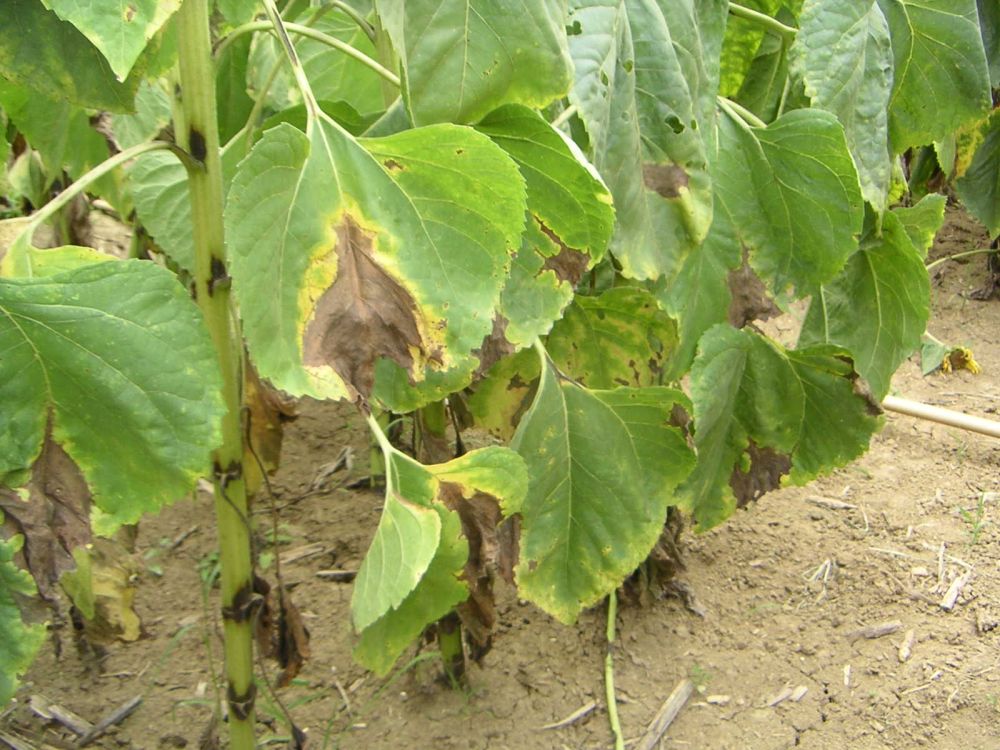
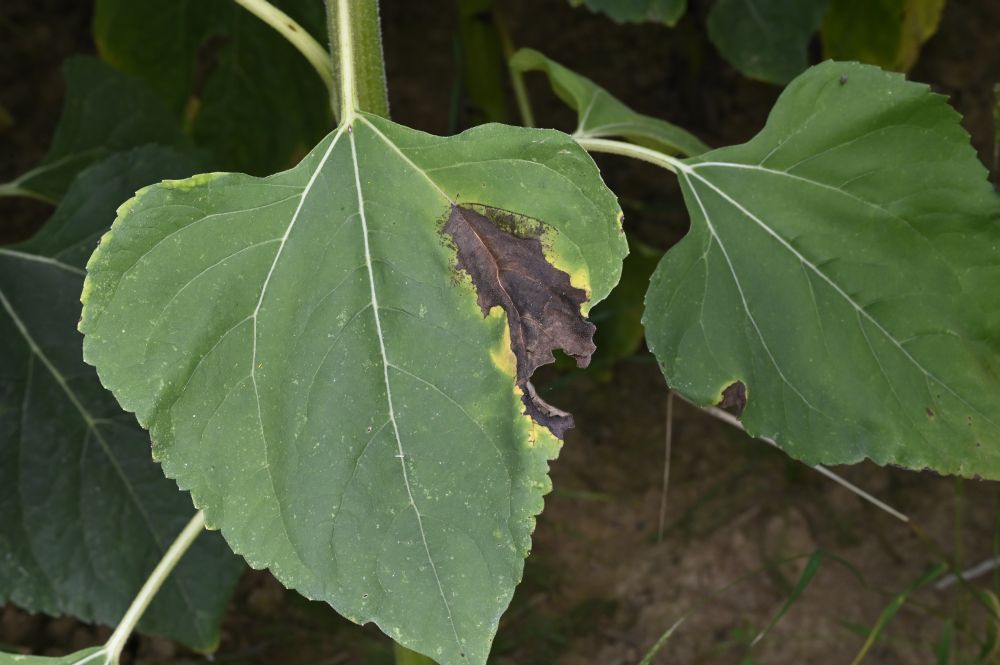
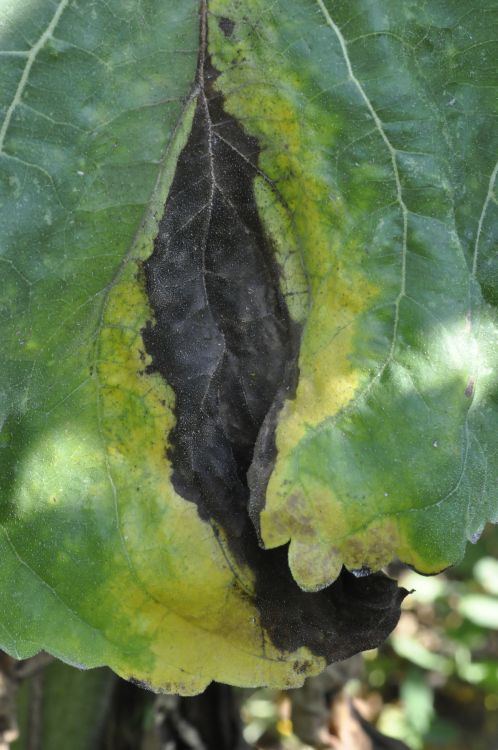
À un stade plus avancé, les feuilles atteintes se flétrissent puis se dessèchent. Le champignon progresse de manière systémique le long du pétiole pour atteindre la tige. Cette phase de colonisation est lente et souvent asymptomatique pendant plusieurs semaines, ce qui explique le décalage fréquent entre la date de contamination et la date d’apparition sur tige.
Les lésions observées sur tige sont allongées, de couleur brun foncé à brun grisâtre, et sont le plus souvent localisées au niveau des nœuds, à l’insertion des pétioles. Elles peuvent atteindre une longueur de 15 à 20 cm et évoluer jusqu’à encercler complètement la tige. Dans ce cas, la circulation de la sève est interrompue, ce qui entraîne un dessèchement prématuré du capitule ainsi qu’une fragilisation importante de la tige, susceptible de casser sous l’effet du vent, de la pluie ou lors de la récolte.
Des symptômes peuvent également être observés sur le capitule. Ils se traduisent par l’apparition de petites taches brunes à l’insertion des bractées ou des folioles situées à l’arrière du capitule, puis par une extension progressive vers la tige. Dans les situations les plus sévères, l’ensemble du capitule peut se dessécher prématurément.
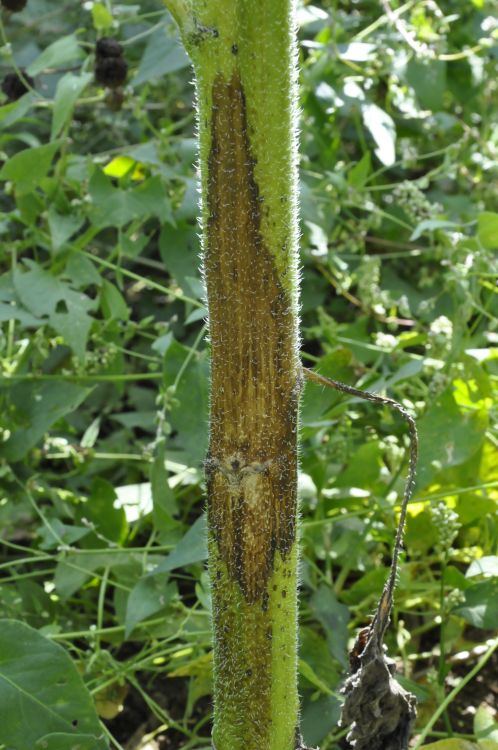
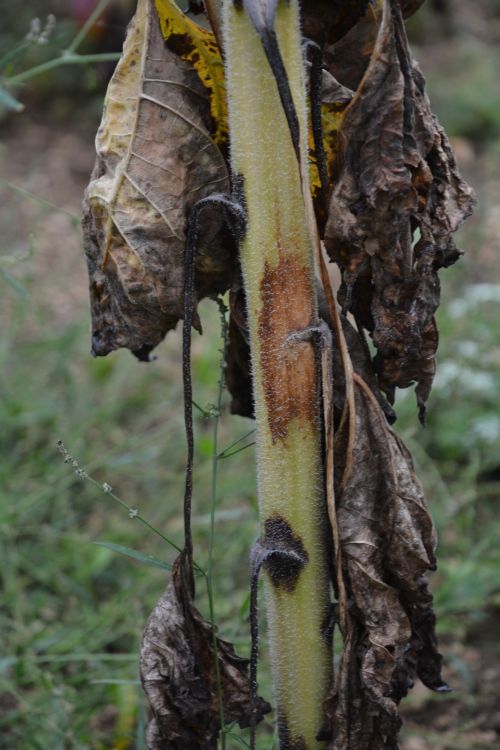
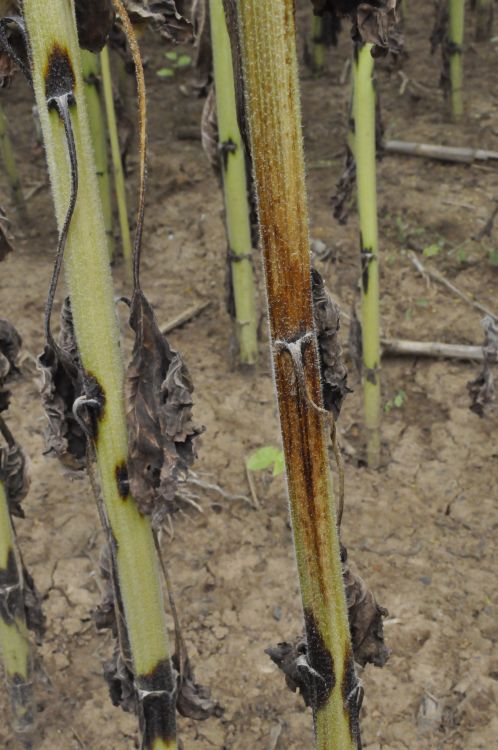
Attention aux confusions !
Les symptômes du phomopsis peuvent être confondus avec ceux d’autres maladies du tournesol.
- Sur feuilles, une confusion est possible avec le verticillium, mais la nécrose du phomopsis suit les nervures du limbe foliaire, contrairement à celle du verticillium, qui est inter-nervaire.
- Sur tige, le phomopsis peut être confondu avec le phoma ; toutefois il se caractérise par des taches plus foncées, souvent noires, sans provoquer de casse de tige.
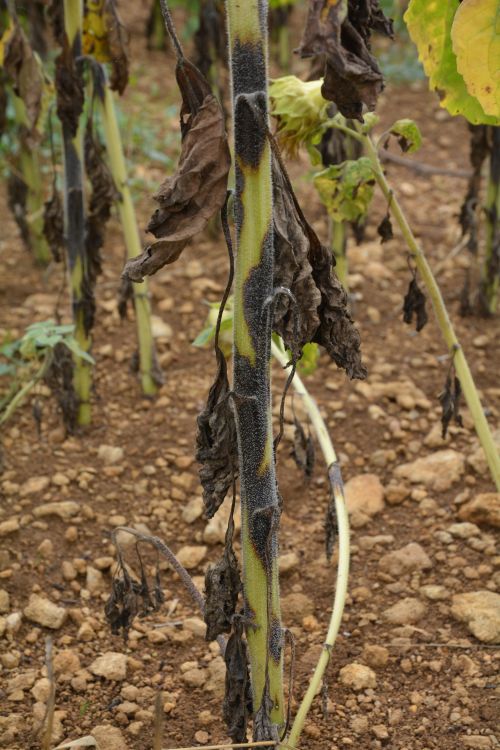
Traces de phoma sur tige de tournesol
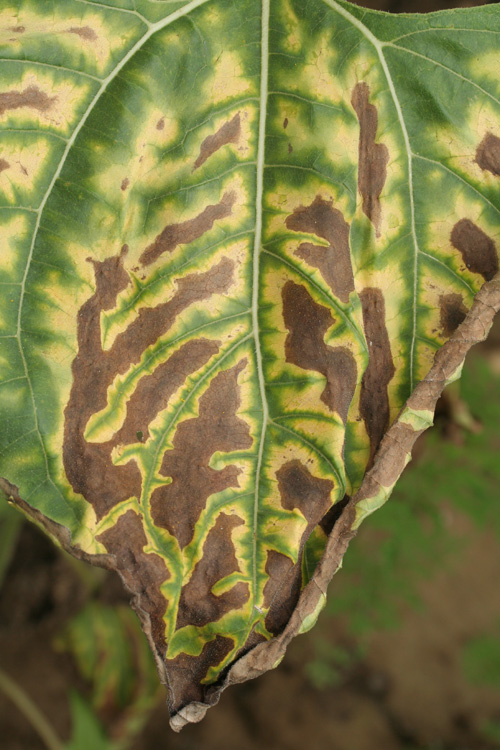
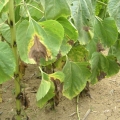
Traces de verticillium sur une feuille de tournesol
Importance de la maladie
En France, le phomopsis du tournesol était très fréquent jusqu’à la fin des années 1990. Depuis le milieu des années 2010, sa fréquence a nettement diminué, jusqu’à devenir presque absente certaines années, à l’exception de quelques campagnes ponctuelles, comme en 2021, où des signalements ont été observés.
Malgré cette évolution, la maladie reste à surveiller dans certaines régions, notamment dans Centre et Centre-Est, où elle est historiquement la plus fréquemment observée.
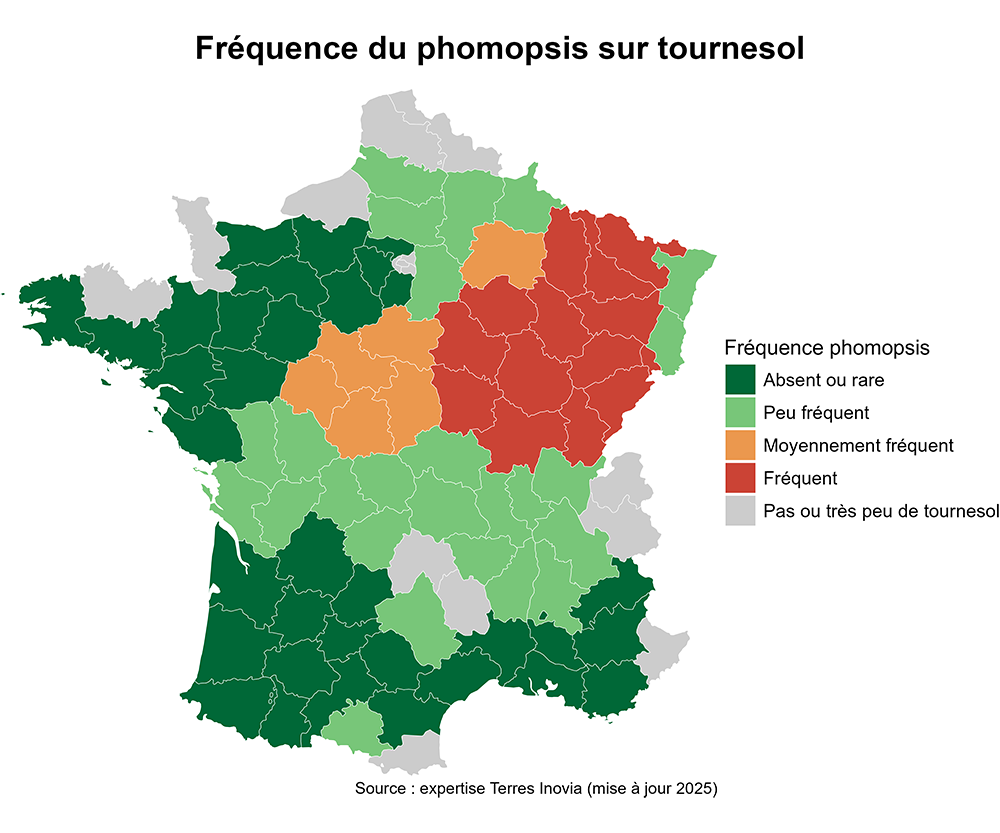
La nuisibilité du phomopsis peut être importante. En conditions favorables, les pertes de rendement peuvent atteindre jusqu’à 40 %, auxquelles s’ajoute une baisse de la teneur en huile des graines pouvant atteindre 25 %. Il est généralement admis qu’un taux de 10 % de tiges présentant des lésions encerclantes peut entraîner une perte de rendement comprise entre 1 et 3 quintaux par hectare, ainsi qu’une diminution d’environ un point de teneur en huile. La maladie est surtout nuisible dans le Nord-Est.
Cycle de vie
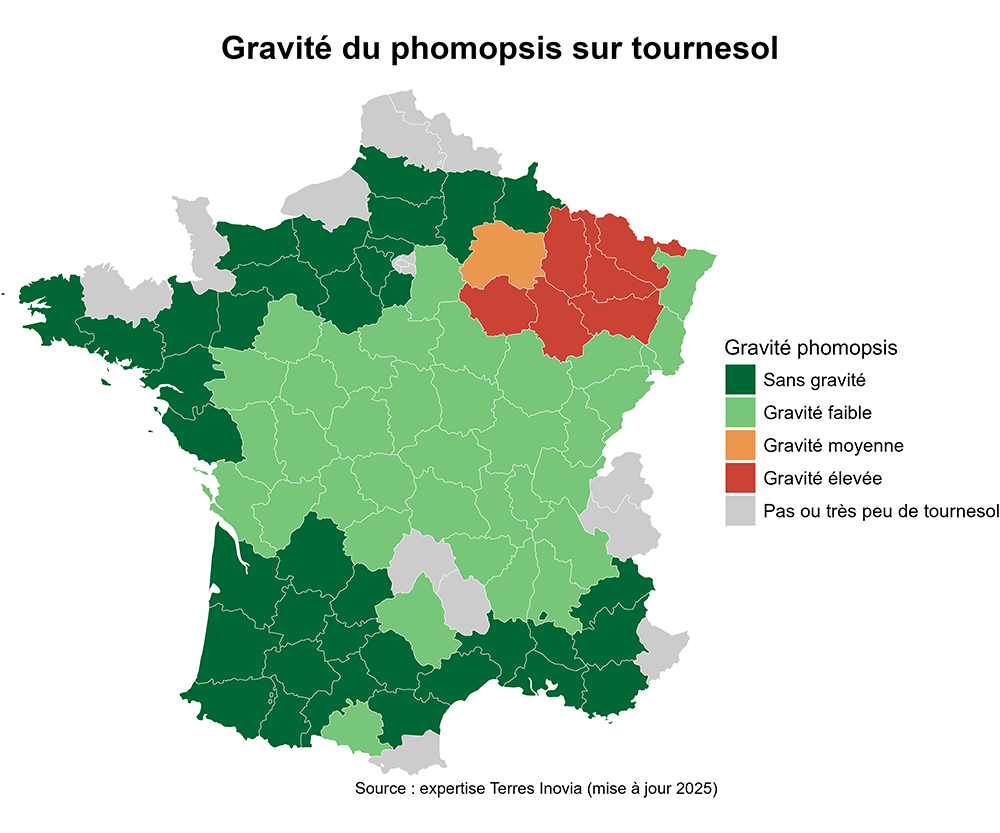
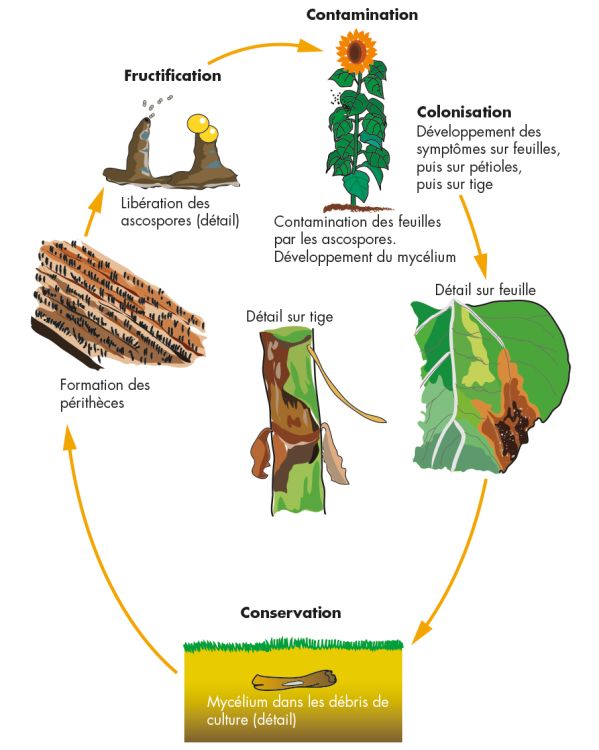
Le champignon hiverne sous forme de mycélium et de périthèces sur les résidus de culture de tournesol présents à la surface du sol. À la fin de l’hiver, lorsque les températures atteignent environ 10 °C, les périthèces se forment. En conditions d’humidité suffisante, ils libèrent des ascospores, qui constituent l’inoculum primaire, qui pourront être émises de façon progressive avec des pics au moments des épisodes pluvieux. Ces spores sont disséminées par le vent ainsi que par les éclaboussures de pluie et contaminent les feuilles du tournesol.
Après l’infection des feuilles, le mycélium colonise les espaces intercellulaires, progresse le long des nervures et de la nervure centrale, puis migre vers le pétiole. Il atteint ensuite la tige de manière systémique, où se développe une lésion nécrotique allongée. Les pertes de rendement apparaissent lorsque les tissus conducteurs de la tige sont envahis et que le système vasculaire est obstrué. La plante se flétrit alors progressivement et la tige, fragilisée, peut casser sous le poids du capitule ou à la suite d’un choc.
Des infections secondaires peuvent être observées à partir de conidies produites dans les lésions de tige. Toutefois, ces conidies semblent avoir un rôle limité dans le développement de l’épidémie. L’agent pathogène est capable de survivre jusqu’à cinq ans sur les résidus de culture, en fonction des pratiques agronomiques et des conditions météorologiques.
Facteurs favorables
Le développement du phomopsis est étroitement dépendant des conditions climatiques. Des températures comprises entre 20 et 24 °C, associées à une humidité relative supérieure à 90 % pendant une durée prolongée, constituent des conditions particulièrement favorables à l’infection et à la progression du champignon.
Certaines pratiques agronomiques peuvent également favoriser l’apparition de la maladie.
Un semis précoce augmente le risque d’attaque sévère, car il favorise la coïncidence entre la période de sensibilité maximale du tournesol, située autour du stade bouton floral, et les périodes climatiques favorables aux contaminations.
Une densité de peuplement élevée entraîne une mauvaise circulation de l’air au sein du couvert végétal et favorise le maintien d’une forte humidité, condition indispensable au développement du phomopsis. Enfin, une fertilisation azotée excessive ainsi qu’une irrigation autour de la floraison peuvent accentuer la gravité des attaques.
Diversité de l’agent pathogène
La diversité des agents responsables du phomopsis varie selon les régions du monde. En France et plus largement en Europe, Diaporthe helianthi est l’espèce majoritairement retrouvée. En Australie, les épidémies sont principalement dues à Diaporthe gulyae, tandis qu’aux États-Unis, ces deux espèces coexistent.
La diversité intra-spécifique de Phomopsis helianthi reste encore peu documentée. À ce jour, il n’existe pas de dispositif de surveillance des populations en France. Toutefois, certaines études ont mis en évidence des différences d’agressivité entre isolats, suggérant une variabilité au sein des populations de cet agent pathogène.
Leviers de lutte
La gestion durable du phomopsis repose sur une approche intégrée, combinant plusieurs leviers complémentaires, à raisonner à l’échelle de la parcelle, de la rotation et du long terme.
Pratiques agronomiques
Les pratiques agronomiques jouent également un rôle majeur dans la réduction du risque :
- allonger la rotation du tournesol, idéalement avec un retour tous les cinq ans
L’allongement de la rotation du tournesol permet de réduire la quantité de résidus infectés disponibles et de limiter la pression d’inoculum d’une campagne à l’autre. Un retour trop fréquent du tournesol favorise au contraire l’accumulation de l’inoculum et augmente le risque d’infections précoces.
- broyer et enfouir les résidus de culture à plus de cinq centimètres de profondeur
Le broyage et l’enfouissement partiel des résidus contribuent à accélérer leur dégradation et à réduire la capacité du champignon à produire des périthèces viables.
- adapter les dates de semis
Un semis plus tardif peut provoquer la formation d’un couvert moins dense au moment des périodes à risque (périodes pluvieuses)
- éviter des densités de peuplement excessives
Une densité de peuplement élevée favorise la fermeture rapide du couvert, limite la circulation de l’air et augmente la durée pendant laquelle l’humidité relative reste élevée à l’intérieur de la végétation. Ces conditions sont particulièrement favorables aux infections foliaires, qui constituent la première étape du développement de la maladie
Résistances variétales
La tolérance variétale constitue un moyen de lutte efficace. Dans les zones à risque, opter pour des variétés très peu sensibles (TPS). Les variétés peu sensibles (PS) sont conseillées uniquement chez les producteurs prêts à traiter si nécessaire. Sur le reste du territoire, le choix variétal n’est pas contraint.
Lutte fongicide
La protection fongicide contre le phomopsis doit être considérée comme un levier d’appoint, dont l’efficacité dépend fortement du contexte. Les traitements visent essentiellement à limiter les infections foliaires précoces, afin de réduire la probabilité de progression du champignon vers la tige. Le recours à cette protection fongicide doit être raisonné en tenant compte du risque régional, de la sensibilité variétale, des caractéristiques de la parcelle et des informations issues des Bulletins de Santé du Végétal. Consultez le guide de culture tournesol Terres Inovia pour les recommandations de traitements.

Tout savoir sur le mildiou du tournesol
Plasmopara halstedii, agent responsable du mildiou du tournesol, est un oomycète biotrophe obligatoire, spécialiste, capable de se conserver pendant 10 ans dans le sol.
Agent pathogène et hôte
Plasmopara halstedii, agent responsable du mildiou du tournesol, est un oomycète biotrophe obligatoire, spécialiste, capable de se conserver pendant 10 ans dans le sol. Le mildiou est capable d’attaquer plusieurs Astéracées dont les espèces Hfelianthus comme H. argophyllus, H. debilis et H. petiolaris, et aussi la forme sauvage et cultivée de H.annuus, le tournesol. Plasmopara halstedii peut également attaquer d’autres Asteraceae comme Bidens, Artemisia, Xanthium, qui pourraient être de potentiels réservoirs d’inoculum.
Comme le mildiou est un agent pathogène biotrophe obligatoire, sa survie en absence de tournesol repose sur des plantes relais. Les principales plantes relais (de P. halstedii vers le tournesol) à considérer sont Ambrosia artemisiifolia, Xanthium strumarium, Iva xanthiifolia et Senecio vulgaris, qui sont parfois abondantes dans les parcelles cultivées en tournesol. Du fait de leur proximité botanique avec H. annuus, ces espèces sont peu sensibles à la plupart des herbicides utilisés dans cette culture.
| Nom latin | Nom courant | Nom latin | Nom courant |
| Ageratum sp. | Agératum | Helianthus giganteus | Tournesol géant |
| Ageratum houstonianum | Agératum du Mexique | Helianthus grosseserratus | Hélanthe à grosses dents |
| Ambrosia artemisiifolia | Ambroisie à feuilles d’armoise | Helianthus hirsutus | Tournesol hérissé |
| Artemisia vulgaris | Armoise commune | Helianthus nuttallii | Tournesol de Nuttall |
| Centaurea sp. | Centaurée | Helianthus petiolaris | Tournesol à pétiole |
| Chrysanthemum sp. | Chrysanthème | Helianthus rigidus | Tournesol rigide |
| Cineraria sp. | Cinéraire | Helianthus scaberrimus | Tournesol rude |
| Clibadium sp. | Clibadie | Helianthus strumosus | Tournesol à rhizomes |
| Coreopsis sp. | Coréopsis | Helianthus subrhomboideus | Tournesol subrhombique |
| Coreopsis lanceolata | Coréopsis lancéolé | Helianthus tuberosus | Topinambour |
| Dimorphotheca sp. | Ostéospermum / Marguerite africaine | Helianthus occidentalis | Tournesol occidental |
| Elephantopus sp. | Éléphantope | Helianthus debilis | Tournesol délicat |
| Emilia sp. | Émilie | Helianthus lenticularis | Tournesol lenticulaire |
| Erigeron sp. | Vergerette | Iva sp. | Iva |
| Eupatorium sp. | Eupatoire | Petasites sp. | Pétasite |
| Eupatorium ageratoides | Eupatoire agératoïde | Rudbeckia sp. | Rudbeckie |
| Eupatorium purpureum | Eupatoire pourpre | Rudbeckia fulgida | Rudbeckie brillante |
| Eupatorium rugosum | Eupatoire rugueuse | Senecio sp. | Séneçon |
| Franseria sp. | Franseria | Venidium sp. | Venidium |
| Gerbera jamesonii | Gerbéra | Verbesina sp. | Verbesine |
| Helianthus sp. | Tournesol | Vernonia sp. | Vernonie |
| Helianthus annuus | Tournesol commun | Xanthium strumarium | Lampourde commune |
| Helianthus argophyllus | Tournesol argenté | Ximenesia sp. | Ximenesia |
| Helianthus divaricatus | Tournesol à feuilles écartées | Zinnia sp. | Zinnia |
Symptômes
Les symptômes provoqués par le mildiou sur le tournesol sont multiples. Selon le stade d’infection de la plante, les symptômes peuvent aller jusqu’à de la mort de la plantule, si l’attaque est très précoce.
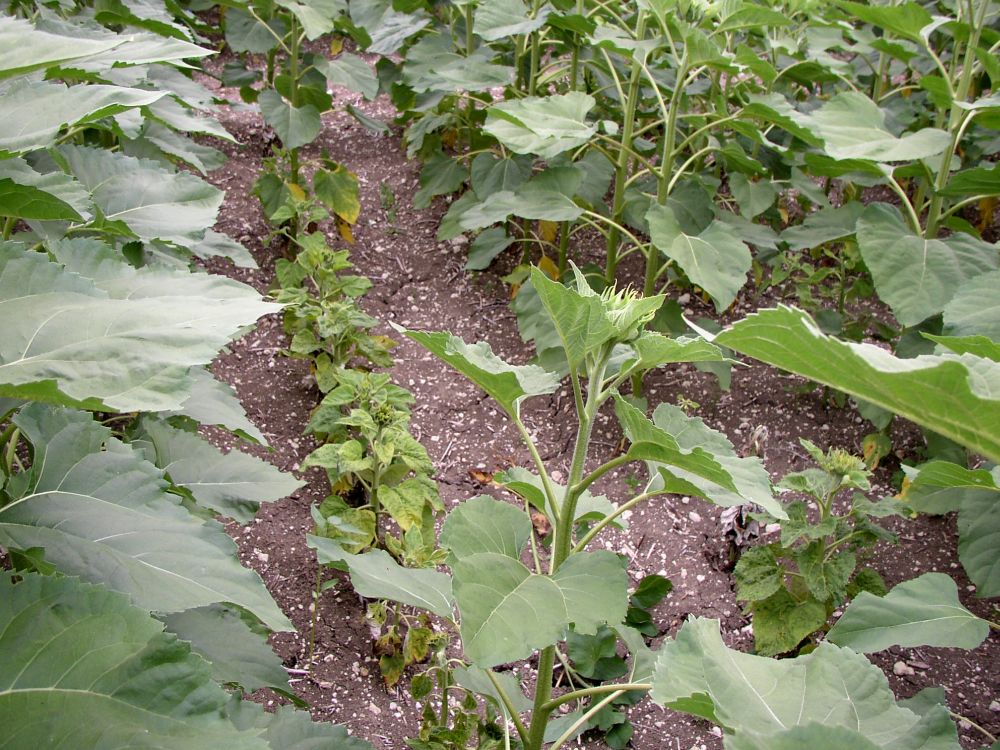
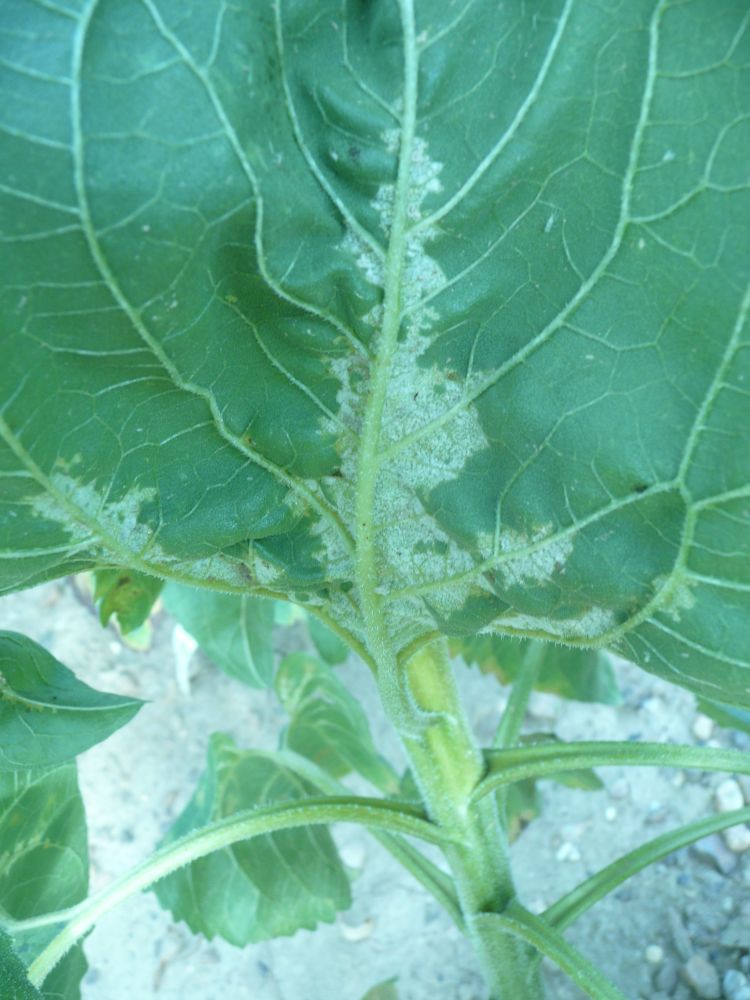
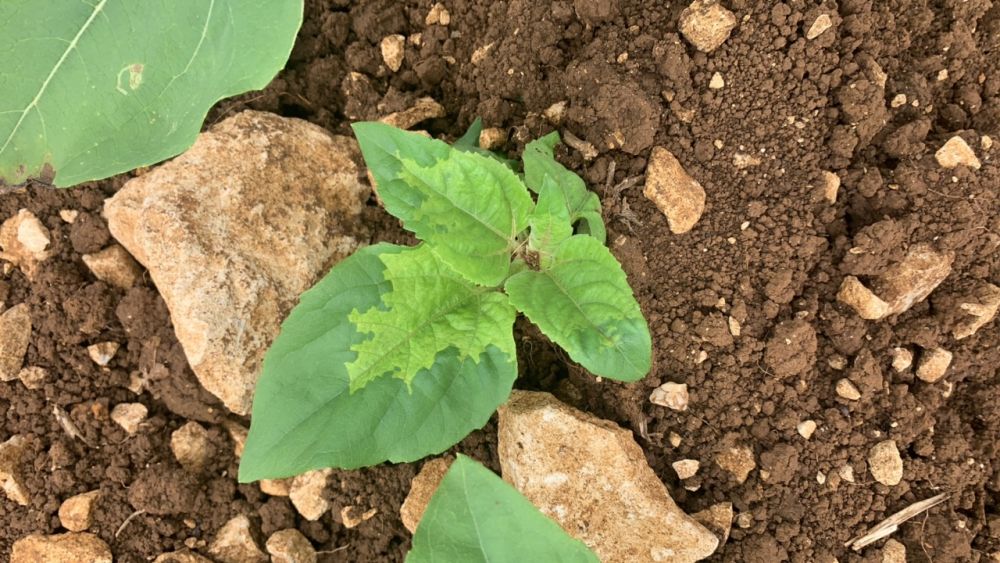
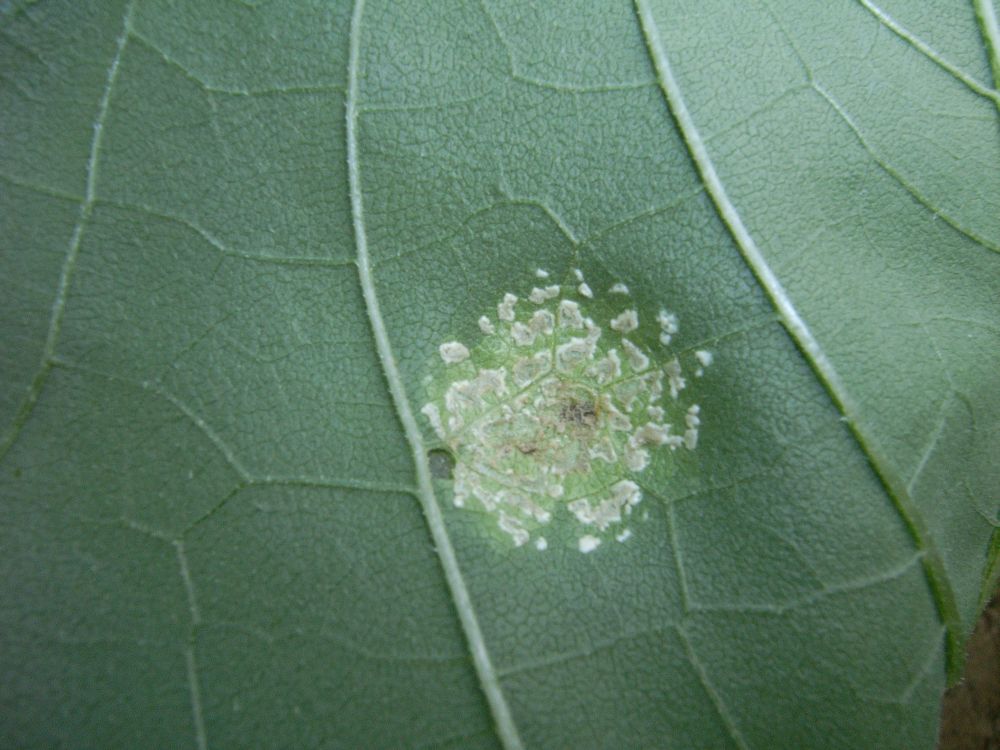
En début de cycle, les plantules contaminées présentent un retard de croissance, elles apparaissent « rabougries », montrent des cotylédons jaunes. Des zones décolorées vert plus clair sont visibles sur les feuilles, dont la face inférieure est recouverte d’un feutrage blanc plus ou moins intense : ce feutrage correspond aux sporulations du mildiou, à partir desquelles pourront se déclarer des contaminations secondaires mais surtout « se fabriquer » l’inoculum pour les campagnes suivantes. Le mildiou va peu à peu coloniser tous les tissus de la plante et « monter dans les étages » : on dit qu’il est systémique et son développement à l’intérieur de la plante entraîne un nanisme caractéristique : les entre-nœuds sont raccourcis.
Les symptômes courants lors d’une attaque sont :
- Nanisme de la plante
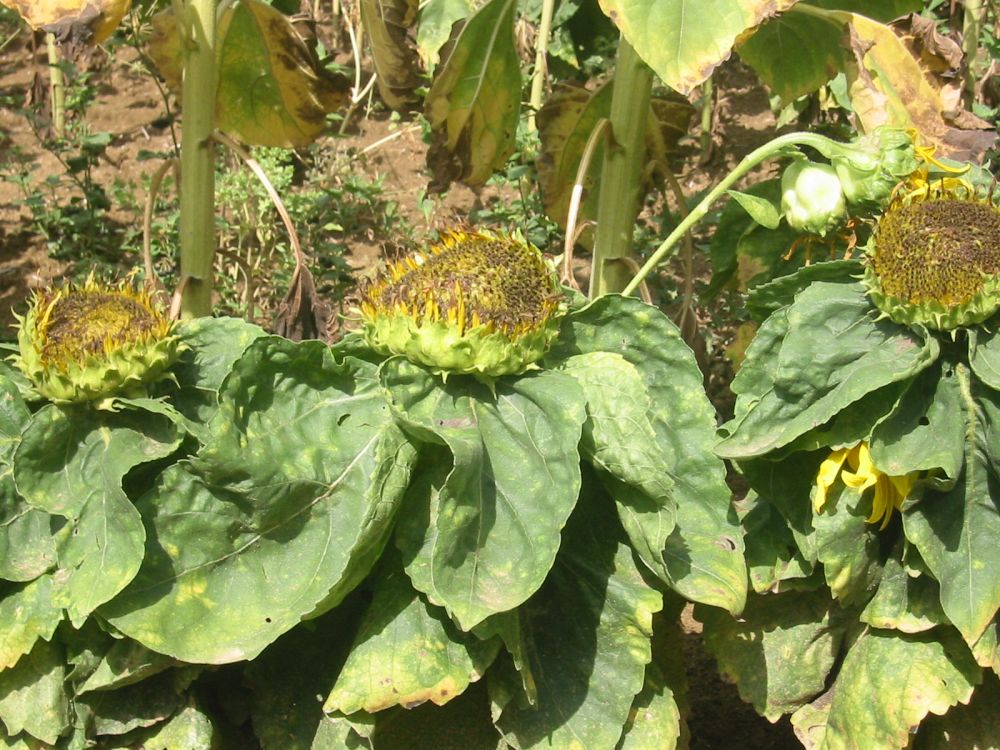
- Port à plat du capitule
- Symptômes en « ailes de fougère »
- Présence de chlorose sur les feuilles délimitées par les nervures
- Blanchiment des feuilles
- Sporulation blanche visible d’abord sur la face inférieure des feuilles
- Capitule stérile
Une visite en début de campagne permet de faire le point sur l’état de santé « mildiou » de la parcelle. Cette visite précoce présente le grand avantage de ne pas passer à côté des symptômes de mildiou, qui peuvent être plus difficiles à repérer lorsque le couvert se développe et les plantes grandissent. Souvent, un petit foyer de mildiou se déclare à l’entrée de parcelle, là où le passage du matériel agricole a créé des zones de tassement favorables à l’accumulation d’eau libre. N’hésitez pas à rentrer plus avant dans la parcelle afin de compléter votre diagnostic !
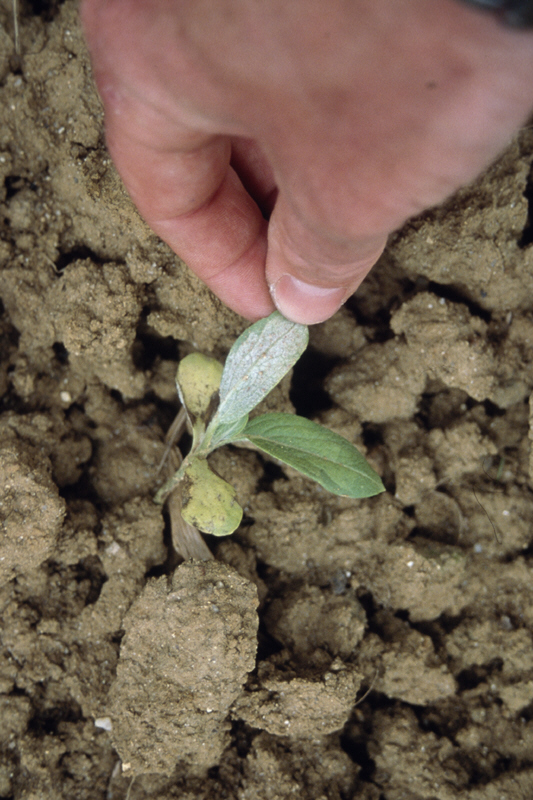
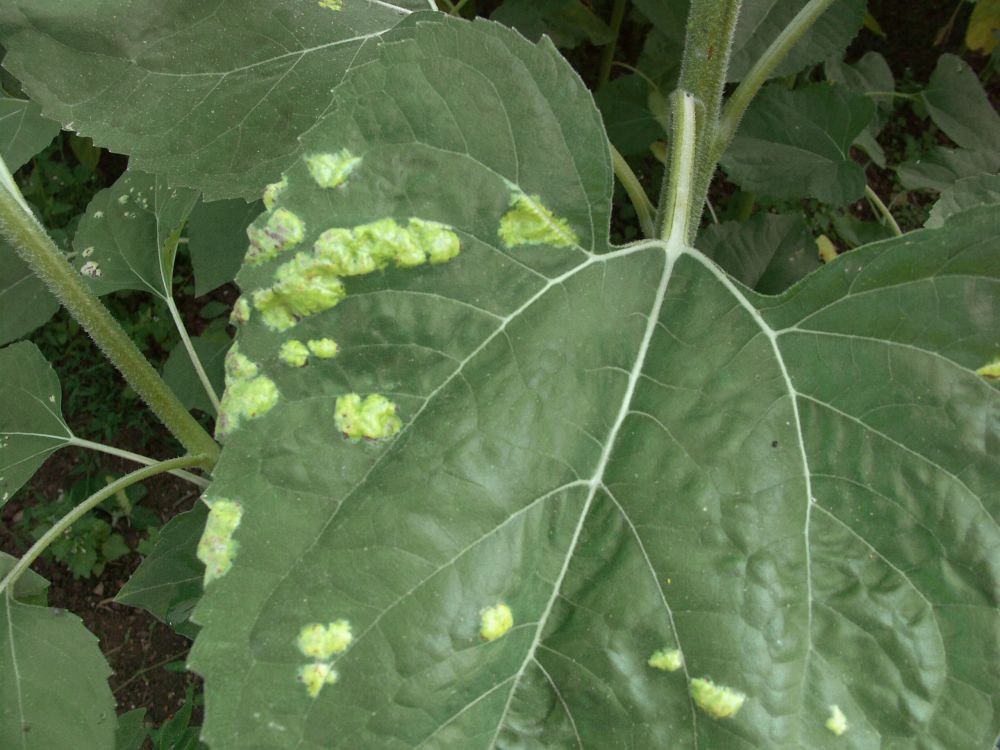
Attention, ne pas confondre mildiou et rouille blanche
Des attaques précoces de rouille blanche peuvent parfois se manifester : celles-ci n’occasionnent pas de nanisme. Des cloques de couleur vert clair se développent sur les feuilles. Sur leur face inférieure, les sporulations du champignon forment des croûtes et non un feutrage homogène.
Cycle de vie
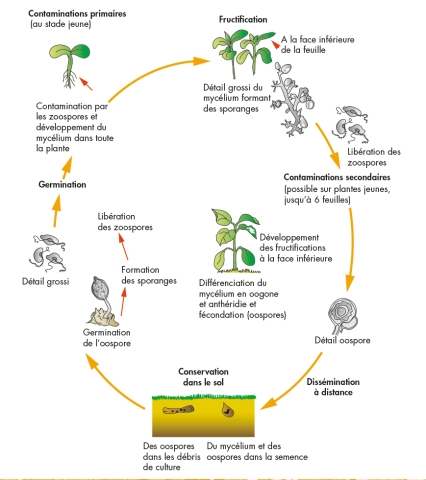
Bien que P. halstedii puisse être dispersé par le vent, l'eau et via les semences contaminées, il s'agit principalement d'un agent pathogène transmis par le sol. Au champ, les infections racinaires des jeunes plants de tournesol sont responsables des symptômes les plus graves et possèdent un fort impact sur le rendement.
Les zoospores de Plasmopara halstedii sont libérés soit à partir de sporanges oosporés (au printemps) soit à partir de sporanges asexués (du printemps à l'été) et peuvent infecter les jeunes plants de tournesol.
L’infection primaire se déroule au printemps et se passe sous forme souterraine via la germination d’oospores. Dans des conditions humides et fraîches, ces oospores vont entraîner la formation de zoosporanges, une structure de fructification produisant les zoospores. Ces zoospores sont biflagellées et vont aller infecter les racines de la plante. La contamination secondaire, contrairement à la primaire, se produit en phase aérienne. Les sporangiophores qui se trouvent sur les cotylédons ou sur la face inférieure des feuilles, vont entraîner la formation de sporanges qui seront disséminés par le vent, et produiront les zoospores responsables de l’infection secondaires. Cette étape est responsable des infections tardives des plantes voisines et contribue à la dissémination de l’agent pathogène.
Toute attaque même minime, contribue à alimenter le réservoir d’inoculum dans le sol.
Importance
Le mildiou est l’une des principales maladies affectant la production de tournesol. Cet agent pathogène a été observé pour la première fois en Amérique du Nord en 1888, puis en Russie et en Europe aux alentours de 1960. Cette introduction en Europe est probablement la conséquence d’une importation de graines contaminées. Depuis les années 1992 et jusqu’en 2019, ce pathogène a été soumis à un régime de quarantaine en Europe.
L’impact global de cette maladie sur le rendement a été estimé à 3,5% de la production de graine en Europe, avec l’utilisation des méthodes de contrôle couramment utilisées.
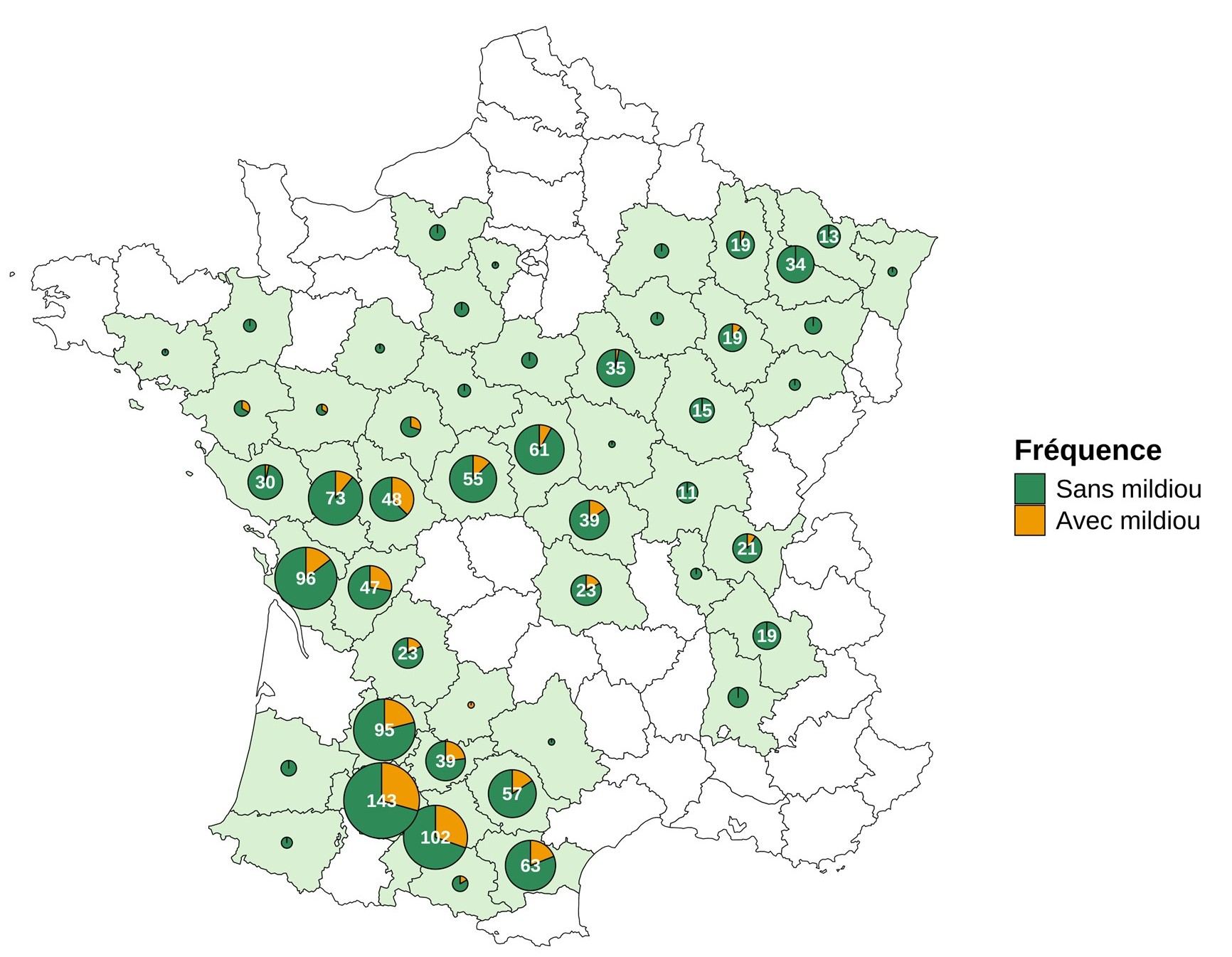
En général, les attaques de mildiou impactent peu le potentiel de production des parcelles de tournesol. Cependant, certains cas bien plus graves peuvent se manifester à l’occasion de conditions favorables (rotation, choix variétal, pluviométrie), plus le pourcentage de pieds nanifié dans la parcelle est important, plus la perte de rendement sera élevée. Dans le Sud-Ouest, les années 2019 et 2020 ont pu marquer les mémoires. En 2025, une situation inhabituelle a été constatée, des cas d’attaques sévères ont été observées dans le Nord-Est.
La nuisibilité des attaques primaires de mildiou est estimée à 1% de perte de rendement pour 1% de plantes nanifiées. Elle est donc significative en cas d’attaque généralisée ou par grands foyers mais quasi-nulle lorsque quelques pieds isolés sont touchés, ou qu’un petit foyer est présent à l’entrée de la parcelle.

La surveillance du territoire national a mis en évidence une pression mildiou en augmentation depuis 6 ans : entre 12 et 19% de parcelles touchées, avec une augmentation significative de la proportion des attaques graves à plus de 10% de pieds nanifiés.
Facteurs favorables
Le retour trop fréquent du tournesol favorise le développement de la maladie. En effet les parcelles les plus attaquées sont celles ou le tournesol revient un an sur deux dans la rotation.
Le mildiou se développant lors de conditions très humides et fraîche, semer dans un sol mal ressuyé, froid et lorsque de fortes pluies sont annoncées sont des conditions favorables au développement de l’infection.
Le mauvais désherbage des parcelles de tournesol de toutes les espèces pouvant héberger le mildiou et les repousses de tournesol, favorise le développement de la maladie.
La culture de plantes hôtes du mildiou en interculture, tel que le niger ou encore la sylphie, est un autre facteur favorable au développement de la maladie.
Diversité de l’agent pathogène
Les races de mildiou sont déterminées selon leur virulence vis-à-vis d’une gamme de lignées différentielles.
Tableau : lignées différentielles utilisées pour la détermination des races de mildiou en France. S : la race est virulente, R : la race est avirulente

Plasmopara halstedii est apparu en France pour la première fois en 1966 avec la race 100. Par la suite, la maladie fut éradiquée grâce à l’utilisation des résistances variétales. Néanmoins, la réapparition du mildiou en 1988 a tiré la sonnette d’alarme, et une surveillance annuelle a été mise en place en France en 1990. Cette surveillance nationale couvre l’ensemble des zones de production. En 1999, seulement deux races ont été détectées sur le territoire français, les races 703 et 710. Depuis le début des années 2000, les races dites « récentes » sont régulièrement détectées, il s’agit des race 304, 307, 314, 334, 704 et 714, en plus des races dites « anciennes », 100, 710 et 703 (CETIOM & INRAE, 2011). En France, depuis le début de la surveillance, environ 24 races ont été identifiées selon leur profil de virulence.
Graphique de l’évolution du nombre de races de mildiou du tournesol en France de 2000 à 2024.

Les races de mildiou en France sont en constante évolution. Au début des années 2000 et jusqu’en 2010, les anciennes races de mildiou 703 et 710 représentaient la majorité de la fréquence des races retrouvées en France, avec une fréquence de la race 710 souvent aux alentours des 70%. Par la suite, c’est la race 714, apparue pour la première fois en 2002, qui a dominé le paysage. En effet, contrairement aux races 703 et 710, la race 714 est virulente contre le gène de résistance Pl6. L’utilisation de plus en plus répandue de ce gène dans les variétés cultivées a entraîné une augmentation de fréquence de cette race dans le paysage.
La race 704 a également été retrouvée en fréquence élevée parallèlement à la race 714. Mais depuis les années 2019, de nouvelles races de mildiou sont apparues et dominent à présent le paysage, il s’agit des races 774#, 704# et plus particulièrement la race 714#. Ces races sont capables d’infecter les variétés comportant le gène de résistance Pl8 (#). Ce gène a été introduit à une fréquence significative depuis quelques années ce qui a entraîné l’apparition de races virulentes correspondantes.
Leviers de lutte
La gestion durable du mildiou passe par une protection intégrée où tous les leviers de lutte doivent être raisonnés à la parcelle, dans la rotation, et pour le long terme.
Pratiques agronomiques
La lutte contre le mildiou passe par des mesures agronomiques simples mais efficaces qui permettent de réduire le risque :
- Allonger les rotations de tournesol.
- Semer dans un sol bien ressuyé et réchauffé sans annonces de fortes pluies les jours suivant le semis.
- Détruire des parcelles cultivées en tournesol toutes les espèces pouvant héberger le mildiou.
- Eviter les plantes hôte en interculture.
Résistances variétales
Ces bonnes pratiques agronomiques peuvent se combiner au choix variétal pour favoriser la diminution du risque d’apparition de la maladie.
La résistance des variétés au mildiou est définie par leur profil RM. Il existe des variétés dites RM9, c’est-à-dire qu’elles sont résistantes aux 9 races officielles de mildiou : 100, 304, 307, 314, 334, 703, 704, 710 et 714, RM8, résistantes à 8 des 9 races (sensible à la race 334). Depuis quelques années, des profils de résistance #, RM8# et RM9#, sont apparus sur le marché, ces variétés sont résistantes à la race 714#, en plus des autres, race la plus communément retrouvée lors d’attaque de variétés RM9.

A ce jour il existe 88 variétés résistantes à la race majoritaire de mildiou (RM9#) en France, leur utilisation permet de lutter contre la maladie. L’alternance des variétés permet de changer, au fil des campagnes, les gènes de résistances auxquels on expose le mildiou dans la parcelle, et donc de réduire le contournement de ces résistances. En effet, cultiver des variétés possédant un même gène de résistance au fil des campagnes entraine une forte pression de sélection sur le mildiou, vis-à-vis de ce gène, ce qui favorise les cas de contournements.
Traitement de semence
Le recours au traitement de semence est possible mais non obligatoire. Son utilisation est à raisonnée en fonction de l’historique mildiou de la parcelle ainsi que de la variété utilisée. A ce jour, il existe deux spécialités à base d’oxathiapriproline (LUMISENA et PLENARIS), disponibles comme traitement de semence mildiou.
LUMISENA (n°2200078) de la société CORTEVA et PLENARIS (n°2200736) de la société SYNGENTA sont deux traitements de semences à base d’oxathiapiproline à 200 g/l en formulation FS.
Cette substance active connue notamment en vigne (ZORVEC) pour sa bonne action contre le mildiou de la vigne est un inhibiteur de la protéine de liaison à l’oxystérol. Elle intervient dans l’équilibre, le transport et le stockage des lipides de la cellule du champignon. L’oxathiapiproline est classé dans le groupe 49 du FRAC (Fongicide Résistance Action Committee) qui juge le risque de résistance comme moyen à élevé. C’est en effet un fongicide à mode d’action unisite. Il est déconseillé de l’employer seul. C’est un point commun à toutes les luttes durables : associer deux modes d’action efficace, que ce soit en mildiou vigne, fongicides céréales ou colza ou mildiou du tournesol.
Si disponible, Terres Inovia conseil d’associer l’oxathiapiproline à un autre anti-mildiou efficace afin de limiter la pression de sélection.
Attention, l’utilisation de semences traitées doit être réfléchi au cas par cas et ne doit pas être systématique, afin de ne pas favoriser l’apparition de résistances chez le mildiou
Le raisonnement pour la lutte contre le mildiou doit être tenu à la parcelle car il dépend de l’historique de chacune :
- la parcelle a-t-elle subi des attaques de mildiou sur les 5 dernières campagnes ?
- quelles variétés (génétique, profil RM) y ont été cultivées ?
- avec quel(s) traitement(s) de semences anti-mildiou ?
C’est sur ces questions que se base notre position technique.
Position technique mildiou Terres Inovia 2026
L’évolution constante des races de mildiou impose une adaptation régulière des stratégies de lutte et des choix variétaux. Les observations réalisées sur le territoire national montrent que, dans la majorité des cas analysés d’attaques de mildiou sur variétés de type RM9, l’isolat en cause correspond à la race 714Pl8. C’est pourquoi il est aujourd’hui recommandé de privilégier les variétés dites RM8/9#, résistantes à cet isolat 714Pl8, dans le cas d’attaque précédente sur variété RM9.
Il convient toutefois de rappeler que les populations de Plasmopara halstedii sont en constante évolution. Aucune stratégie de lutte ne peut être considérée comme totalement durable ou absolue. Les recommandations doivent être régulièrement réévaluées en fonction des observations de terrain.
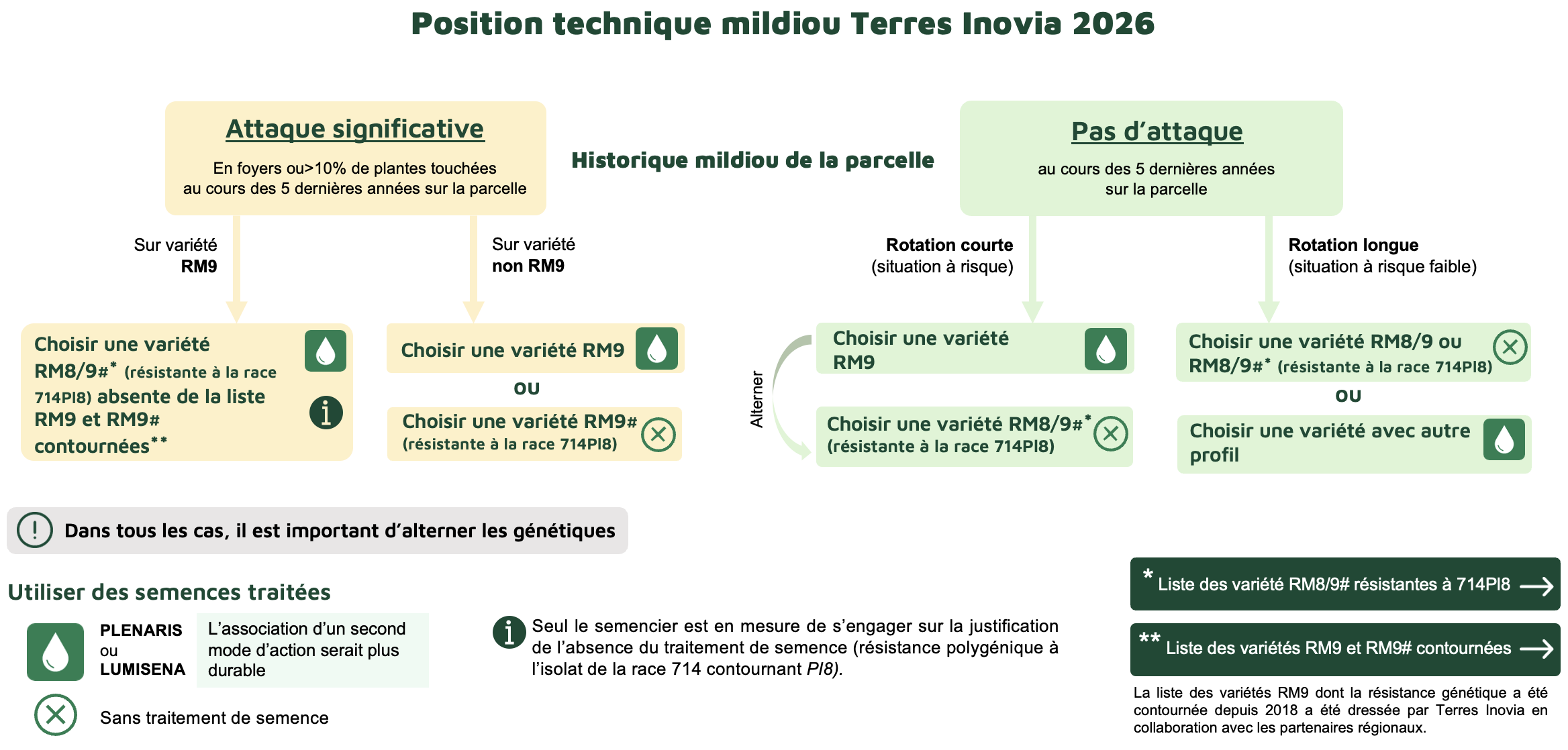
Même dans le cas de l’utilisation d’une variété résistante et d’un traitement de semence, le risque mildiou existe toujours. N’oublions jamais deux choses :
- le traitement de semences peut être lessivé en cas de grosses pluies
- et le mildiou possède une capacité d’adaptation extraordinaire face aux molécules fongicides et aux gènes de résistance des variétés.
Ces moyens de lutte doivent donc être bien utilisés afin de les faire durer :
- utiliser les bonnes pratiques agronomiques
- varier les profils RM des variétés
- utiliser raisonnablement le traitement de semence
Pour plus d’informations sur la fréquence et l’intensité du mildiou en France, retrouvez notre note commune mildiou publiée chaque fin d’année sur le site de Terres Inovia.
En savoir plus sur le mildiou du tournesol

Nos autres articles
The 2026 growing guide for sunflowers is now available
Terres Inovia has updated its sunflower growing guide. This comprehensive guide, updated with the institute's new visual identity, will accompany growers and advisors step-by-step through the coming campaign. As in previous years, it can be downloaded free of charge from the Terres Inovia website, or ordered in printed form.
Terres Inovia a mis à jour son guide de culture consacré au tournesol. Ce support complet, actualisé avec la nouvelle identité visuelle de l’institut, accompagnera pas-à-pas les producteurs et les conseillers lors de la prochaine campagne. Comme chaque année, il est téléchargeable gratuitement sur le site internet de Terres Inovia et peut également être commandé en version imprimée.
Économe en intrants et bénéficiant d’un progrès génétique continu, le tournesol est une culture durable et compétitive, pourvoyeuse de bénéfices pour les systèmes de culture dans lesquels il est inclus. Tête de rotation à cycle court, doté d’une bonne capacité de tolérance au stress hydrique, il s’adapte à de nombreux contextes de production.
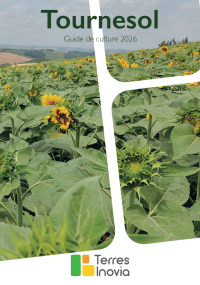
Le guide de culture tournesol de Terres Inovia permet de tout savoir sur l’itinéraire technique du tournesol : choix variétal, implantation, stratégie de lutte contre les bioagresseurs, conservation des graines, etc.
Dans cette édition 2026, Terres Inovia a actualisé l’ensemble de ses conseils et positions techniques, à l’instar des recommandations pour lutter contre le mildiou, les caractéristiques réglementaires des solutions préconisées, ou encore la liste des variétés évaluées dans le réseau Terres Inovia. Quant aux références économiques présentées, elles sont en phase avec les éléments de contexte actuel.
Le guide en version imprimée est également gratuit, seule une participation aux frais de port est demandée. Le guide de culture tournesol 2026 sera livré à partir du 23 février 2026.

Nos autres actualités
North & East zone - Sunflower crop report 2025
Myco-Risk
DGAL for €268,559 and the remainder from own funds
377 721 €
36 months Non NationalLes enjeux
L’organisation des dispositifs d’épidemio-surveillance permet de diffuser les Bulletins de Santé du Végétal (BSV) à l’ensemble des agriculteurs et prescripteurs. Pour analyser des risques liés aux bioagresseurs, les rédacteurs des BSV requièrent des références sur les périodes et seuils de risque vis-à-vis des bioagresseurs à enjeu majeur. Or, le mycosphaerella est une maladie qui prend une ampleur de plus en plus importante dans la culture du colza en France. Le manque de connaissances sur la biologie, la nuisibilité, les facteurs à risques et les moyens prophylactiques limite les capacités des techniciens et conseillers à analyser les risques et à proposer des recommandations raisonnées.
Les objectifs
Le projet Myco-Risk se propose d’apporter des éléments pour aider à analyser les risques et proposer des recommandations de lutte intégrée vis-à-vis du Mycosphaerella du colza. Résolument destiné à un usage opérationnel, ce projet s’articule autour de 3 objectifs :
- Acquérir des données permettant de mieux cerner l’influence des facteurs climatiques, agronomiques et environnementaux sur le Mycosphaerella.
- Evaluer la nuisibilité de Mycosphaerella sur colza, en particulier au regard des dates d’arrivée et de l’intensité des symptômes visibles en définissant une période de surveillance, de sensibilité et si possible des seuils indicatifs de risque. Des perspectives concernant de nouvelles stratégies de lutte contre le Mycosphaerella devraient découler des enseignements de cet axe de travail.
- Elaborer et diffuser une grille d’estimation a priori du risque, établie à partir des connaissances précédemment acquises.
Les résultats attendus
- Proposer des évolutions, si possible, du protocole harmonisé national de suivi BSV du colza.
- Répondre aux besoins des rédacteurs de BSV et conseillers agricoles : documents support de méthodes de reconnaissance, de suivi de la maladie, de prise en compte des paramètres importants pour l’analyse de risque…
- Fournir des éléments de recommandations propres à la protection intégrée : mesures prophylactiques, raisonnement de la lutte directe selon le contexte, etc.
Le rôle de Terres Inovia

Porteur de projet
Terres Inovia est le seul porteur de ce projet. Il a donc la charge de la totalité du projet et est responsable de son bon déroulement. Les expériences portant sur la nuisibilité sont réalisées à l’aide de prestataires mais aussi en interne avec l’expertise de la DRT. Concernant la partie sur la compréhension de la biologie de la maladie, celle-ci est mise en place dans les essais portant sur la nuisibilité avec notamment le suivis de l’expression des symptômes en lien avec la dissémination des spores et les conditions climatiques. La partie portant sur l’évaluation variétales vis-à-vis du Mycosphaerella est réalisée au sein des essais variétés de Terres Inovia chaque qui sont mis en place chaque année, en conditions de contamination naturelle.
Do you have a question?
Contact our specialist who will respond promptly to your request.
These projects may be of interest to you
Here are some other projects dealing with the same themes.
Phosmet exit plan
Alternative operational strategies to phosmet withdrawal to reduce attacks and nuisance caused by autumn rapeseed pests.
Opening Occitanie
- Supporting the agro-ecological transition of 30 farms in Occitania
-
Rapeseed
Pois d'hiver
Tournesol
Pois de printemps
Soja
Féverole d'hiver
Féverole de printemps
Lentille
Pois chiche
Lin d'hiver
Lin de printemps
Lupin d'hiver
Lupin de printemps
Cameline
Chanvre
Ravageurs
Fertilité et gestion durable des sols
CONCERTO
Concerted agro-ecological management of insect pests in field crops
-
Rapeseed
Tournesol
Pois d'hiver
Pois de printemps
Soja
Féverole d'hiver
Féverole de printemps
Lentille
Pois chiche
Lin d'hiver
Lin de printemps
Lupin d'hiver
Lupin de printemps
Cameline
Chanvre
Job opportunities
M2ProLIV
Towards multi-functional protein ingredients obtained by moderate processing of lipid-rich plant co-products with health benefits
Cécilia Fontyn - c.fontyn@terresinovia.fr
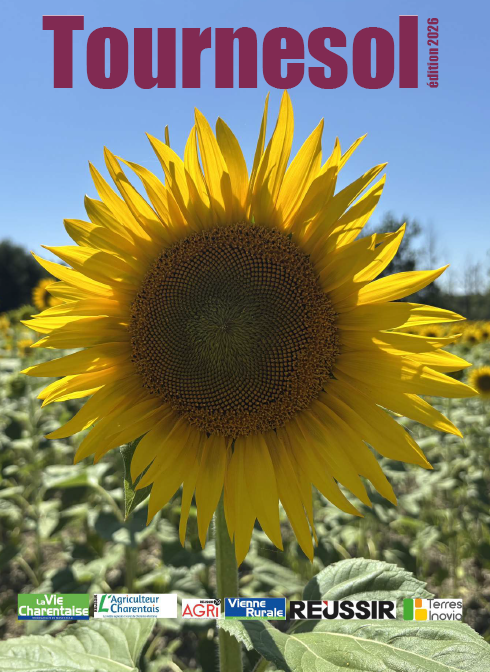
01/01/2025 Eclairer les décisions stratégiques Terres Inovia En cours NonSpécial Tournesol 2026: Tertes Inovia renews its partnership with the Réussir group
Once again, the technical institute has contributed to the preparation of a publication dedicated to sunflower cultivation, published by the Réussir group.
Une nouvelle fois, l'institut technique a contribué à l'élaboration d'un support édité par le groupe Réussir et dédié à la culture du tournesol.
Dans ce nouveau numéro du Spécial Tournesol 2026, plusieurs articles ont été rédigés par les experts de Terres Inovia.
- Une année 2025 chaude, sèche et... peu productive, par Elodie TOURTON.
- Phosphore, potasse : les apports sont-ils bien valorisés ? par Emile LEREBOUR
- Quel intérêt de la fertilisation azotée ? par Emile LEREBOUR
- Évaluer le risque taupin et noctuelle terricole pour adapter la lutte, par Laurent RUCK
- Un verticillium qui gagne du terrain dans l'ouest et le centre de la France, par Cécilia FONTYN
- Dégâts d'oiseaux à la levée : comment diminuer les risques ? par Christophe SAUSSE
- Caractéristiques des variétés de tournesol selon leur type et leur précocité, par Céline MOTARD
Consultez le Spécial Tournesol 2026 : ici.
Emile LEREBOUR - e.lerebour@terresinovia.fr
Laurent RUCK - l.ruck@terresinovia.fr
Cécilia FONTYN - c.fontyn@terresinovia.fr
Christophe SAUSSE - c.sausse@terresinovia.fr
Céline MOTARD - c.motard@terresinovia.fr
Terres Inovia at CIMA 2025: strong mobilization against plant diseases
Des thématiques clés

Terres Inovia note 2026 on downy mildew in sunflowers
Downy mildew is a telluric organism that can survive as oospores for more than 10 years in the soil, even without sunflowers.
Rappels sur la maladie
Le mildiou est un organisme tellurique qui peut survivre sous forme d’oospores plus de 10 ans dans le sol1, même sans tournesol.
L’absence d’attaque en culture ne signifie donc pas qu’il n’y a pas de mildiou dans la parcelle !
Les spores de mildiou ont besoin d’eau libre dans le sol pour germer et infecter les plantules de tournesol. Des conditions climatiques pluvieuses dans la période suivant le semis sont donc des plus favorables aux contaminations primaires racinaires du mildiou.
Le mildiou est également connu pour sa grande capacité d’évolution. Ainsi, aucune variété, même résistante à toutes les races, n’apporte pas de solution définitive et infaillible contre le mildiou. Les solutions de traitement de semences peuvent elles aussi perdre en efficacité si elles sont mal utilisées. La protection contre cette maladie passe par un raisonnement à la parcelle et sur le long terme, tenant compte de l’historique de la parcelle (attaques, variétés et traitement de semences utilisés). Les maîtres-mots : allongement de la rotation et alternance !
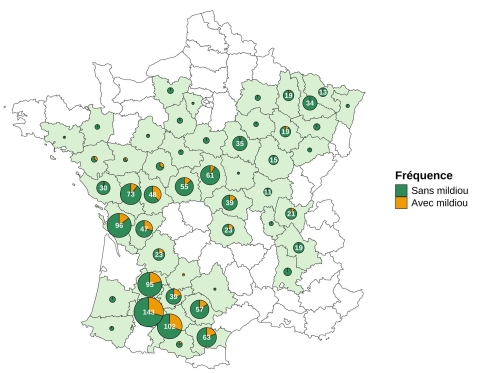
Fréquence mildiou par département : résultats de l'enquête 2025
La pression mildiou de la campagne 2025 est en augmentation par rapport à l’année précédente. Parmi les 1280 parcelles observées par les acteurs du dispositif interprofessionnel de surveillance (Terres Inovia, acteurs du BSV Poitou-Charentes, semenciers), 16,9% des parcelles ont été touchées par le mildiou contre 12,2% en 2024.
Comme en 2023 et 2024, les attaques ont de nouveau été d’une grande sévérité (comparées aux 20 dernières années), avec plus de 15% des parcelles touchées présentant plus de 10% de pieds nanifiés, et 5,1% à plus de 30% de pieds nanifiés. La gravité des attaques de mildiou est en légère baisse par rapport à 2024, mais la fréquence de parcelles avec mildiou est en augmentation ce qui favorise la multiplication de l’inoculum pour les années suivantes.

Situation particulière en 2025 : des attaques significatives de mildiou ont été observées dans le nord-est de la France (hors enquête kilométrique), en Meurthe-et-Moselle, Haute-Marne et Meuse. Les conditions météo de l’année ont pu être très favorables au mildiou, qui passait jusque-là inaperçu. Cette région n’était pas connue pour subir des attaques de mildiou, ce qui montre que même en absence de symptômes les années précédentes, des épisodes de mildiou peuvent tout le même survenir. Cela renforce la nécessité de rester vigilant face à cette maladie.
Position technique 2026 de Terres Inovia
Le schéma ci-dessous explique comment combiner au mieux les moyens de lutte pour bien gérer la situation en fonction de l’historique des parcelles. L’évolution constante des races de mildiou impose une adaptation régulière des stratégies de lutte et des choix variétaux. Les observations réalisées sur le territoire national montrent que, dans la majorité des cas analysés d’attaques de mildiou sur variétés de type RM9, l’isolat en cause correspond à la race 714# (contournant Pl8) C’est pourquoi il est aujourd’hui recommandé de privilégier les variétés dites RM8/9#, résistantes à cet isolat 714Pl8, dans le cas d’attaque précédente sur variété RM9.
Il convient toutefois de rappeler que les populations de Plasmopara halstedii sont en constante évolution. Aucune stratégie de lutte ne peut être considérée comme totalement durable ou absolue. Les recommandations doivent être régulièrement réévaluées en fonction des observations de terrain.
Input assessment
Our services
- Design, monitoring and appraisal of TI station trials
- Management of TI-labeled thematic experimentation networks
- Conduct of EOR trials
- Market assessment and expertise
Terres Inovia's advantages
- Expertise on systems including oleopro
- Acquisition of accredited reference data,
- 9 experimental stations covering the whole of France
- Management of thematic networks
These services may be of interest to you
Building a localized supply chain
Terres Inovia can help you build a new, regionalized industry.From strategy to field…Oilseed impurities
Method used: in-house methodOilseed impurities ISO
Method used: NF EN ISO 658Water content ISO oilseeds
Method used: NF EN ISO 665Would you like a quote?
Would you like to know more about this service or receive a quote? Send us your request!
Mastering camelina cultivation
Our other training courses
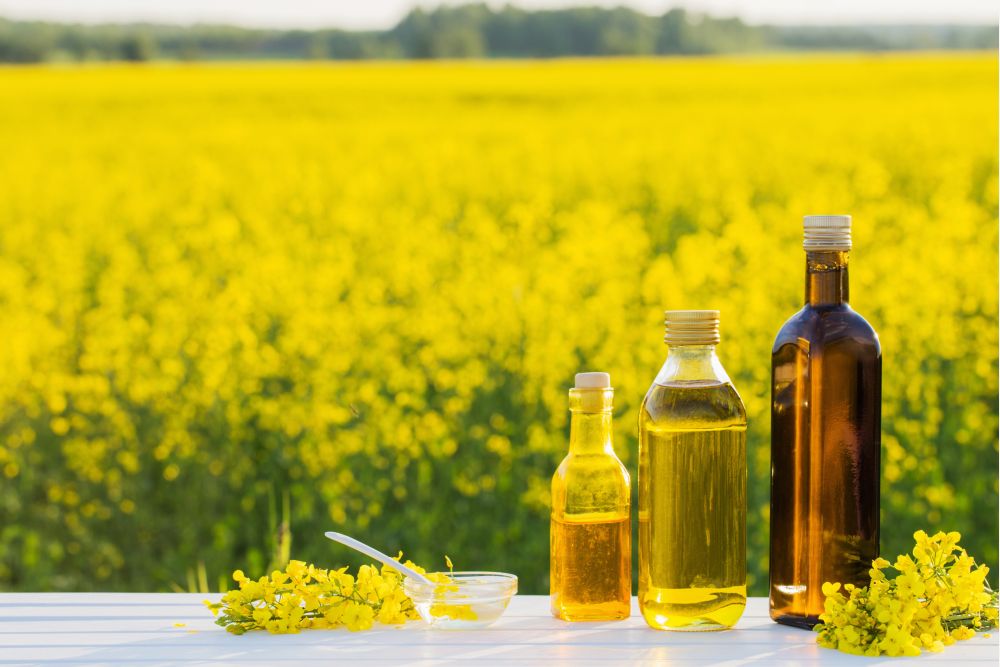
Short-circuit production of edible oil
Sur devis
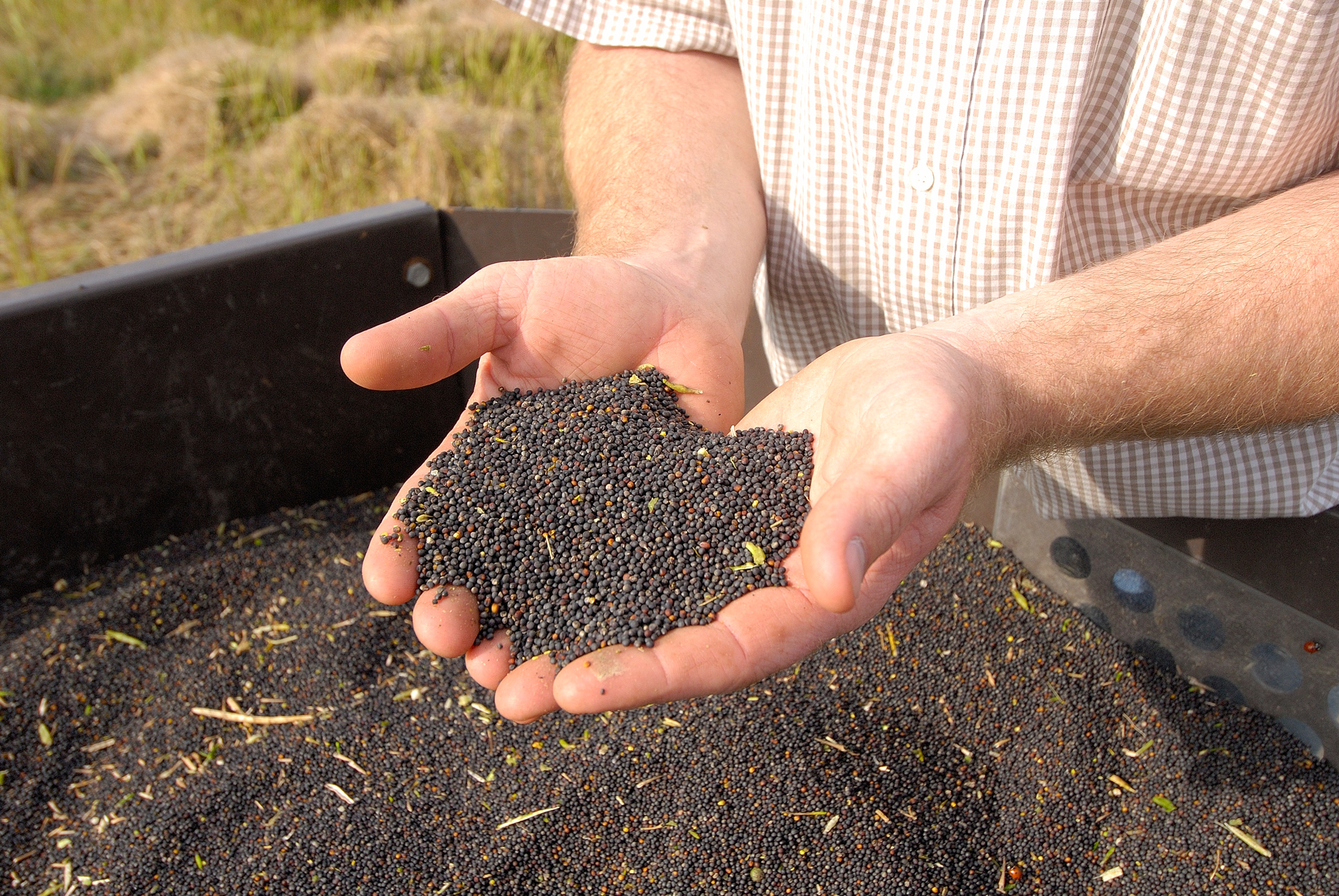
Optimization of crushing and mechanical extraction of oil-protein seeds
Sur devis
Camelina: transforming a diversification crop into a technical and economic opportunity.
Boosted by a rapidly expanding market, camelina requires precise control of its cultivation itinerary if it is to achieve its full potential. This training course offers a complete technical and economic approach to successfully integrating camelina into cropping systems.
The program includes
1. camelina: basics and challenges
- Origin, development cycle and agronomic characteristics
- Crop strengths and positioning in cropping systems
2. market opportunities and value-adding framework
- Main outlets: sustainable fuels, food and feed, cosmetics, industrial uses
- Regulatory context
3.camelina technical itineraries
- Conditions for success and choice of plot
- Planting and varietal selection
- Fertilization and weed management
- Pest and disease management
- Adapting the itinerary to the type of crop: main crop, summer or winter catch crop, intercropping
4 Harvesting and securing production
- Key harvesting principles and settings
- Mowing and raking
5.camelina in organic farming
- Agronomic benefits
- Technical specificities and outlets
6.economic performance
- Comparison of margins according to technical itineraries
- Economic analysis at crop system level
7.field diagnosis
- Observation of plots and/or trials
- Collective analysis of situations encountered
At the end of the course, participants will be able to :
- Understand the agronomic, economic and regulatory issues involved in growing camelina.
- Identify the various outlets for camelina and their requirements
- Recommend key cultivation techniques for successful camelina production, whatever the cropping method (main crop, catch crop, combination, organic farming).
- Adapt camelina technical itineraries to soil and climate conditions and to production objectives.
Face-to-face format with a field component (depending on conditions and training period):
-
Theoretical classroom input: Presentation of the crop, its outlets and technical itineraries (main crop, catch crop, combination), illustrated by trial results and concrete case studies.
-
Field observation: Analysis of real-life situations in plots and observation of trials to carry out collective diagnoses and illustrate technical levers.
Active methods: Presentations, case studies, practical exchanges, questions and answers, applied diagnostics.
Assessment: Quiz to validate knowledge acquired, questions and answers throughout the course, self-assessment by participants, individual satisfaction survey.
Theoretical support: Presentations, lectures, regulatory texts and summary documents given to participants.
Case studies: Real-life situations based on experimental results and feedback from the field, analyzed collectively.
Practical exchanges: Sharing of experiences between participants and trainers to enrich technical analysis and diagnoses.
Technicians, agricultural advisors, farmers, agents of structures working with camelina for biofuel production Q&A, quiz, individual satisfaction survey, self-positioningIf you have any requests for adaptations to help you succeed in your course, please contact the Disability Advisor:
Christel CARO
Tel: 01 30 79 95 09
Mail: formation@terresinovia.fr
Aucun 0€ TTC https://public.dendreo.com/4rsx27tf4npws6tp4zAwc/media/h17x4yzwmvzfgytkjb6Aq7zA3flf2q6khf1xmsczn8qAw8jpnz5sw4brlfk2kAbynAvwgpj5h35tqtkdkrhg3rtsm7yAyrjA4rzs9vlhjr7g4pj8 1 Jour 102 Intra-entrepriseSuccessful pea and faba bean crops in the South-West
Our other training courses
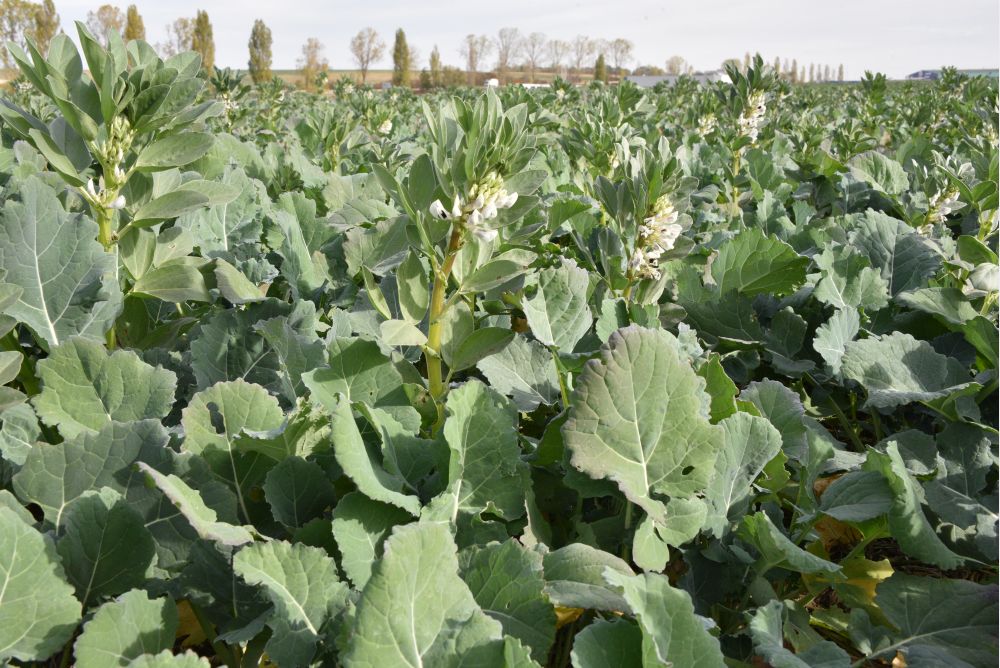
Dare to use cover crops in your cropping systems
Sur devis
Optimization of crushing and mechanical extraction of oil-protein seeds
Sur devis
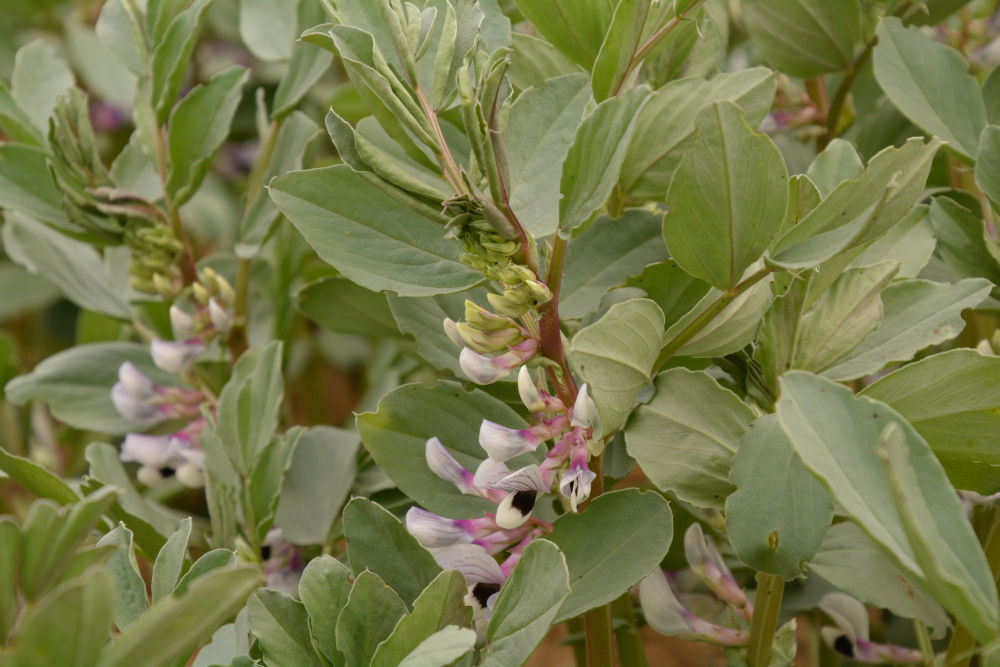
Diagnosing and managing pea and faba bean diseases
Sur devis
Peas and faba beans: make the most of their potential in South-West systems
Crops with high agronomic and economic value, peas and field beans play a key role in rotations in the South-West. Adapted to the region's varied soils and climatic constraints, they can be used to diversify crop rotations while reducing inputs. To get the best out of them, careful management is essential: choice of plot, varieties, technical itinerary... This training course will guide you step-by-step in securing and optimizing these crops in your local context.
Program:
1. understanding how crops work in the South-West of France
- Pea and faba bean physiology: key stages, environmental requirements
- Agronomic, environmental and economic advantages in the regional context
2. crop management adapted to local conditions and associated decision rules
- Varietal selection adapted to the South-West climate
- Planting and sowing density according to regional soil types
- Phytosanitary protection: specific issues (Aphanomyces, Sclerotinia, aphids, etc.)
3 Diagnosis and management of hazards
- Identification of the main crop accidents observed in the region
4.value-adding and outlets
- Specific regional outlets (human food, export, local animal sectors)
- Storage and sorting strategies adapted to South-West markets
5.performance and sustainability
- Technical and economic analysis of itineraries in a local context
- Input reduction, nitrogen savings and benefits for the following crop
Training organized in collaboration with FILEG (free for their members)
At the end of the course, participants will be able to :
- Identify the key success factors for pea and faba bean cultivation in the pedoclimatic context of the South-West,
- Choose and adapt technical itineraries according to soil, climate and local sanitary pressures,
- Diagnose the main crop failures in regional conditions,
- Assess the economic and environmental performance of these crops in a localized context.
Theoretical input: technical and scientific presentations adapted to the pedoclimatic context of the South-West.
Case studies: analysis of real situations encountered by farmers in the region.
Feedback from field experience: sharing of practices and solutions tried and tested by participants and trainer.
Interactive exchanges: time for questions, discussions and sharing between professionals.
Plot visit or field diagnosis (depending on the season): practical application of knowledge in the field.
Evaluation: quiz, questions and answers and individual satisfaction survey to measure skills acquisition.
The course is led by Quentin LAMBERT, a regional expert, guaranteeing local roots and a precise response to the specific challenges of the area.
Teaching aids: technical and summary documents given to participants (memo sheets, illustrated presentations, practical guides).
Visual illustrations: diagrams, photos and concrete examples to facilitate understanding of technical itineraries and diagnostics.
Case studies: analysis of real-life situations, diagnosis of crop accidents, and technico-economic performance studies.
Plot visits (where possible): direct observation of crops, soils and cultivation practices in real-life conditions.
Agricultural technicians and advisors, Farmers and producers, Agricultural teachers and trainers, Agronomic and technical sales managers in agricultural distribution, Agri-food / processing industry players Quizzes, Q&As and individual satisfaction surveys to measure skills acquisitionIf you have any requests for adaptations to help you succeed in your course, please contact the disability referent:
Christel CARO
Tel: 01 30 79 95 09
Mail: formation@terresinovia.fr
Aucun 480€ TTC 5 15 https://public.dendreo.com/4rsx27tf4npws6tp4zAwc/media/38gvc6snjf8gw8lhmz6Acwbxnbrfcn5zmrvg4Ady4v3227brmvdhss5fnr3tmnry4vjd1pj5h35AAs5p4fm24wkplf7tm5t4l16A7mtfkbfw4pj8 1 Jour Quentin LAMBERT 95 Inter-company and intra-company