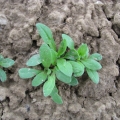
Weeding camelina
Camelina has good covering power, enabling it to compete effectively with weeds, provided planting is successful and emergence is uniform and sufficient.
General
Camelina has good covering power, enabling it to compete effectively with weeds, provided planting is successful and emergence is uniform and sufficient.
However, given the limited number of approved chemical solutions for weed control, both against grasses and broadleaf weeds, it is advisable to plant it in a clean, weed-free plot at the time of sowing.
It is also advisable to avoid situations of high weed pressure, particularly in the presence of resistant grasses or particularly invasive species such as mugwort(Ambrosia artemisiifolia).
Weed management for camelina in summer intercropping
Weed pressure
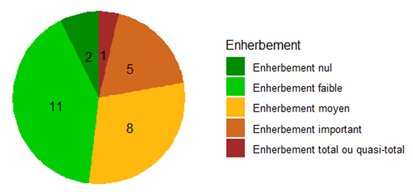
In 2024, agronomic monitoring was carried out on camelina plots planted as summer catch crops. The graph below shows significant to total weed cover on around a quarter of the areas observed. The main weed species observed were :
- Crop regrowth: barley and peas
- Annual broadleaf weeds: goosefoot, mercurial, bindweed, barnyard grass, ragwort, etc.
- Perennials: thistles
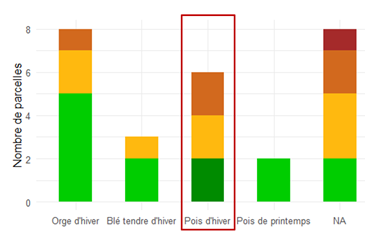
The graph below illustrates the level of weediness observed in camelina plots planted with summer cover crops, according to the type of previous crop. It shows that weed control is more complex after winter peas, notably due to the presence of pea regrowth and broadleaf weeds.
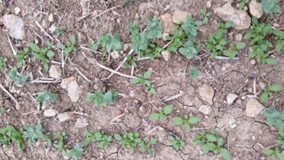
Weed pressure is one of the main limiting factors identified in the 2024 plot monitoring program, and weed management is therefore a key factor in ensuring crop success.
Weed management levers
First and foremost, it's important to choose a plot with a low risk of weed infestation, as control levers are limited during summer intercropping. To limit the risk of weed infestation, it's important to choose suitable crop successions, alternating spring and winter crops.
Beyond the choice of plot, it's important to sow camelina on clean soil. If weeds are present at harvest time, they can be managed by stubble ploughing, or with a total herbicide if camelina is direct-seeded.
Finally, there are a number of registered herbicides available for chemical weed control.
Below is a non-exhaustive list of authorized molecules (source: ephy-Anses and phytosanitary index):
| Active ingredients | Grammage | AMM dose | Product (*) | Positioning | Application stage |
| clethodim | 240 g/l | 0.5 l/ha | Centurion 240 EC | Post emergence | 2 f to 6-8 f |
| quizalofop-p-ethyl + clethodim | 70 g/l + 140 g/l | 0.8 l/ha | Vesuvius Max | Post emergence | 2 f to 6-8 f |
| clopyralid | 100 g/l | 1.25 l/ha | Lontrel 100 | Post emergence | 2 f to 6-8 f |
| metazachlore | 500 g/l | 1.5 l/ha | Rapsan 500 SC | Pre-emergence or early post-emergence | |
| quinmerac + metazachlor | 100 g/l + 400 g/l | 1.87 l/ha | Rapsan TDI | Pre-emergence | 00 à 08 |
Where winter cereals are grown before camelina, a herbicide treatment is essential in the event of heavy infestation of post-plant regrowth. To ensure optimum selectivity and maximum efficacy, the treatment should be carried out with a specific graminicide based on clethodim or quizalofop-P-ethyl, applied imperatively before the camelina resumes active growth (start of elongation).
Please note: the above table lists herbicides registered for use on camelina, and not herbicides whose selectivity towards camelina has been demonstrated. Suspicions of phytotoxicity exist for clopyralid- and metazachlor-based herbicides, and Terres Inovia is currently working on the selectivity of these herbicides to identify suitable herbicides.
If a herbicide is used in vegetation, whatever the product used, it must be applied before the start of stem elongation, in order to limit any risk of phytotoxicity.
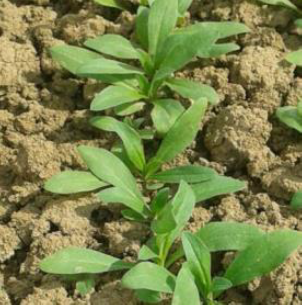
Mechanical weeding of summer catch crops is not relevant.
Weed management for camelina as a main crop
The choice of crop succession is an important lever in weed management: alternating winter and spring crops helps maintain low weed pressure on the plot.
As a main spring crop, camelina can be sown late due to its relatively short cycle length. This offers the opportunity to carry out several false sowings in spring, and reduce the weed population. Late sowing of camelina, which can be done as late as May, also makes it possible to avoid a large proportion of the spring weed flora, and create a real break in the rotation. The table below gives a non-exhaustive list of authorized control molecules (source: ephy-Anses and phytosanitary index).
| Active ingredients | Grammage | MA dose | Product (*) | Positioning | Application stage |
| clethodim | 240 g/l | 0.5 l/ha | Centurion 240 EC | Post emergence | 2 f to 6-8 f |
| quizalofop-p-ethyl + clethodim | 70 g/l + 140 g/l | 0.8 l/ha | Vesuvius Max | Post emergence | 2 f to 6-8 f |
| clopyralid | 100 g/l | 0.2 l/ha | Lontrel 100 | Post emergence | 2 f to 6-8 f |
| clomazone + dmta-p + metazachlore | 40g/l - 200 g/l- 200 g/l | 2.5 l | Polar | Pre-emergence | Stage 00 to 09 |
| dmta-p + quinmerac | 333 g/l = 167 g/l | 1.5 l/ha | Solanis | Post emergence | 2 f to 6-8 f |
| metazachlore | 500 g/l | 1.5 l/ha | Rapsan 500 SC | Pre-emergence or early post-emergence | |
| quinmerac + metazachlor | 100 g/l + 400 g/l | 1.87 l/ha | Rapsan TDI | Pre-emergence | 00 à 08 |
Please note: the table below lists herbicides registered for use on camelina, not herbicides with proven selectivity for camelina.
If a herbicide is used in vegetation, whatever the product used, it must be applied before the start of stem elongation, in order to limit any risk of phytotoxicity.
As far as mechanical weed control is concerned, only one blind pass of the currycomb harrow can be used on the main crop. In post-emergence, the use of this tool is not recommended due to the high risk of pulling out plants.

Training for camelina
Mastering camelina cultivation
Sur devis
Short-circuit production of edible oil
Sur devis
Optimization of crushing and mechanical extraction of oil-protein seeds
Sur devis
Camelina editions