
The 2026 growing guide for sunflowers is now available
Terres Inovia has updated its sunflower growing guide. This comprehensive guide, updated with the institute's new visual identity, will accompany growers and advisors step-by-step through the coming campaign. As in previous years, it can be downloaded free of charge from the Terres Inovia website, or ordered in printed form.
Terres Inovia a mis à jour son guide de culture consacré au tournesol. Ce support complet, actualisé avec la nouvelle identité visuelle de l’institut, accompagnera pas-à-pas les producteurs et les conseillers lors de la prochaine campagne. Comme chaque année, il est téléchargeable gratuitement sur le site internet de Terres Inovia et peut également être commandé en version imprimée.
Économe en intrants et bénéficiant d’un progrès génétique continu, le tournesol est une culture durable et compétitive, pourvoyeuse de bénéfices pour les systèmes de culture dans lesquels il est inclus. Tête de rotation à cycle court, doté d’une bonne capacité de tolérance au stress hydrique, il s’adapte à de nombreux contextes de production.
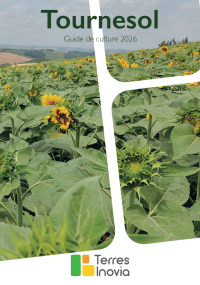
Le guide de culture tournesol de Terres Inovia permet de tout savoir sur l’itinéraire technique du tournesol : choix variétal, implantation, stratégie de lutte contre les bioagresseurs, conservation des graines, etc.
Dans cette édition 2026, Terres Inovia a actualisé l’ensemble de ses conseils et positions techniques, à l’instar des recommandations pour lutter contre le mildiou, les caractéristiques réglementaires des solutions préconisées, ou encore la liste des variétés évaluées dans le réseau Terres Inovia. Quant aux références économiques présentées, elles sont en phase avec les éléments de contexte actuel.
Le guide en version imprimée est également gratuit, seule une participation aux frais de port est demandée. Le guide de culture tournesol 2026 sera livré à partir du 23 février 2026.

Nos autres actualités

North & East zone - Sunflower crop report 2025
Combining weed control methods for spring peas and field beans
With spring pea and faba bean sowing approaching, it's time to plan your weed control strategy according to the flora known to be present in the plot.
Les semis des pois et féveroles de printemps approchant, il est temps de prévoir votre stratégie de désherbage en fonction de la flore connue sur la parcelle.
Une application en prélevée : une solution sécurisante
Dans les situations de fortes infestations en dicotylédones concurrentielles (gaillet, renouées, matricaire) ou difficiles à maîtriser uniquement en post-levée (éthuse, arroche, renouée des oiseaux), une stratégie « tout en prélevée » offre un choix de produits plus large pour sécuriser la culture, mais reste plus onéreux.
La prélevée doit s’effectuer au plus près du semis, sur des semences recouvertes de terre et un sol rappuyé, afin de limiter les risques de phytotoxicité. Excepté dans les sols battants, un roulage est conseillé afin de bien recouvrir la graine avant toute intervention.
Un sol frais au moment du traitement et une légère pluviométrie dans les jours qui suivent sont les conditions idéales pour une bonne efficacité. Dans le cas de relevées d’adventices ou d’efficacité insuffisante (sol sec), un rattrapage en post-levée est possible.
Pour rappel, la féverole possédant moins de solutions de rattrapage en post-levée que le pois, la prélevée est importante pour assurer une bonne maîtrise des adventices.
Une stratégie post-levée seule : Pression faible et flore connue
Dans le cas de parcelles à faible infestation et/ou de flore connue, le choix d’une intervention unique en post-levée peut être suffisant. Veiller à intervenir sur des adventices jeunes (stade cotylédon à 2-3 feuilles), dans des conditions poussantes et en dehors de fortes amplitudes thermiques.
Certains programmes peuvent se fractionner afin d'augmenter l'efficacité contre certaines adventices. Espacer alors les deux interventions de 10-15 jours minimum.
Un programme de prélevée et post-levée
Un programme complet (pré+post) permet de maîtriser de très fortes infestations ainsi que des levées échelonnées d’adventices tout en maîtrisant le coût de son désherbage. Les adventices les plus difficiles à contrôler orientent le choix du ou des produits appliqués en prélevée.
Pour maîtriser les coûts, appliquer le produit de prélevée à une dose inférieure à la dose homologuée (3/4 de celle-ci), puis appliquer en post-levée sur des adventices jeunes des produits à faible dose.
Pour rappel, les différents produits à base de pendiméthaline, imazamox et bentazone ne sont pas mélangeables. Leur application dans un même programme en post-levée doit se faire en 2 applications – se référer aux délais de rentrée des différentes spécialités pour recomposer l’association initialement visée.
Exemple de programmes pour la féverole de printemps
Exemples de programmes pour le pois de printemps
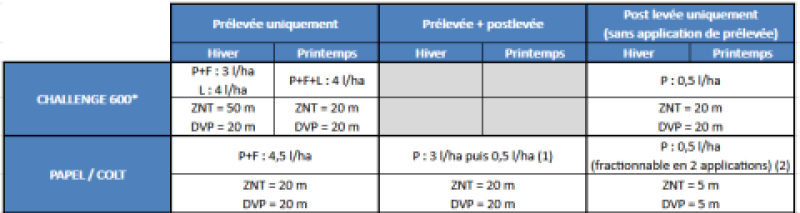
Rappel des règles d’utilisation de l’aclonifen (CHALLENGE 600 ou COLT/PAPEL) en pré et post-levée
*herbicide générique : CHANON, etc,..
P=pois
F=féverole
L=lupin
(1) : respecter un délai de 25 jours entre les 2 applications pour pois d'hiver, 15 jours pour pois de printemps
(2) : respecter un délai de 10 jours entre les 2 applications de postlevée
Gestion des graminées
Problématique montante dans les parcelles de protéagineux de printemps, la gestion des graminées constitue une difficulté majeure et ne doit pas être négligée. Les bases de pendiméthaline en prélevée telles que le NIRVANA S 3 l/ha et le PROWL 400 2l /ha présentent une efficacité modérée. Celle-ci peut être complétée par une association avec de l’aclonifen, Challenge 600 ou Colt à 2 l/ha.
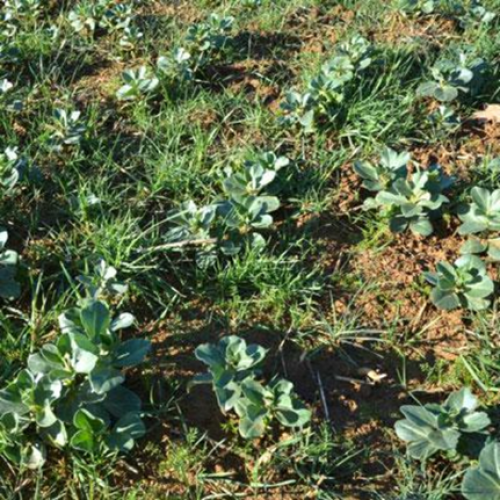
Les anti-graminées foliaires peuvent être mobilisés en rattrapage de post-levée. Leur efficacité est extrêmement variable selon les situations de résistances des ray-grass/vulpin aux Fop et Dime.
Spectres d’action des produits sur pois
Spectres d’action des produits sur féverole
Désherbage mécanique : une solution efficace en conditions sèches
Avec des printemps parfois secs, le désherbage mécanique peut apporter une aussi bonne efficacité que certains programmes chimiques. Également, les stratégies mixtes associant prélevée chimique et post-levée mécanique sont des solutions efficaces si la météo est favorable. Elles sont moins onéreuses et faciles à mettre en œuvre, d’autant plus pour la féverole qui présente peu de solutions chimiques de rattrapage et se prête mieux que le pois au binage et à des passages mécaniques tardifs. Pour rappel, les interventions mécaniques gagnent en efficacité si elles s’effectuent avec 2 journées de beau temps avant et après.
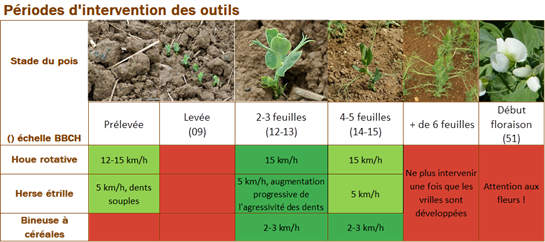
Pois de printemps : le désherbage en plein (herse étrille ou houe rotative) et la bineuse céréales sont possibles tant que les vrilles ne sont pas trop développées (4-5 feuilles max).
Avant la levée : un passage de herse étrille est possible, à l’aveugle, dès que la portance du sol est suffisante, sur des adventices jeunes et donc faciles à détruire.
A partir d’1 feuille : la houe rotative est la plus sélective sur les pois à ce stade. Elle est particulièrement adaptée aux sols limoneux. Son efficacité est liée au stade des adventices (fil blanc à 2 feuilles maximum).
A partir de 2-3 feuilles : effectuer un passage avec la herse étrille avant le stade 5 feuilles. Ne plus intervenir dès que les vrilles du pois sont développées ; les risques de pertes de plantes par arrachage sont élevés.
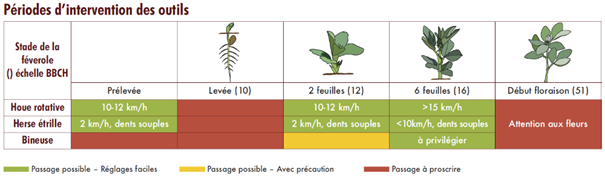
Féverole de printemps : les passages mécaniques peuvent s’opérer jusqu’à tard, en particulier pour la bineuse, tant que la hauteur du couvert le permet. Généralement, passé 6 feuilles, le risque de casse de tige augmente. Si ce stade est atteint, il faut donc bien raisonner les interventions. Aux stades antérieurs, la herse étrille peut présenter de bons résultats sur des adventices jeunes. La houe rotative ayant une efficacité moindre est à réserver plutôt aux sols limoneux qui valoriseront sa fonction d’écroûteuse. L’intérêt de la bineuse est de pouvoir intervenir sur des adventices plus développées.
Pour les féveroles semées à grand écartement (>45cm), la combinaison d’un herbicide localisé sur le rang avec un binage réalisé en différé quand les pédoclimatiques sont idéales présentera une très bonne efficacité pour une charge maîtrisée.
► Stratégies de désherbage mécanique ou mixte de la féverole
Wild sunflowers: a united front to get rid of them!
As ever, this weed requires early action in the field to control infestation. VTHs are part of the control arsenal, but other levers deserve everyone's attention in order to coordinate management on a global scale.
Toujours d’actualité, cette adventice nécessite que les actions soient menées tôt dans la parcelle afin d’en maîtriser l’infestation. Les VTH font partie de l’arsenal de lutte, mais d’autres leviers méritent l’attention de tous afin de coordonner la gestion à l’échelle globale.
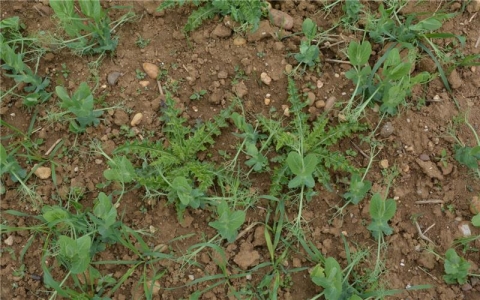
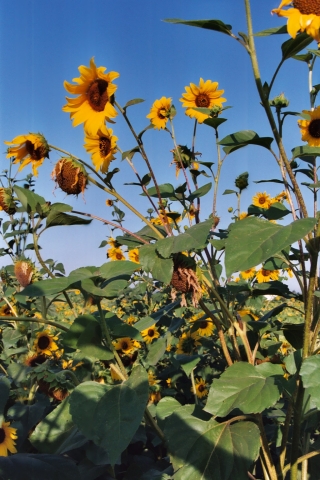
Caractérisé par un port buissonnant, une polyflorie (nombreux capitules de petite taille), une hauteur souvent supérieure à 2 m et la plupart du temps une tige ou des pétioles anthocyanés (avec une teinte rougeâtre), le tournesol sauvage reste une menace à ne pas négliger. Des solutions en cultures existent, elles doivent être préservées et s’inscrire dans le cadre d’une gestion globale.
Les caractéristiques du tournesol sauvage permettent de le distinguer du tournesol cultivé. En revanche, les confusions sont fréquentes avec les tournesols ornementaux, issus d’un croisement entre une lignée et un tournesol ornemental à proximité de la parcelle de multiplication de semences. Tournesol sauvage et tournesol ornemental sont considérés comme des tournesols adventices.
La polyflorie, un faux indice !
Attention à ne pas confondre les tournesols adventices avec des repousses de tournesol cultivé ayant une polyflorie, ces dernières étant systématiquement sur l’inter-rang, de hauteur comparable au tournesol cultivé et sans coloration rougeâtre. Par ailleurs, en réaction à un stress, certaines plantes de tournesol cultivé peuvent également présenter un caractère polyflore, mais restent d’une hauteur comparable aux autres tournesols et sans coloration rougeâtre.
Des précautions pour assurer la pérennité des VTH
Apparu en 2005 sur le territoire français, les tournesols adventices sont toujours signalés dans 10 à 15 % des parcelles enquêtées annuellement par Terres Inovia à l’échelle du territoire national (échantillon moyen annuel de 519 parcelles enquêtées). L’essentiel des signalements correspond à des pieds isolés, le plus souvent sur le rang, preuve d’une néo-infestation des parcelles dont l’origine est liée au lot de semences employées.
La déhiscence prématurée des graines engendre une forte augmentation du stock semencier en l’absence de moyens de gestion. Une situation de néo-infestation non maitrisée, peut rapidement évoluer vers des foyers puis des infestations partielles ou totales. La concurrence exercée sur le tournesol cultivé peut se traduire par une perte de rendement qui dépasse 50 % du potentiel et altérer la teneur en acide oléique.
En l’absence de problématique connue sur la parcelle, identifier dès que possible les tournesols « hors types ». Si ces individus présentent les caractéristiques d’un tournesol adventice (couleur rougeâtre sur pétiole et au centre du capitule, taille significativement supérieure, polyflorie avec difficulté pour identifier un capitule principal), il faut alors détruire les plantes. Si des graines sont déjà formées sur l’un des capitules, il est nécessaire de sortir les plantes de la parcelle.
Si la problématique est déjà connue, avec une présence moyenne à forte, les variétés tolérantes aux herbicides (VTH) sont indispensables, avec une application impérative de l’herbicide associé. Aucune zone de la parcelle ne doit rester sans traitement.
Le risque de croisement avec un tournesol d’une VTH est préoccupant. Les travaux menés en 2008 par Terres Inovia avaient mis en évidence le risque avéré de transmission du caractère VTH en présence de tournesols sauvages au sein d’une parcelle cultivée avec une VTH. Tandis que les solutions de désherbage développées sur VTH (SX, Clearfield ou Clearfield Plus) demeurent les seules efficaces contre les infestations de tournesols adventices en végétation, l’acquisition de la résistance à ces solutions par l’adventice rendrait la lutte impossible. Il est donc impératif d’appliquer l’herbicide associé en début de cycle, afin de prévenir tout risque de croisement en cas de contamination du lot de semences.
Agir pour assainir la parcelle
Après une infestation, il est recommandé d’éviter le labour, afin de laisser les graines en surface, lesquelles seront ainsi soumises aux contraintes climatiques, ce qui altérera leur potentiel germinatif. Les faux-semis avant les cultures de printemps ainsi que le déstockage par un déchaumage aussitôt après la récolte des cultures d’automne sont utiles à moyen terme s’ils sont répétés dans les différentes intercultures. La répétition des passages pendant l’été ne présente en revanche pas d’intérêt. Dans la mesure où la dormance des tournesols sauvages est plus profonde que celle des tournesols cultivés, l’effet d’un déstockage d’automne après la récolte du tournesol sera inutile. Sur la dernière interculture avant le prochain tournesol, un labour profond avec retournement peut s’envisager, pour repartir sur une situation assainie. Dans le cas contraire, privilégier un décalage de la date de semis et une destruction des individus levés au glyphosate.
La gestion efficace des tournesols sauvages implique tous les acteurs de la filière, pas uniquement les agriculteurs mais aussi le conseil et la distribution ainsi que les semenciers (meilleur contrôle des lots de semences).
Retrouvez tous les articles des éditions d'Arvalis & Terres Inovia infos ici : https://www.terresinovia.fr/fr/actualites/consultez-le-dernier-numero-darvalis-terres-inovia-infos-6
Fanny Vuillemin - f.vuillemin@terresinovia.fr
Franck Duroueix - f.duroueix@terresinovia.fr
Alain Rodriguez - alain.rodriguez@acta.asso.fr
Controlling weed in chickpea: act early to be effective
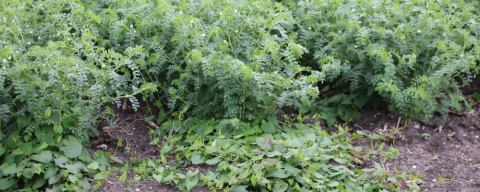
Chickpea is a slow-growing crop in the first part of the cycle, right up to the start of flowering, which is conducive to inter-row weed infestations. At present, a strategy based on a pre-emergence application is essential to ensure acceptable efficacy. This can be followed by a post-emergence application, depending on the flora.
Application de la prélevée
Selon les conditions climatiques, la levée du pois chiche peut être relativement longue. Toutefois, il est conseillé de ne plus appliquer d’herbicides dans les quelques jours qui précèdent la levée afin d’éviter tout risque de phytotoxicité. Le positionnement de la prélevée au plus près du semis est donc à privilégier. L’humidité dans les premiers centimètres du sol conditionnera l’efficacité de ces herbicides racinaires dans les semaines qui suivent l’application. Pour leurs larges spectres, deux stratégies sont privilégiées : Prowl 400 2l/ha + Challenge 600 2l/ha ou Nirvana S 1,8 à 2l/ha (voir tableau ci-dessous). Attention, dès cette camapagne, le Prowl 400 n’est plus utilisable sur les pois chiches semés avant le 01/02.
Antidicotylédones en post-levée : deux spécialités commerciales disponibles
Le Challenge 600 peut être utilisé en post levée (à 0,5 l/ha), sous conditions d’une impasse de cette spécialité commerciale en prélevée. Il doit être appliqué tôt, au stade 2-3 feuilles du pois chiche sur des adventices jeunes (2-3 feuilles maximum). ONYX (Pyridate 600 g/l) apporte un bénéfice net sur la postlevée avec une efficacité régulière sur datura, repousses de tournesol, morelle et renouées. Comme le Challenge, il doit être appliqué tôt, à partir de 2 feuilles (et jusqu’à 8 feuilles) sur des adventices entre 2 et 4 feuilles. Une application par an et fractionnable en 2x 0,75l/ha. Un effet dose est constaté sur datura, morelle, renouées et matricaire (1,5 l plutôt que 0,75 ou 1 l).

(1) Utilisation possible seulement si semis réalisé après le 01/02.
(2) En fonction du type de sol, moduler la dose de Nirvana entre 1,5 et 2 l/ha maximum. Déconseillé dans les sols sableux.
(3) Si Challenge 600 non utilisé en prélevée
(4) Renouées en relais d’une prélevée efficace uniquement
(5) Fractionnement à 7-10 jours d’intervalle
(6) Non couvert par les firmes
Voir le tableau complet des herbicides en fin d'article
Désherbage mécanique
En complément ou en substitution, des solutions de désherbage mécanique sont possibles et montrent chez certains producteurs des efficacités tout à fait acceptables.
- Un passage d’herse étrille « à l’aveugle » en post semis prélevée sera profitable, puis de nouveau en végétation, à partir du stade 3-4 feuilles (le pivot des plantes est alors assez développé pour ne pas être arraché par l’outil). En adaptant la vitesse et l’agressivité, le passage de herse étrille est possible dès 1 feuille.
- Un passage de bineuse dans l’inter-rang est possible, si l’implantation est réalisée au semoir monograine, à partir du stade 4-5 feuilles (en veillant à ne pas recouvrir les plantes).
Le déclenchement des passages mécaniques se fera selon la levée des adventices (privilégier des interventions sur adventices jeunes), le stade de la culture (voir tableau ci-dessous) et les conditions météorologiques (intervenir toujours par temps séchant : sol bien ressuyé et pas de pluie annoncée dans les jours suivants, afin d’éviter le repiquage des adventices ou la mise en germination de nouvelles graines).
Dans nos essais, en situation de printemps humide, écartement à 60 cm, nous avons pu constater qu’une stratégie basée uniquement sur l’utilisation de la herse étrille en début de cycle à 1-2 feuilles, n’a pas donné satisfaction. De même, une stratégie basée uniquement sur du binage à partir de 4 feuilles ne permet pas une efficacité comparable à une stratégie combinant les deux outils : Herse étrille à 1-2 feuilles puis binage à partir de 3-4 feuilles, stratégie qui pour le coup a présenté de bons résultats en expérimentation. La météo de l’année et la diversité de la flore dans la parcelle ont une grande influence sur les résultats.
Désherbage mécanique du pois chiche, réglages et possibilités de passage en fonction du stade de la culture et du choix de l'outil.

Désherbage mixte
Allier chimique et mécanique prend tout son sens, d’autant plus pour une culture mineure où les solutions disponibles sont peu nombreuses et ne permettent pas toujours de répondre à toutes les flores rencontrées. En situation sèche au semis ou pluvieuse au printemps par exemple, une stratégie tout en prélevée peut s’avérer insuffisante : inefficacité de la prélevée ou re-salissement au printemps. On peut alors adopter, en substitution ou complément de la prélevée, une stratégie avec herbicide de post-levée appliqué à 3-4 feuilles en combinaison avec un ou plusieurs passages de bineuse à partir de 4-5 feuilles. L’application de la post-levée sera considérée en fonction des levées d’adventices. Cette stratégie donne de bons résultats en flore simple à moyenne (dans notre essai 2023 : renouée liseron, mercuriale, véronique des champs et ray-grass).
Pour aller plus loin


Consult the latest issue of Arvalis & Terres Inovia infos
All four editions of the January 2026 issue of Arvalis & Terres Inovia infos are available online.
Les quatre éditions du numéro d'Arvalis & Terres Inovia infos de janvier 2026 sont disponibles et consultables en ligne.
Tournesol et oléoprotéagineux
- Tournesol : les variétés évaluées par Terres Inovia en 2025
- Implantation du tournesol : viser une levée avant le 1er mai
- Tournesol sauvage : faire front commun pour en venir à bout !
- Légumineuses de printemps : surveiller les thrips, sitones et pucerons dès la levée
- Pois et féveroles : les solutions disponibles pour protéger
Bonne lecture !
Les quatre éditions consultables en ligne
Input assessment
Our services
- Design, monitoring and appraisal of TI station trials
- Management of TI-labeled thematic experimentation networks
- Conduct of EOR trials
- Market assessment and expertise
Terres Inovia's advantages
- Expertise on systems including oleopro
- Acquisition of accredited reference data,
- 9 experimental stations covering the whole of France
- Management of thematic networks
These services may be of interest to you
Building a localized supply chain
Terres Inovia can help you build a new, regionalized industry.From strategy to field…Oilseed impurities
Method used: in-house methodOilseed impurities ISO
Method used: NF EN ISO 658Water content ISO oilseeds
Method used: NF EN ISO 665Would you like a quote?
Would you like to know more about this service or receive a quote? Send us your request!
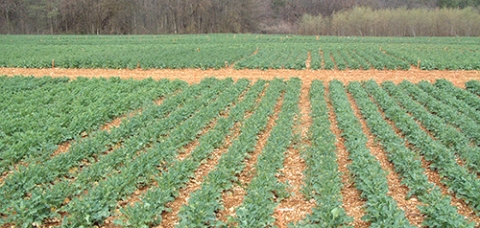
Propyzamide: conditions are favourable
The sharp drop in temperatures combined with satisfactory soil humidity in the North-East zone means that propyzamide can now be applied to manage grassy weeds in rapeseed crops.
Propyzamide (KERB FLO and generic products) is an essential herbicide molecule for managing weeds in rape plots heavily infested with grasses, particularly when these are resistant to other active ingredients. Propyzamide has a systemic root action on ryegrass, vulpine, cereal regrowth (especially wheat), bromegrass, wild oats (especially winter wild oats), bluegrass, vulpie and bentgrass.
Good usage practices
Certain application conditions are essential to optimize efficacy and preserve the molecule's durability:
- Only one application of propyzamide at 750 g/ha per season, from early November to late December on rapeseed.
- Do not apply to water-saturated soil, to avoid run-off and reduced efficacy.
- Aim for application on cool, moist soil. Efficacy depends on soil humidity. Temperatures below 10°C are strongly recommended to ensure persistence of action.
Experimental results show that the application of propyzamide-based products is not very sensitive to biomass, and this should not call into question the optimum period. Due to the foliar broadleaf control action of aminopyralid, IELO / YAGO / BIWIX / DITOP products must be applied within a rain-free period. Applications made too late (beyond November) will lack broadleaf control efficacy.
Mixing herbicide + insecticide: how to proceed?
It's always tempting to save a pass by combining herbicide and insecticide. But this is sometimes a bad economy.
First of all, it's important to consider the need for insecticides. As a reminder, the indicative risk threshold is 5 larvae per plant for well-developed colza and 2 to 3 larvae per plant for small colza or poorly established colza with nitrogen hunger.
In areas with strong resistance to pyrethroids (SKDR sector), the MINECTO GOLD + propyzamide mixture is strongly discouraged by the Institute for accounting and efficacy reasons. MINECTO GOLD must be combined with an oily adjuvant (such as ACTIROB). The presence of oil causes propyzamide to flocculate, greatly reducing its effectiveness. Furthermore, Minecto Gold should be applied when temperatures are mild and larvae are active, to maximize its effectiveness. Propyzamide, on the other hand, is applied in cold weather.
Similarly, in sectors not affected by strong resistance and still using pyrethroids to control flea beetle larvae, it is often preferable to carry out the interventions separately. Indeed, even if in practice the propyzamide + pyrethroid mixture is still possible, the optimum conditions for applying the insecticide (mild temperatures) differ from those for the herbicide (cool temperatures).
Mastering camelina cultivation
Our other training courses
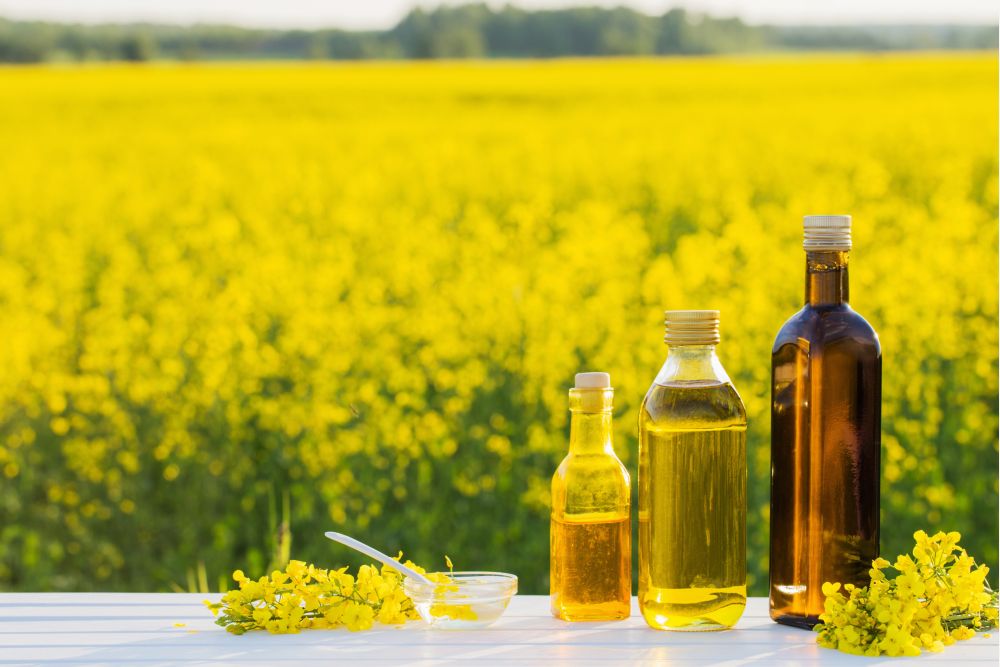
Short-circuit production of edible oil
Sur devis
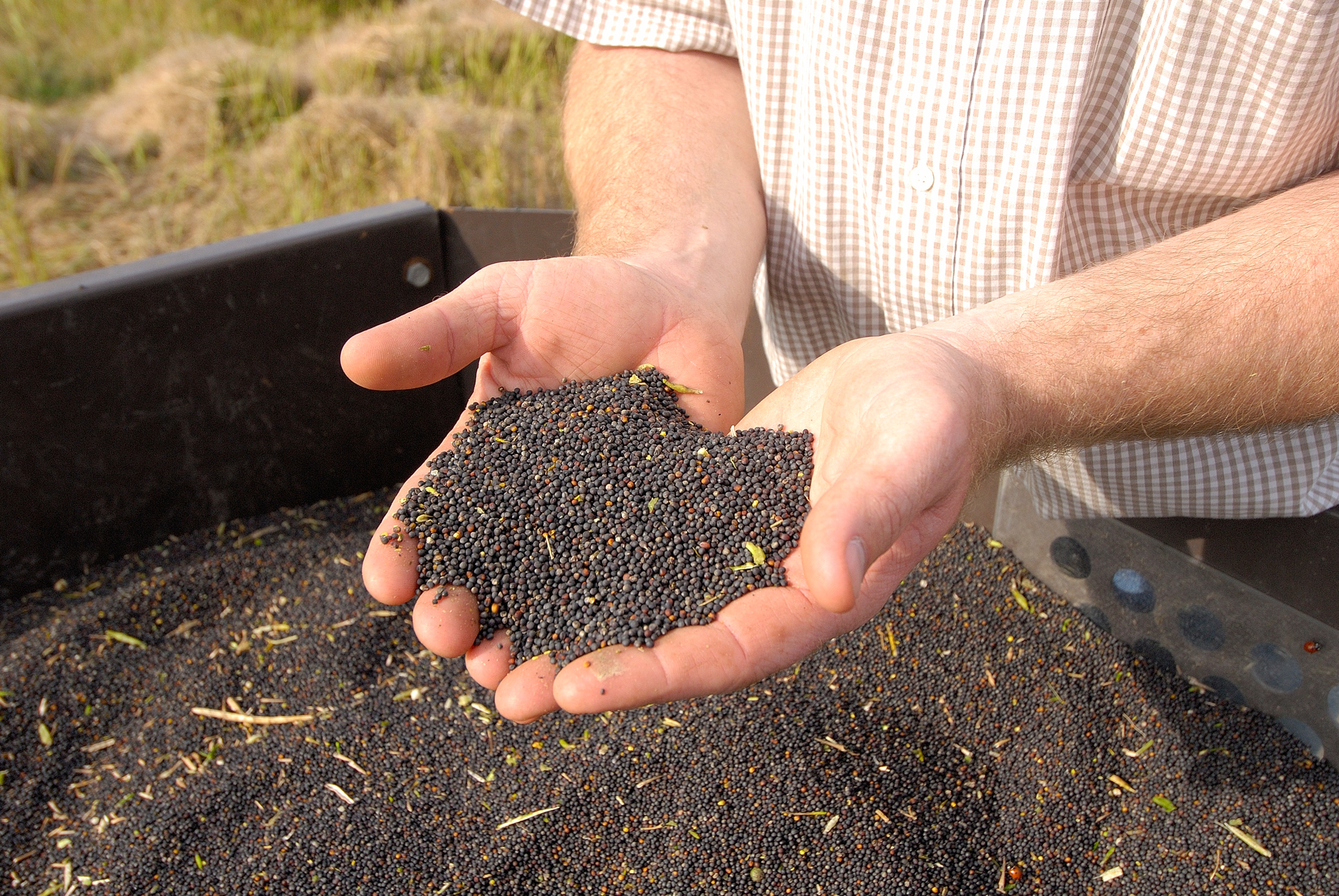
Optimization of crushing and mechanical extraction of oil-protein seeds
Sur devis
Camelina: transforming a diversification crop into a technical and economic opportunity.
Boosted by a rapidly expanding market, camelina requires precise control of its cultivation itinerary if it is to achieve its full potential. This training course offers a complete technical and economic approach to successfully integrating camelina into cropping systems.
The program includes
1. camelina: basics and challenges
- Origin, development cycle and agronomic characteristics
- Crop strengths and positioning in cropping systems
2. market opportunities and value-adding framework
- Main outlets: sustainable fuels, food and feed, cosmetics, industrial uses
- Regulatory context
3.camelina technical itineraries
- Conditions for success and choice of plot
- Planting and varietal selection
- Fertilization and weed management
- Pest and disease management
- Adapting the itinerary to the type of crop: main crop, summer or winter catch crop, intercropping
4 Harvesting and securing production
- Key harvesting principles and settings
- Mowing and raking
5.camelina in organic farming
- Agronomic benefits
- Technical specificities and outlets
6.economic performance
- Comparison of margins according to technical itineraries
- Economic analysis at crop system level
7.field diagnosis
- Observation of plots and/or trials
- Collective analysis of situations encountered
At the end of the course, participants will be able to :
- Understand the agronomic, economic and regulatory issues involved in growing camelina.
- Identify the various outlets for camelina and their requirements
- Recommend key cultivation techniques for successful camelina production, whatever the cropping method (main crop, catch crop, combination, organic farming).
- Adapt camelina technical itineraries to soil and climate conditions and to production objectives.
Face-to-face format with a field component (depending on conditions and training period):
-
Theoretical classroom input: Presentation of the crop, its outlets and technical itineraries (main crop, catch crop, combination), illustrated by trial results and concrete case studies.
-
Field observation: Analysis of real-life situations in plots and observation of trials to carry out collective diagnoses and illustrate technical levers.
Active methods: Presentations, case studies, practical exchanges, questions and answers, applied diagnostics.
Assessment: Quiz to validate knowledge acquired, questions and answers throughout the course, self-assessment by participants, individual satisfaction survey.
Theoretical support: Presentations, lectures, regulatory texts and summary documents given to participants.
Case studies: Real-life situations based on experimental results and feedback from the field, analyzed collectively.
Practical exchanges: Sharing of experiences between participants and trainers to enrich technical analysis and diagnoses.
Technicians, agricultural advisors, farmers, agents of structures working with camelina for biofuel production Q&A, quiz, individual satisfaction survey, self-positioningIf you have any requests for adaptations to help you succeed in your course, please contact the Disability Advisor:
Christel CARO
Tel: 01 30 79 95 09
Mail: formation@terresinovia.fr
Aucun 0€ TTC https://public.dendreo.com/4rsx27tf4npws6tp4zAwc/media/h17x4yzwmvzfgytkjb6Aq7zA3flf2q6khf1xmsczn8qAw8jpnz5sw4brlfk2kAbynAvwgpj5h35tqtkdkrhg3rtsm7yAyrjA4rzs9vlhjr7g4pj8 1 Jour 102 Intra-entrepriseSuccessful pea and faba bean crops in the South-West
Our other training courses
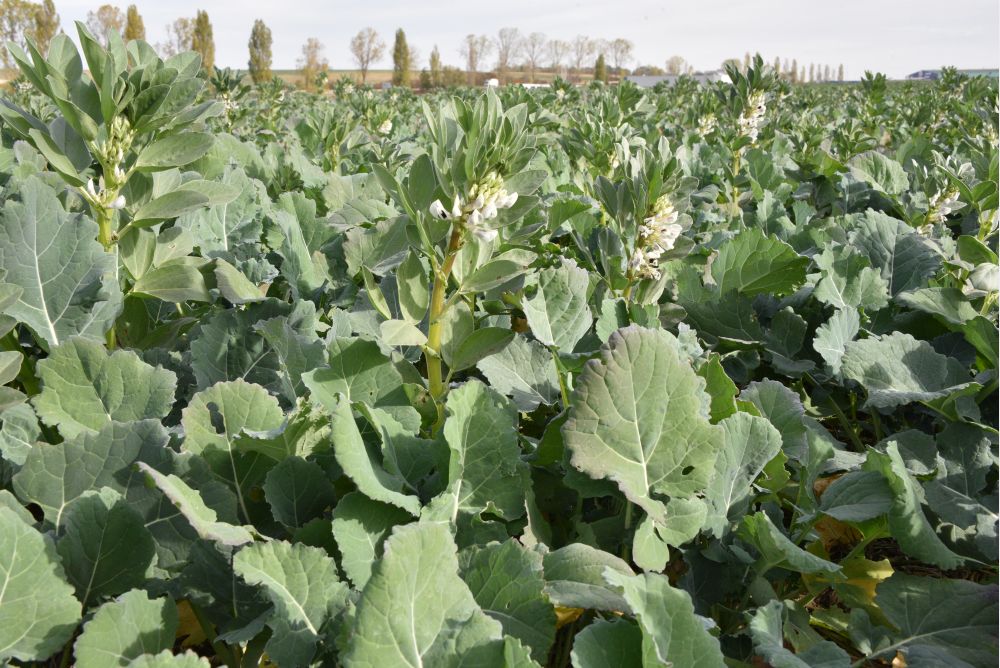
Dare to use cover crops in your cropping systems
Sur devis
Optimization of crushing and mechanical extraction of oil-protein seeds
Sur devis
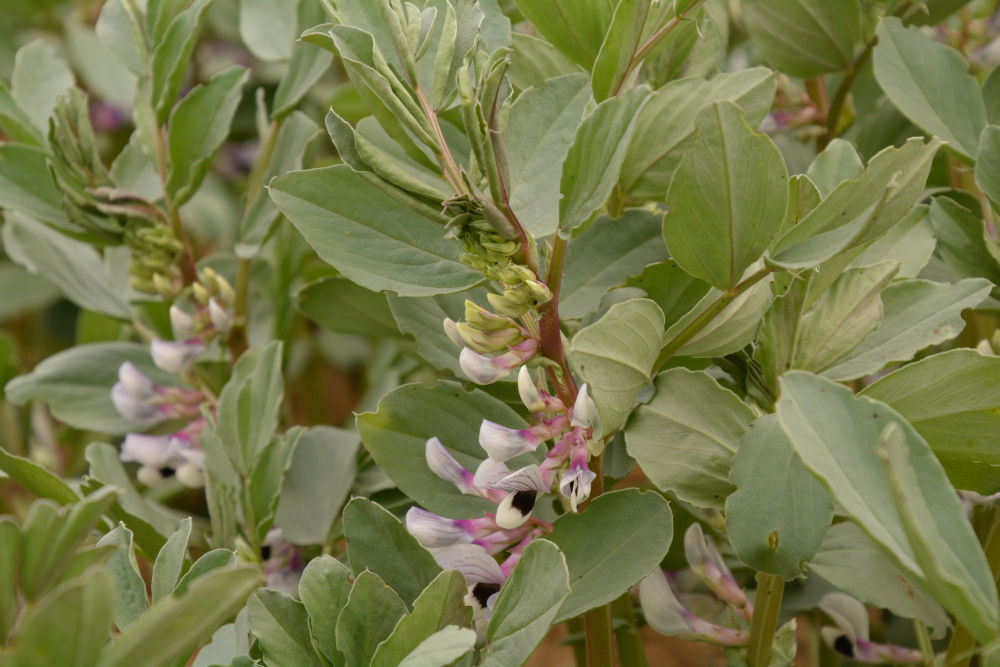
Diagnosing and managing pea and faba bean diseases
Sur devis
Peas and faba beans: make the most of their potential in South-West systems
Crops with high agronomic and economic value, peas and field beans play a key role in rotations in the South-West. Adapted to the region's varied soils and climatic constraints, they can be used to diversify crop rotations while reducing inputs. To get the best out of them, careful management is essential: choice of plot, varieties, technical itinerary... This training course will guide you step-by-step in securing and optimizing these crops in your local context.
Program:
1. understanding how crops work in the South-West of France
- Pea and faba bean physiology: key stages, environmental requirements
- Agronomic, environmental and economic advantages in the regional context
2. crop management adapted to local conditions and associated decision rules
- Varietal selection adapted to the South-West climate
- Planting and sowing density according to regional soil types
- Phytosanitary protection: specific issues (Aphanomyces, Sclerotinia, aphids, etc.)
3 Diagnosis and management of hazards
- Identification of the main crop accidents observed in the region
4.value-adding and outlets
- Specific regional outlets (human food, export, local animal sectors)
- Storage and sorting strategies adapted to South-West markets
5.performance and sustainability
- Technical and economic analysis of itineraries in a local context
- Input reduction, nitrogen savings and benefits for the following crop
Training organized in collaboration with FILEG (free for their members)
At the end of the course, participants will be able to :
- Identify the key success factors for pea and faba bean cultivation in the pedoclimatic context of the South-West,
- Choose and adapt technical itineraries according to soil, climate and local sanitary pressures,
- Diagnose the main crop failures in regional conditions,
- Assess the economic and environmental performance of these crops in a localized context.
Theoretical input: technical and scientific presentations adapted to the pedoclimatic context of the South-West.
Case studies: analysis of real situations encountered by farmers in the region.
Feedback from field experience: sharing of practices and solutions tried and tested by participants and trainer.
Interactive exchanges: time for questions, discussions and sharing between professionals.
Plot visit or field diagnosis (depending on the season): practical application of knowledge in the field.
Evaluation: quiz, questions and answers and individual satisfaction survey to measure skills acquisition.
The course is led by Quentin LAMBERT, a regional expert, guaranteeing local roots and a precise response to the specific challenges of the area.
Teaching aids: technical and summary documents given to participants (memo sheets, illustrated presentations, practical guides).
Visual illustrations: diagrams, photos and concrete examples to facilitate understanding of technical itineraries and diagnostics.
Case studies: analysis of real-life situations, diagnosis of crop accidents, and technico-economic performance studies.
Plot visits (where possible): direct observation of crops, soils and cultivation practices in real-life conditions.
Agricultural technicians and advisors, Farmers and producers, Agricultural teachers and trainers, Agronomic and technical sales managers in agricultural distribution, Agri-food / processing industry players Quizzes, Q&As and individual satisfaction surveys to measure skills acquisitionIf you have any requests for adaptations to help you succeed in your course, please contact the disability referent:
Christel CARO
Tel: 01 30 79 95 09
Mail: formation@terresinovia.fr
Aucun 480€ TTC 5 15 https://public.dendreo.com/4rsx27tf4npws6tp4zAwc/media/38gvc6snjf8gw8lhmz6Acwbxnbrfcn5zmrvg4Ady4v3227brmvdhss5fnr3tmnry4vjd1pj5h35AAs5p4fm24wkplf7tm5t4l16A7mtfkbfw4pj8 1 Jour Quentin LAMBERT 95 Inter-company and intra-companyAgronomic control of chickpea and lentil cultivation in the southwest of France
Our other training courses
Master the cultivation of lentils, an interesting diversification crop for your rotations!
Sur devis
Optimization of crushing and mechanical extraction of oil-protein seeds
Sur devis
Integrating lentils and chickpeas into your crop rotations: a strategic agronomic choice
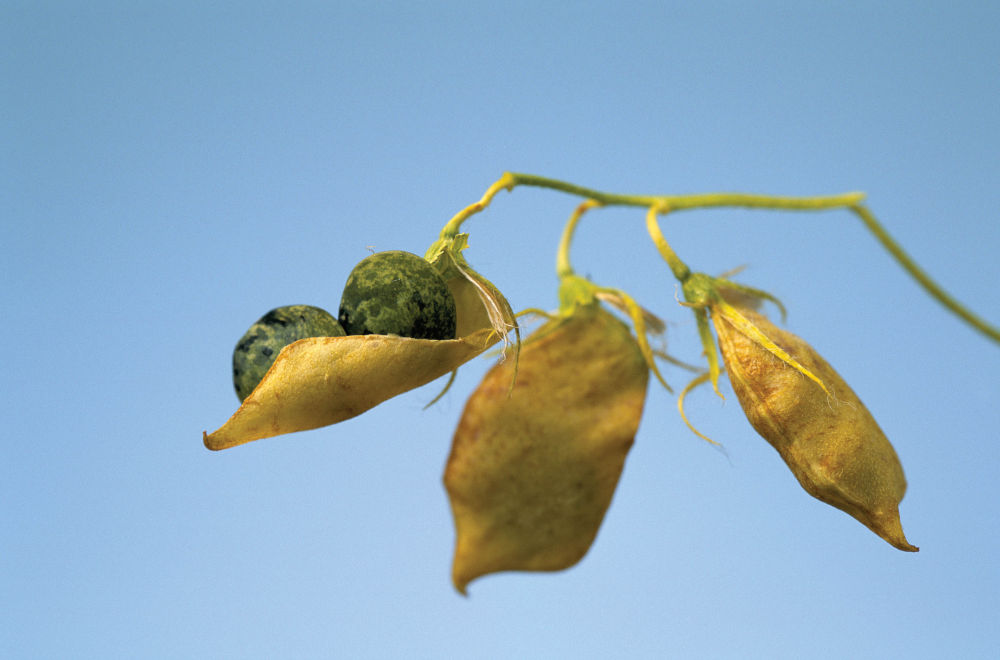
Lentils and chickpeas are economical, high-performance crops that improve soil fertility, break pest and disease cycles and offer secure outlets. Adapted to the pedoclimatic context of the South-West of France, the training course offers theoretical contributions and visits to master technical itineraries and integrate these legumes sustainably.
Program:
1 Introduction to legumes:
- Definition of legumes and how they work,
- Role of legumes in soil fertilization and crop rotation.
2 - Lentil management in the South-West of France
- Agronomic characteristics: spring species, low-input crop
- Typologies (blond, coral, green) and value-adding opportunities
- Adapting the technical itinerary to regional constraints: soil types, water availability, temperatures, etc.
- Planting, varietal selection, cultural management, fertilization, protection
- Harvesting: optimal conditions, equipment settings
3. chickpea management in the South-West
- Agronomic, environmental and economic benefits
- Regionalized technical itinerary: choice of sowing dates, densities, management in dry conditions, harvesting, storage and contracting.
- Management of pests and diseases specific to the region
4 Focus on organic farming
Training carried out in collaboration with FILEG (free for their members)
At the end of the course, participants will be able to :
- Explain the agronomic functioning of lentil and chickpea crops
- Identify their agronomic, economic and environmental benefits
- Choose species and varieties suited to the soil and climate conditions of the South West of France
- Implement rational crop management: planting, fertilization, weed and pest management
- Diagnose the main crop accidents
- Apply good harvesting and post-harvest practices
- Integrate the specificities of organic farming into the local context
Face-to-face format:
-
In-class technical input: presentations, case studies, interactive discussions
-
Practical application in the field: plot visits, crop observation, etc.
Active methods: Illustrated presentations, debates, questions and answers, feedback
Evaluation: Quizzes, questions and answers, application exercises, individual satisfaction surveys, self-assessment
Theoretical support: Lectures, visual presentations, written material given to participants.
Field visits: Analysis of lentil and chickpea crops in real-life conditions, identification of key technical points.
Practical exchanges: Feedback from field experience and group discussions with the trainer.
Advisors/Technicians from development, economic and agri-supply organizations. Teachers. Farmers Quiz, Q&A, application exercise, individual satisfaction survey, self-positioningIf you have any requests for adaptations to help you succeed in your course, please contact the disability referent:
Christel CARO
Tel: 01 30 79 95 09
Mail: formation@terresinovia.fr
Aucun 480€ TTC 5 15 https://public.dendreo.com/4rsx27tf4npws6tp4zAwc/media/nf6fsAsf4852qmjwlj3gqzsjgv6g97l3mn2x4ml2nbgwsAlx4flhkmk5mjww49tc3nbggpj5hjlw2765g8lhgyzA3fgAc9trjf8hmq5kmfbAcpj8 1 Jour Quentin LAMBERT 94 Inter-company and intra-company