
Recognition and management of winter pea airborne disease complex
Following a wet winter, with alternating mild spells and frost, the return of warmer weather as we approach the beginning of March 2026 completes the conditions conducive to the establishment and development of the pea disease complex, comprising three pathogens (Anthracnose, Ascochytosis, Bacteriosis).
À la suite d'une période hivernale humide, ayant connu des alternances de douceur et de gel, le retour d’une météo plus chaude à l’approche de ce début mars 2026 complète des conditions propices à l’installation et au développement du complexe de maladies du pois composé de trois pathogènes (Anthracnose, Ascochytose, Bactériose).
Si l’implantation s’est réalisée dans de bonnes conditions et combine certains des leviers agronomiques limitant l’exposition aux maladies (date de semis tardive, semis profond, absence d’hydromorphie, etc.), il ne reste alors plus qu’à surveiller dès maintenant ses parcelles et réaliser si besoin une protection maitrisée et réactive pour préserver leur potentiel.
Reconnaître les principales maladies aériennes composant le complexe
Le complexe est une association de plusieurs maladies qui interagissent et qui peuvent occasionner des symptômes seules ou en complexe :
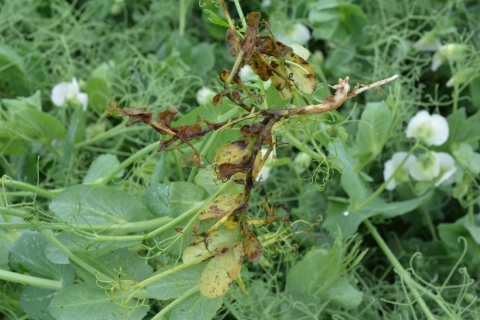
Bactériose : cette maladie provoquée par une bactérie se manifeste sur les feuilles par de petites taches vert foncé à l’aspect huileux qui évoluent en plages plus ou moins larges, des formes irrégulières et anguleuses, de couleur marron foncé, parfois translucides. Cette maladie peut apparaitre à un stade jeune dès janvier-février.
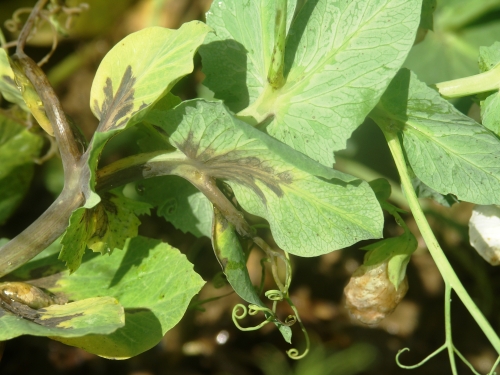
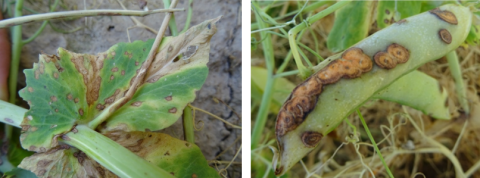
Anthracnose, provoqué par Colletotrichum sp. Depuis l’apparition de ce complexe de maladies en 2021, l’anthracnose semble être prédominante dans la majorité des situations, à l’exception du bassin sud de la France. Ainsi les symptômes provoqués par ce pathogène sont fréquemment observés. Des nécroses claires, rondes à ovales, avec une marge noire, apparaissent et évoluent le plus souvent en ‘coulures’, nécrosant toute ou partie des organes touchés. Les symptômes âgés présentent une couleur saumon très caractéristique, en particulier sur les gousses. Cette maladie apparait souvent précocement dès février-mars.
Ascochytose : l’ascochytose est provoqué par 3 pathogènes différents. Les 2 principaux (Ascochyta pinodes et pinodella) provoquent des ponctuations noires, avec un gradient plus prononcé sur la base de la plante, entraînant la sénescence précoce des organes fortement touchés. Les premiers symptômes peuvent être observés à partir de la sortie hiver.
Également, un troisième pathogène mais moins fréquent, Ascochyta pisi, provoque des symptômes différents, se rapprochant de l’anthracnose : taches plus ou moins rondes à ovales cernées d’une marge brune avec ponctuations au centre. A la différence de l’anthracnose, ces marges brunes sont plus fines, les effets de coulures moins prononcés et elle ne présente pas de coloration orange avec le temps.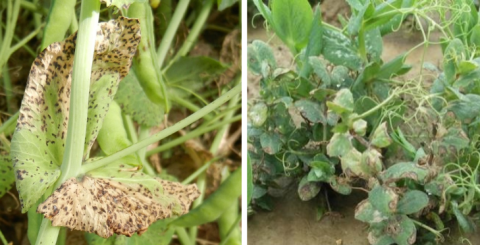
Le complexe maladies aériennes
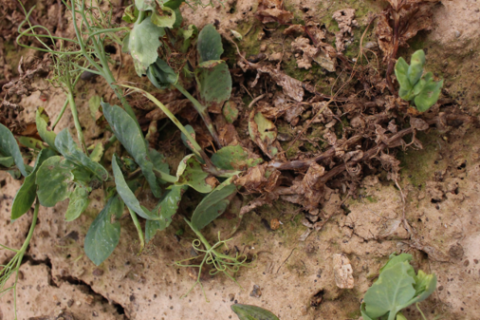
Lorsque ces maladies sont présentes au même moment sur la culture, on parle alors de complexe. Le plus souvent ce sont la bactériose et l‘anthracnose qui se développent plus ou moins simultanément puis peu après apparait l‘ascochytose. Ce complexe se développe généralement en foyer et peut se généraliser à la parcelle lors d’années aux conditions propices, les maladies agissant probablement en synergie (pluies régulières, températures douces). Les maladies peuvent présenter un gradient de symptômes plus marqués en bas des plantes et évoluant avec le temps vers les étages supérieurs. Les symptômes des différents pathogènes peuvent alors être difficiles à différencier lorsque les zones nécrotiques s’étendent et fusionnent. Il est recommandé d’observer les étages intermédiaires touchés, plus propices à présenter des symptômes encore identifiables. A noter qu’un tel développement illustre une pression déjà bien avancée des maladies.
Une protection fongicide précoce et maitrisée
Le changement climatique semble favorable à un démarrage plus précoce des maladies (notamment les alternances de températures contrastées, avec des périodes très douces pendant l’hiver, des gelées plus ou moins tardives, et une humidité élevée). Toutefois, les conditions de fin de cycle tendent à être moins favorables aux maladies. Ainsi, la période de risque se décale dans le temps et il peut être nécessaire certaines années de positionner sa protection fongicide plus tôt dès fin février.
L’intérêt d’un traitement précoce permet :
- De ralentir le développement de la maladie avant qu’elle ne soit plus maîtrisable.
- De sécuriser rapidement les pois lors d’une phase de reprise de croissance cruciale à leur dynamique de développement. Tout retard freine la capacité des pois à emmagasiner de la biomasse, gage de réserves et de surfaces photosynthétiques.
- De ne pas stresser la plante dont la dynamique de nodulation est encore en cours. Une plante stressée freinera en premier lieu ses capacités de symbiose pouvant entraver son potentiel.
La stratégie fongicide doit se composer de 2 traitements dits « piliers » fortement recommandés :
- Fin février-début mars : Même si les symptômes peuvent être discrets, dans la majorité des situations, la simple détection du complexe maladies à cette période témoigne de la présence d’un inoculum prêt à se développer à la moindre opportunité climatique.
- Début floraison : Stade permettant encore d’accéder facilement à l’ensemble de la plante avant que le couvert ne se referme. Également, il est fréquent d’observer de faibles débuts de symptômes en bas de tige à cette période. L’objectif est d’éviter que ces symptômes ne montent et n’impactent les organes fructifères et les étages foliaires participant activement à la photosynthèse. De plus, cela permet de prévenir du botrytis, maladie véhiculée par les pétales contaminés.
Des traitements relais pourront être effectués dans certains cas spécifiques :
- Entre début mars et début floraison : en cas de très forte pression du complexe maladies et/ou d’une 1ère intervention peu efficace (dose faible, positionnement trop tardif).
- Après floraison, liée à une montée tardive des maladies du bas des plantes vers les organes fructifères, lié à une météo de fin de cycle très humide et une pression maladie déjà bien présente début floraison.
En résumé, une stratégie entre 2 et 3 traitements selon les conditions :
En situation de pression faible à modérée (printemps sec), 2 traitements seront à réaliser : 1 traitement début mars pour maîtriser le complexe avant même l’apparition de symptômes. Puis un relai début floraison, nécessaire pour maîtriser les débuts de foyers en bas des plantes avant que le couvert ne se referme.
En situation de pression modérée à forte (printemps humide), 3 traitements seront à réaliser : les 2 piliers début mars et à début floraison. Un 3ème traitement viendra en relai avant le début de la floraison si forte pression courant mars-avril, ou après la floraison si retour d’humidité courant mai-juin.
En année exceptionnelle (comme 2024 avec une pluviométrie continue de la sortie d’hiver à l’été), jusqu’à 4 traitements pourront être envisagés, à réserver surtout aux parcelles à bon potentiel et présentant une valorisation avantageuse (contrat de production semence, alimentation humaine) permettant un retour sur investissement, les 2 traitements “piliers” (début mars et début floraison) relayés par 1 application supplémentaire avant et 1 application après floraison.
Les substances actives et produits conseillés
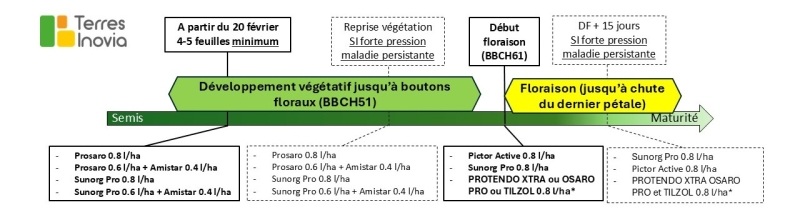
Pour le 1er traitement (et un traitement relai avant début floraison), privilégiez une base triazole. Il est possible de l’associer à l’azoxystrobine dans un souci de diversifier les modes d’actions. Attention toutefois à ne pas appliquer l’azoxystrobine seule, qui présente une efficacité plus limitée que la triazole.
Pour le traitement début floraison (et un traitement relai après début floraison), conservez une base triazole associée ou non à l’azoxystrobine. Dans les cas de forte pression maladie, le PICTOR ACTIVE présentera la meilleure efficacité mais pour un coût plus élevé.
Attention, en raison des évolutions réglementaires dans le cadre de la protection des insectes pollinisateurs (Arrêté du 20 novembre 2021), le PROSARO n’est plus autorisé au cours de la floraison des pois. Privilégier son positionnement sur les 1ers traitements avant la floraison. Toutefois, certains génériques du PROSARO conservent une autorisation d’utilisation à floraison, il s’agit de PROTENDO EXTRA, OSARO PRO et TILZOL. Avant toute intervention avec un autre générique et/ou une autre solution fongicide, vérifiez avec votre distributeur s’il est autorisé à floraison. (Plus d’informations dans l’article : Utilisation des spécialités fongicides à floraison : quelles évolutions au 1er janvier 2026)
Il est recommandé d’éviter les demi-doses, le risque de mauvaise maîtrise de la maladie est élevé et peut justifier une perte d’investissement à travers des traitements relais non nécessaires si une protection efficace aurait été faite.
Principales stratégies de gestion des maladies du pois d’hiver
Attention, ce schéma présente l’ensemble des possibilités, mais il n’affiche pas les contraintes de passages et de doses par produit. Veillez à bien les respecter.
Les questions récurrentes du terrain
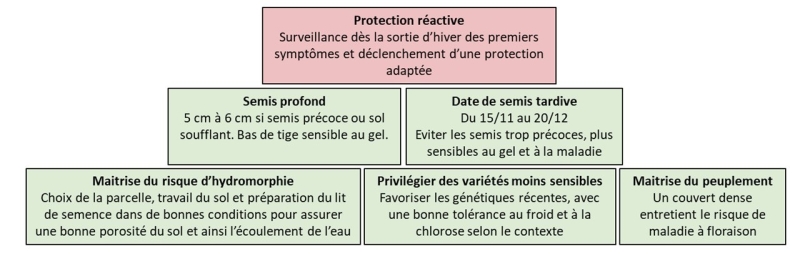
- Quels leviers agronomiques peuvent limiter la sensibilité au complexe maladies ? On dénombre 5 principaux leviers agronomiques, qui cumulés, présentent une efficacité bien meilleure en freinant l’arrivée et la dynamique de propagation des maladies, permettant plus de souplesse dans la protection fongicide. L’année 2024, caractérisée par une pression forte historique, a mis en évidence quelques cas de réussite de producteurs qui ont dépassé/sécurisé les 40 q/ha grâce à l’application de la plupart de ces leviers agronomiques et grâce à une protection réactive et adaptée.
Quel intérêt de faire un fongicide en présence de bactériose ? Les fongicides n’ont pas d’efficacité directe sur la bactériose. Toutefois, la bactérie responsable semble agir en synergie avec les pathogènes fongiques. Ces derniers peuvent en effet favoriser sa pénétration en créant des portes d’entrée. Maîtriser le risque fongique permet donc de limiter le développement de la bactériose, mais permet aussi de réduire de façon générale les dégats liés au complexe.
Si le bas des tiges est nécrosé, mon pois va-t-il dépérir ? Dans la grande majorité des cas, non, cela aura peu d’effet sur sa capacité à s’alimenter. Seuls les cas de plantes fortement impactées peuvent dépérir. En cas de doute, sectionnez quelques bas de tige et observez l’intérieur. Vous devriez voir les canaux vasculaires verts encore présents. Également, le port turgescent des plantes et l’émission de nouvelles feuilles témoignent de la vitalité de la plante.
- Existe-t-il des solutions contre la bactériose ? A ce jour non. La bactériose du pois ne semble pas répondre à des traitements alternatifs tels que le cuivre, des biostimulants ou encore des produits de recouvrement tels que des huiles et terpènes. Autrement, la piste de résistance génétique à plus long terme pourrait apporter des solutions.
Doit-on traiter en sortie d’hiver si la météo est peu humide ? 2025 a été une année historiquement saine au niveau des maladies. Si beaucoup ont tenté l’impasse avec succès sur la moitié nord de la France, sachez que des symptômes, discrets, étaient bien présents dans la plupart des parcelles suivies par l’Institut courant mars. Ceux-ci n’ont pas évolué grâce à la faible pluviométrie printanière. Dans la moitié sud de la France, la pluviométrie légèrement plus élevée, a permis le développement des maladies. Les impasses ont très vite marqué une différence de potentiel et les rattrapages fongicides sont souvent plus onéreux qu’un positionnement maitrisé.
Peut-on piloter les protections ? Actuellement, nous manquons encore de connaissance sur ce complexe (dont l’apparition est récente dans le paysage français) pour faciliter la prise de risque d’absence de protection en sortie d’hiver. Des études sont en cours pour mieux appréhender ces pathogènes et leurs conditions de développement, pour développer à terme des seuils d’intervention et faciliter le pilotage.
- Existe-t-il des différences variétales ? Les variétés présentent des comportements différents mais plutôt lié à un profil agronomique qu’à une résistance. Les variétés qui ont une capacité à redémarrer t se redresser du sol rapidement en sortie d’hiver semblent moins exposées au complexe de maladies. D’autres facteurs tel que la tolérance au froid (limitant la bactériose) peuvent influencer ce comportement. Des études sur l’identification et la sélection de ces critères sont en cours. La plupart des variétés récentes présentent un comportement meilleur face à la maladie sur la base de ces profils améliorés.
Recognition and management of botrytis in winter beans
Following a wet winter, with alternating mild spells and frost, the return of warmer weather at the start of March 2026 completes the conditions conducive to the establishment and development of botrytis, the main early-cycle disease of winter beans.
À la suite d'une période hivernale humide, ayant connu des alternances de douceur et de gel, le retour d’une météo plus chaude en ce début de mars 2026 complète des conditions propices à l’installation et au développement du botrytis, principale maladie de début de cycle de la féverole d’hiver.
Si l’implantation s’est réalisée dans de bonnes conditions et combine certains des leviers agronomiques limitant l’exposition aux maladies (date de semis tardive, semis profond, absence d’hydromorphie, etc.), il ne reste alors plus qu’à surveiller dès maintenant ses parcelles et réaliser une protection si les symptômes s’approchent du seuil de nuisibilité, pour préserver le potentiel de la culture.
Reconnaître le botrytis sur féverole
Le botrytis provoque des petites taches rondes à ovales de 2-3 mm, de couleur brun-chocolat, entourées d’un halo plus foncé. Avec le temps, les tâches deviennent coalescentes et entraînent la nécrose de la feuille et sa chute prématurée. La maladie provoque également des taches similaires, plus allongées, sur les tiges.
Seuil de nuisibilité : Les récentes études permettent de fixer un seuil d’atteinte au potentiel de la plante à 10 % de surface foliaire touchée. Ne pas hésiter à déclencher une protection à l’approche de ce seuil, le botrytis se gérant très mal dans des situations où la maladie est déjà très installée.
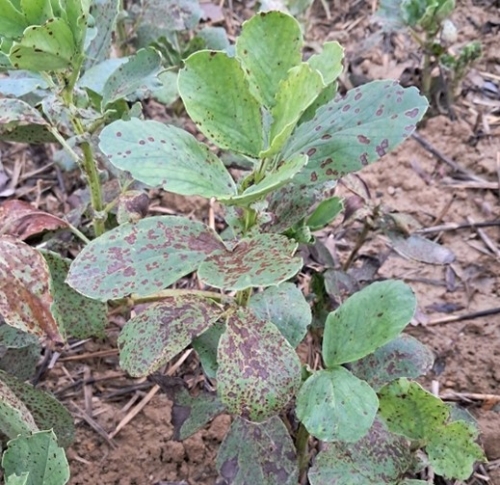
Symptômes de botrytis sur féverole d'hiver - Crédit photo : Terres Inovia
Attention aux confusions
Le botrytis est souvent confondu avec d’autres maladies ou des symptômes physiologiques.
L’ascochytose : Les confusions entre ascochytose et botrytis sont fréquentes. La maladie, assez peu fréquente, présente des taches de grande taille, souvent peu nombreuses par feuille. Le centre devient rapidement clair et présente des ponctuations noires (pycnides). La tache est entourée d’un halo noir. Les symptômes peuvent évoluer en coulures avec le temps. La plupart des variétés actuelles présentent une bonne tolérance à l’ascochytose, expliquant la faible présence de la maladie.
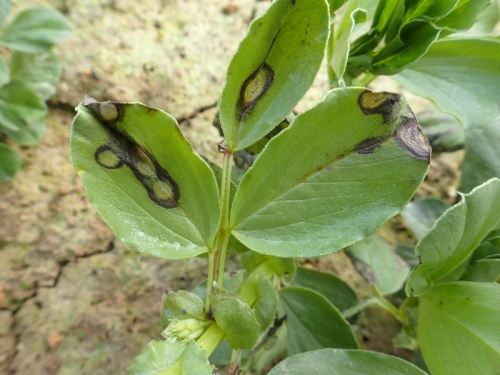
Symptômes ascochytose sur féverole d'hiver - Crédit photo : Terres Inovia
- Les dégâts de gel : Peu fréquent cette année, les dégâts de gel se traduisent par un noircissement et un flétrissement des tissus, souvent à partir des bordures des feuilles. Les dégâts sont souvent localisés sur la tige principale. Sauf cas d’importants dégâts de gel, les tiges secondaires compensent rapidement.
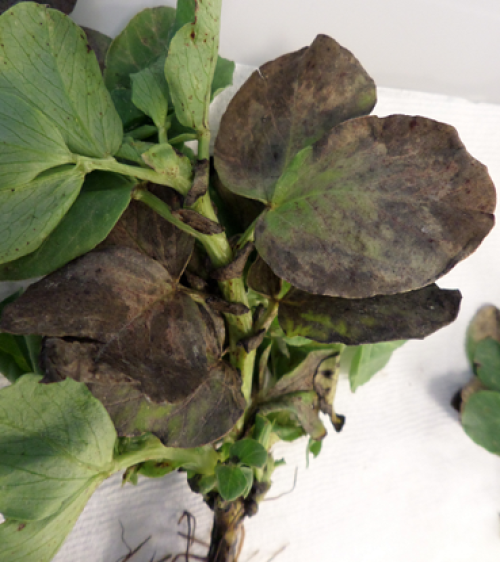
Symptômes de gel sur féverole d'hiver - Crédit photo : Terres Inovia
- Les réactions physiologiques : On constate cette année de nombreux cas d’apparition de plages nécrotiques, avec des aspects anguleux, soit en bordure de feuille, soit isolées au centre des feuilles. Ces plages sont souvent localisées à des étages foliaires précis et n’évoluent pas. Il s’agit d’une réaction physiologique des plantes à la suite de fortes variations climatiques durant l’hiver, souvent entre gel et fort ensoleillement. Leur impact est négligeable sur la plante. Attention à bien distinguer ces symptômes physiologiques du botrytis lors des diagnostics visuels : à ne pas confondre avec les taches coalescentes et nécrosées de botrytis sur lesquelles les premières petites tâches provoquées par la maladie sont toujours visibles.
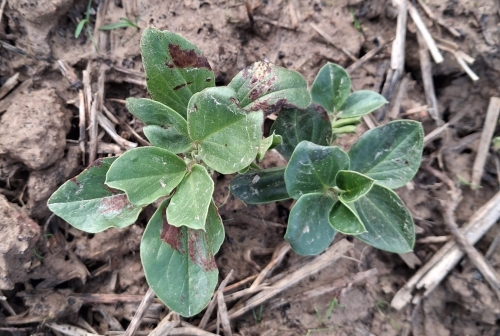
Symptômes physiologiques sur féverole d'hiver - Crédit photo : Terres Inovia
Une protection fongicide précoce et maitrisée si présence de botrytis en sortie hiver
Le changement du climat permet des conditions de démarrage plus précoces du botrytis (douceur et humidité propices plus fréquentes en sortie d’hiver). Toutefois, les conditions de fin de cycle tendent à être moins favorables à la maladie. Ainsi, la période de risque se décale dans le temps et nécessite, en réaction, de positionner sa protection fongicide plus tôt, dès début mars si la présence de botrytis est avérée.
L’intérêt d’un traitement précoce permet :
- De gagner en efficacité via un positionnement curatif précoce, sachant que le botrytis se gère difficilement en curatif sur des attaques fortes.
- De freiner très vite l’avancée de l’inoculum, avant que sa multiplication exponentielle ne soit plus maîtrisable.
- De sécuriser rapidement les féveroles lors d’une phase de reprise de croissance cruciale à leur dynamique de développement. Tout retard freine la capacité des féveroles à emmagasiner de la biomasse, gage de réserves et de surfaces photosynthétiques.
- De ne pas stresser la plante dont la dynamique de nodulation est encore en cours. Une plante stressée freinera en premier lieu ses capacités de symbiose pouvant entraver son potentiel.
La stratégie fongicide doit se composer de 1 traitement dit « pilier » fortement recommandé début floraison, stade permettant encore d’accéder facilement à l’ensemble de la plante avant que le couvert ne se referme. Également, il est fréquent d’observer de faibles débuts de symptômes sur les étages inférieurs à cette période. L’objectif est d’éviter que ces symptômes ne montent et n’impactent les organes fructifères et les étages foliaires participant activement à la photosynthèse.
Des traitements complémentaires pourront être effectués selon le contexte de l’année :
- Entre début mars et début floraison : en cas d’arrivée précoce du botrytis, un traitement curatif précoce permettra de maîtriser la maladie.
- Après floraison, en lien avec une montée tardive du botrytis et/ou de l’installation de la rouille, maladie de fin de cycle rapide et préjudiciable.
En résumé, une stratégie entre 1 et 3 traitements contre le botrytis selon les conditions :
En situation de pression faible à modérée : Cela concerne les printemps secs, l’absence de botrytis précoce ou en fin de cycle. 1 traitement sera à réaliser début floraison pour nettoyer et contenir l’inoculum présent en bas du couvert.
En situation de pression modérée à forte : Cela concerne les printemps humides, avec soit une présence précoce du botrytis, soit une résurgence en fin floraison. 2 traitements seront à réaliser : le traitement dit « pilier » début floraison accompagné d’un relai : soit en mars-avril si la pression de botrytis est précoce, soit un traitement fin floraison si la gestion de début floraison est insuffisante.
En année exceptionnelle : Cela comprend une pression de botrytis tout au long du cycle en lien avec une météo humide. 3 traitements seront à réaliser : le traitement « pilier » début floraison, avec un relai avant, pour gérer la pression précoce du botrytis, et un relai après pour gérer des remontées de la maladie. A noter que cette situation rare est la conséquence d’une combinaison climatique très défavorable et des leviers agronomiques souvent absents.
Le traitement fin floraison pourra être à raisonner selon la présence de rouille avec ou sans botrytis.
Actuellement, le contexte de présence de botrytis dans la plupart des parcelles oriente sur une stratégie à 2 traitements minimum, à confirmer au cas par cas.
Les substances actives et produits conseillés
Le botrytis étant difficile à gérer sur des situations curatives avancées, ne pas retarder les interventions et ne pas diminuer les doses au risque de surinvestir dans des rattrapages peu efficaces.
La gestion du botrytis se fait via l’azoxystrobine et le pyriméthanil. En cas de pression forte, privilégier une base pyriméthanil associée à l’azoxystrobine, permettant une meilleure gestion de la maladie. En l’absence de pyriméthanil, utilisez une pleine dose d’azoxystrobine.
Les triazoles n’ont pas d’homologation botrytis (catégorie pourriture grise). Ils permettent la gestion des autres maladies à floraison et en fin de cycle (ascochytose, rouille, oïdium). L’utilisation des triazole est à raisonner selon la maladie dominante ciblée si cohabitation de celles-ci en fin de cycle.
Attention, en raison des évolutions réglementaires dans le cadre de la protection des insectes pollinisateurs (Arrêté du 20 novembre 2021), le PROSARO n’est plus autorisé au cours de la floraison des féveroles. Privilégier son positionnement en dehors de cette phase. Toutefois, certains génériques du PROSARO conservent une autorisation d’utilisation à floraison, il s’agit de PROTENDO EXTRA, OSARO PRO et TILZOL. Avant toute intervention avec un autre générique et/ou une autre solution fongicide, vérifiez avec votre distributeur s’il est autorisé à floraison. (Plus d’informations dans l’article : Utilisation des spécialités fongicides à floraison : quelles évolutions au 1er janvier 2026)
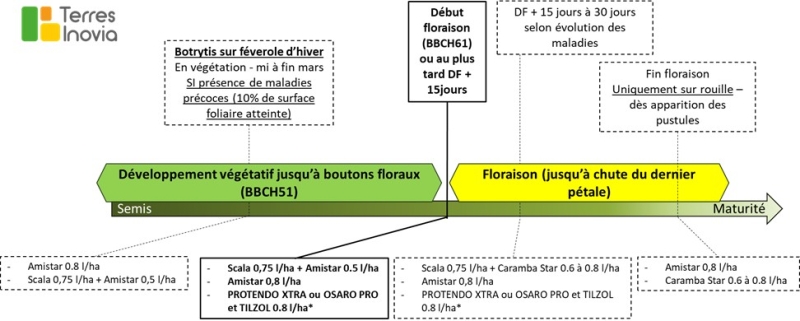
Principales stratégies de gestion des maladies de la féverole d’hiver
Attention, ce schéma présente l’ensemble des possibilités, mais il n’affiche pas les contraintes de passages et de doses par produit. Veillez à bien les respecter.
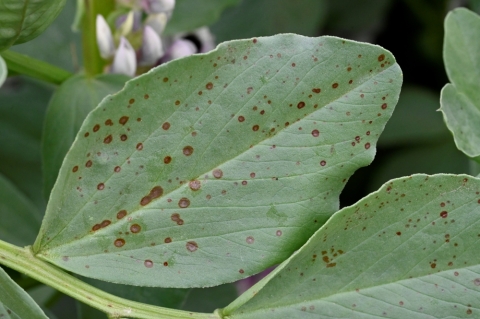
Rapeseed: excess water to be put into perspective depending on the sector
Heavy rainfall since mid-January has caused excess water in many regions, and even flooding in the worst-affected areas. Here's an update on the colza situation in northeast France.
Heavy rainfall since mid-January has caused excess water in many regions, and even flooding in the worst-affected areas. Here's an update on the colza situation in northeast France.
Heavy rainfall
Heavy rainfall since mid-January has led to excess water in many regions, and even flooding in the worst-affected areas.
There are several reasons for this situation:
- Large quantities of water have fallen, causing water to accumulate in some plots. Depending on the sector, the number of rainy days since January has been high (see table below).
Weather station | Number of rainy days from January 01 to February 24, 2026 | Cumulative rainfall (mm) from January 01 to February 24, 2026 |
Dijon (21) | 20 | 114 |
Nancy (54) | 29 | 157 |
Reims (51) | 22 | 146 |
Lille (59) | 26 | 146 |
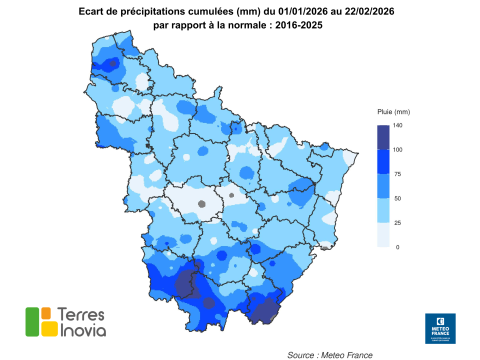
- Soil type: cold, damp loam soils are the most affected (Burgundy-Franche-Comté, Champagne Humide area, Brie area, Lorraine, Barois),
- Soil structure: the presence of a compacted zone limits infiltration into the soil.

Heavy rainfall
Heavy rainfall since mid-January has led to excess water in many regions, and even flooding in the worst-affected areas.
There are several reasons for this situation:
- Large quantities of water have fallen, causing water to accumulate in some plots. Depending on the sector, the number of rainy days since January has been high (see table below).
Weather station | Number of rainy days from January 01 to February 24, 2026 | Cumulative rainfall (mm) from January 01 to February 24, 2026 |
Dijon (21) | 20 | 114 |
Nancy (54) | 29 | 157 |
Reims (51) | 22 | 146 |
Lille (59) | 26 | 146 |
- Soil type: cold, damp loam soils are the most affected (Burgundy-Franche-Comté, Champagne Humide area, Brie area, Lorraine, Barois),
- Soil structure: the presence of a compacted zone limits infiltration into the soil.
Une pénalisation de la croissance de la plante
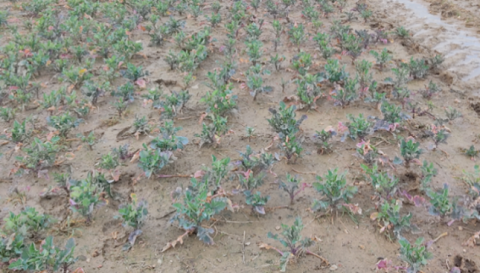
Ces fortes précipitations entrainent une anoxie racinaire dont le colza est très sensible à cette période.
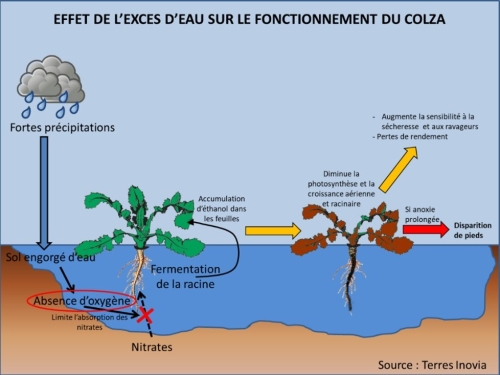
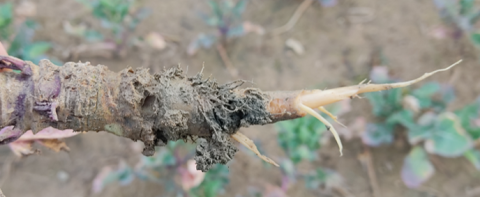
En effet, l’excès d’eau bloque l’absorption des nitrates et provoque une fermentation des racines qui produit de l’éthanol s’accumulant dans les feuilles. Cette accumulation perturbe le fonctionnement de la photosynthèse et pénalise le redémarrage des plantes en limitant la croissance aérienne et surtout racinaire.
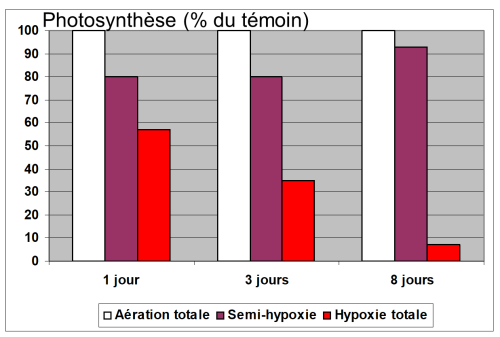
Sur le graphique ci-dessous, nous remarquons que les situations d’hydromorphie modérée (semi-hypoxie) ont un faible impact sur la photosynthèse. Par contre, les situations d’hydromorphie importante (hypoxie totale = ennoiement) impactent fortement la photosynthèse.
La plante prend alors une couleur rougeâtre. La racine se décompose avec une odeur désagréable. Dans les cas les plus graves (anoxie importante et prolongée), le système racinaire pourrit et les pieds disparaissent.
Situation de la parcelle avec excès d’eau important | Dégâts sur les racines |
| 
|
Par la suite, ces défauts d’enracinement diminueront :
- l’exploration racinaire,
- la valorisation des ressources du sol et des engrais,
- les capacités de compensation en cas d’accidents climatiques (stress hydrique) ou d’attaques de ravageurs au printemps (méligèthes).
Quels impacts aujourd’hui ?
Tous les secteurs ne sont pas touchés dans la même mesure par des problèmes liés à l’hydromorphie. La Bourgogne-Franche-Comté semble plus concernée que les autres secteurs de la région Nord et Est. Les prochains jours seront déterminants pour réaliser le diagnostic des parcelles.
La conduite à tenir dépendra de l’importance de la zone impactée par l’hydromorphie.
Si l’hydromorphie concerne une grande partie de la parcelle. Le remplacement de la culture est conseillé. Pour cela, tenir compte de la réserve hydrique du sol et des herbicides appliqués à l’automne.
Voir aussi : Culture de remplacement après colza
Si l’hydromorphie concerne des zones limitées dans la parcelle, adapter la dose d’azote au potentiel de rendement (revu à la baisse) et maintenir la protection fongicide. Pour éviter que ces zones ne se resalissent, certains agriculteurs sèment à la volée du trèfle blanc ou violet pour occuper l’espace et limiter les levées d’adventices.
Berl'eyes
Grâce à l'IA, prenez en photo vos berlèses et obtenez en quelques secondes le nombre de larves d'altise présentes dans vos tiges de colza.
Comment utiliser l'outil ?
L'application sert à compter des larves d'altise à la suite d'une méthode berlèse. Les performances sont comparables à une observation humaine avec une marge d'erreur d'environ 15 % en dessous.
Cet outil est financé par le Plan d'action de sortie du phosmet.


Ces outils pourraient vous intéresser

Crop protection product mixtures
Phytosanitary
Silo insects
Pests

Estimating the risk of terminal bud weevils
Pests
Controlling rapeseed stem weevil: monitor its arrival for optimum insecticide positioning
Rapeseed stem weevils are the main pests of spring rapeseed, and can cause stem bursts that penalize yield components, particularly in dry years. Control methods are still effective. But the positioning of the intervention is crucial to ensure effective protection.
Rapeseed stem weevils are the main pests of spring rapeseed, and can cause stem bursts that penalize yield components, particularly in dry years. Control methods are still effective. But the positioning of the intervention is crucial to ensure effective protection.
Vigilance when flights are early and massive
Stem weevils are the first insects to colonize rapeseed plots at the end of winter. A thaw above 9°C triggers the first flights, which can intensify when temperatures rise above 12°C. Depending on the year's climatic conditions, flight can be early (mid-February) or late (during March). The installation of a yellow spoon on the vegetation is a good way of spotting the arrival of the insect. We consider that there is a risk of damage to the crop as soon as the insects are present and the rapeseed is in the bolting stage (C2 to E). Past experience shows that years with early and massive flights are the years in which we see the most damage (frequency and intensity) in plots across a territory.
Intervening at peak flight
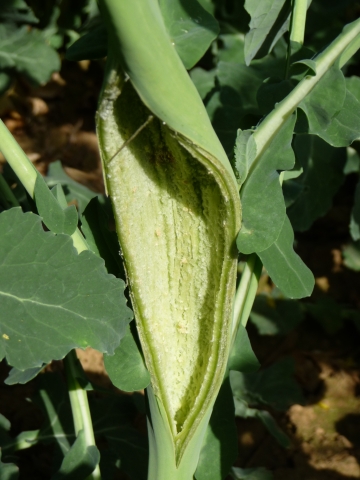
Farmers wishing to secure their production should intervene 8 - 10 days after the first "significant" captures, or ideally at the regional flight peak (consult the BSV for the date of the flight peak at regional level). The aim is to intervene when as many insects as possible are in the plot, and before egg-laying begins. Intervening as soon as the first insects are caught usually means spraying too early. It's better to wait a few days, even if it's true that the organization of work sites (sowing, nitrogen, etc.) and weather conditions can complicate implementation at this time of year. On the other hand, late infestations or re-infestations should not be overlooked, as they can occur right up to the end of bolting (E stage). Generally speaking, a single well-timed intervention is enough to control most of the risk. However, if a second flight peak occurs 2-3 weeks after application, re-intervention may be necessary.
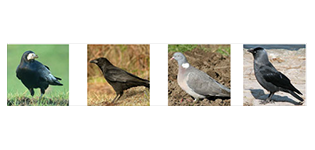
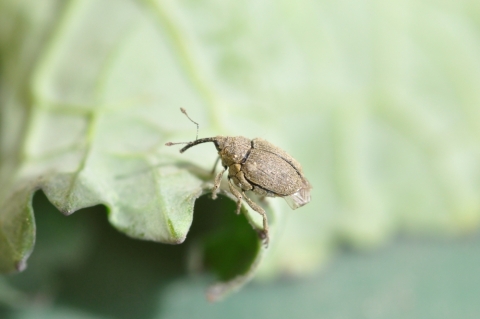
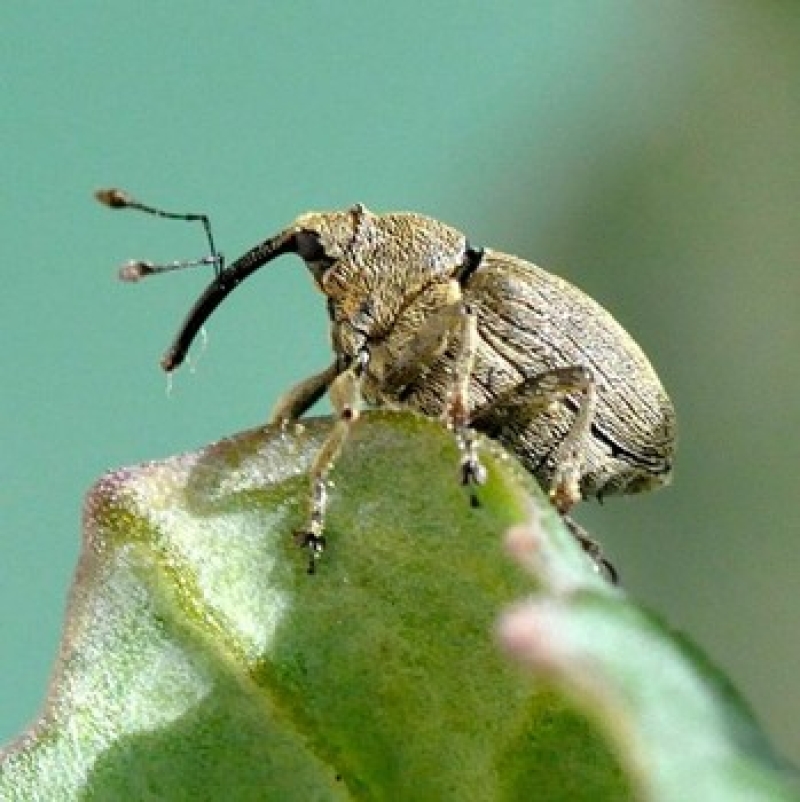
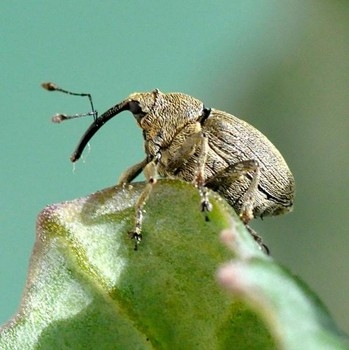
Do not confuse rapeseed stem weevil with cabbage stem weevil, which is considered to have little or no harmful effect on rapeseed.
The rapeseed stem weevil (left) has black leg tips. The smaller cabbage stem weevil (right) has red leg tips and a whitish dorsal spot between the thorax and abdomen.

Les solutions insecticides sont toujours efficaces
L’efficacité de la lutte chimique dépend avant tout du positionnement de la protection et de sa persistance d’action. A ce jour, Terres Inovia n’a pas constaté de perte d’efficacité au champ. Et le monitoring réalisé par l’Institut ne montre pas de phénomène de résistance émergent inquiétant.
Les références DECIS PROTECH 0.33 l/ha et KARATE ZEON 0.075 l/ha sont efficaces pour réduire les dégâts du charançon de la tige du colza (réduction du nombre de tiges déformées et/ou éclatées). TREBON 30 EC est comparable aux références. En cas d’infestation tardive, il présente l’intérêt d’être également efficace sur méligèthes. SHERPA 100 EW et CYTHRINE MAX sont un peu en retrait. MAVRIK SMART est inférieur aux références (synthèse des essais Terres Inovia).
OAD Prédiction du vol de charançon de la tige du colza
Pour prédire la dynamique des vols de ce ravageur, Terres Inovia met à disposition l’Outil d’Aide à la Décision « Prédiction des vols de ravageurs ». L’outil informe sur la probabilité de capture en cuvette jusqu’à J+7, sous forme graphique et sous forme de carte. Il s’agit d’un outil de mise en alerte complémentaire aux réseaux d’observation sur le terrain.
En savoir plus

Watch out for leaf beetles
Watch out for rapeseed stem weevil
Les charançons de la tige du colza pénalisent les composantes de rendement. Les pontes en perturbant le flux de sève sensibilisent les plantes aux stress ultérieurs et limitent leurs capacités de compensation. Un stress hydrique ou une attaque d’un autre ravageur au printemps sur un colza affaibli préalablement par le charançon de la tige sont ainsi plus dommageables. Le positionnement de l’intervention insecticide est déterminant pour garantir l’efficacité de la protection.
Le raisonnement tactique repose sur les relevés rapportés par les réseaux de cuvettes jaunes (BSV ou autres) et un bon examen du stade du colza.
Lire article sur la cuvette jaune
Pensez à nettoyer et à remettre votre cuvette sur la végétation pour détecter le début du vol. Le réchauffement actuel pourrait déclencher l’arrivée des premiers charançons dans les colzas, même si les pluies associées ou non à des vents sont plutôt défavorables aux déplacements d’insectes.
En ce début février, les colzas les plus avancés du Centre-Val de Loire se situent au stade C2 (apparition de la tige) voire même D1 ponctuellement. En Poitou-Charentes ils sont au stade C1 (formation de nouvelles feuilles). En Normandie et Ouest Ile-de-France, les plantes atteignent fréquemment le stade C2, selon les variétés, les réserves en azote, les types de sol... Attention, les infestations en larves d’altises peuvent être élevées cette année.
Dans ces cas, les éventuelles pertes de biomasse en janvier associées aux conditions hivernales renforcent la nécessité d’une vigilance accrue pour la suite de la campagne.
Quelques charançons de la tige du colza ont été capturés en région Centre-Val de Loire (BSV du 3 février 2026).
OAD pour prédire les vols de Charançon de la tige
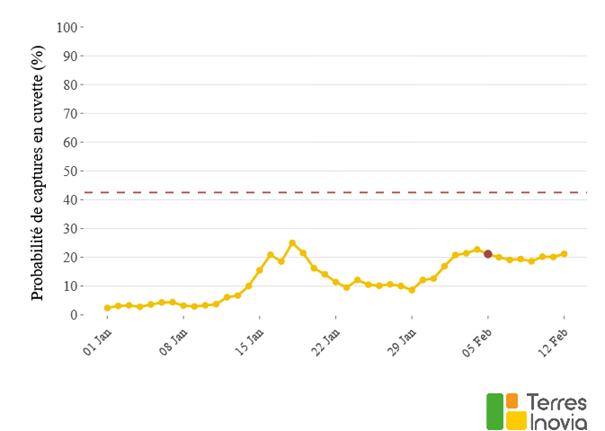
Pour accompagner la surveillance de vos colzas, Terres Inovia met à disposition un OAD de prédiction de vol du charançon de la tige. Sur la base des captures relevées sur le territoire depuis 2011 par les observateurs BSV et en se basant sur un réseau de stations météorologiques couvrant les différents bassins de production, le modèle fournit une courbe de probabilité de piégeage sur la commune renseignée, jusqu’à J+7.
Lorsque la courbe se rapproche du seuil d’alerte (ligne en pointillés), vous devez vérifier régulièrement les captures dans votre cuvette.
Une vue d’ensemble sur une carte de France est également consultable pour indiquer le risque journalier de la date sélectionnée et jusqu’à J+7.
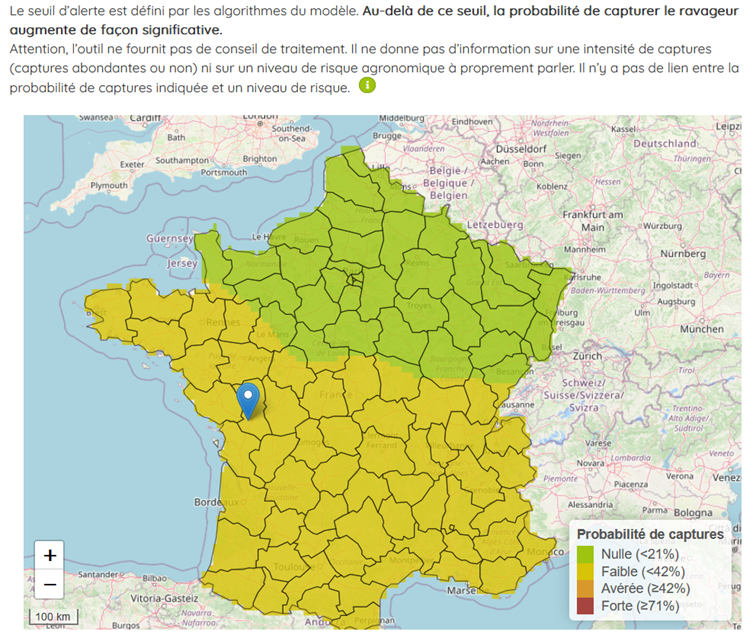
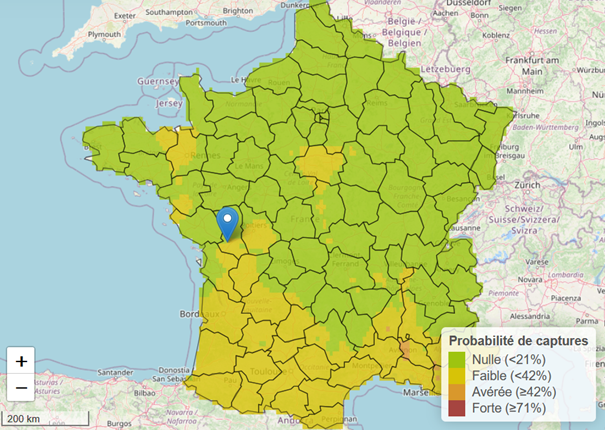
| Attention : Les informations prédites par les outils ne tiennent pas compte des spécificités de chaque parcelle et ne dispensent pas de la surveillance au champ (cuvettes jaunes placées à hauteur de végétation et observation de l'état du colza). |
Pour les 7 prochains jours, le risque de capture de charançons de la tige du colza est nul à faible et reste globalement sous le seuil d’alerte
Découvrez l'outil :
Intervenir au pic de vol
La sécurisation du potentiel conduit à intervenir idéalement lorsque le pic de vol régional est atteint et que les femelles sont aptes à pondre.
Il est recommandé d’intervenir lorsque les captures traduisent une présence significative d’insectes dans le réseau de parcelles, et avant l’entrée en phase de ponte. Un traitement réalisé dès les toutes premières captures peut conduire à une application prématurée.
Les solutions insecticides sont toujours efficaces
Le succès de la lutte chimique dépend du positionnement de l’intervention et de la persistance d’action. À ce jour, Terres Inovia n’observe pas de baisse d’efficacité au champ. Les résultats du monitoring ne montrent pas l’émergence de résistances inquiétantes.
DECIS PROTECH 0.33 l/ha et KARATE ZEON 0.075 l/ha sont efficaces pour réduire les dégâts du charançon de la tige du colza (réduction du nombre de tiges déformées et/ou éclatées). TREBON 30 EC est comparable à ces références et en cas d’infestation tardive et de présence de méligèthes, il présente l’intérêt d’être également efficace sur méligèthes...
SHERPA 100 EW et CYTHRINE MAX sont un peu en retrait. MAVRIK SMART est quant à lui inférieur aux références sur charançon de la tige et est à réserver pour la lutte éventuelle contre méligèthes entre les stades D1 et E-F1.
Attention : veiller à réserver les produits TREBON 30 EC ou MAVRIK SMART pour la lutte éventuelle contre méligèthes entre les stades D1 et E-F1.
Julien Charbonnaud - j.charbonnaud@terresinovia.fr - Centre-Val de Loire
Jean Lieven - j.lieven@terresinovia.fr - Normandie, Ile-de-France Ouest
Thomas Mear – t.mear@terresinovia.fr - Bretagne, Pays de la Loire
Elodie Tourton - e.tourton@terresinovia.fr - Poitou-Charentes, Vendée, Limousin
Rapeseed: Assessing rapeseed biomass to optimize spring nitrogen fertilization

Raisonner la fertilisation azotée des colzas est indispensable pour assurer la productivité de la parcelle et maîtriser le poste de charge opérationnel le plus important de la culture. L’estimation de la biomasse du colza à la sortie de l’hiver et sa prise en compte dans le calcul de dose d’azote est un moyen simple et efficace pour optimiser sa marge brute.
L’estimation de la biomasse en sortie hiver est indispensable pour ajuster la quantité d’azote à apporter au printemps car la biomasse aérienne (pois vert en kg/m²) est un bon indicateur de l’azote déjà absorbé par la plante. Plus la quantité d’azote absorbé par la culture à l’ouverture du bilan est importante, plus la dose d’azote à apporter sous forme d’engrais au printemps est faible, sans compromis sur le rendement.
L’estimation de la biomasse est à faire lors de la reprise de végétation (stade C1 – C2) et dans tous les cas avant le premier apport d’azote.
Méthode d’estimation de la biomasse par pesée
La pesée s’effectue sur 2 à 4 parcelles d’1 m² en sectionnant les colzas au ras le sol pour une bonne estimation de sa biomasse aérienne. La méthode de prélèvement varie selon l’écartement du colza (voir tableau ci-contre).
Ecartement | Méthode de prélèvement |
Inférieur à 30 cm | Prélever dans un carré de 1 mètre de côté |
45 cm | Prélever 2 rangs contigus de 1,10 mètre linéaire |
50 cm | Prélever 2 rangs contigus de 1 mètre linéaire |
Dans les parcelles avec des colzas hétérogènes, il est recommandé de réaliser 4 prélèvements, à différents endroits représentatifs de la parcelle, tout en évitant les bordures. La valeur moyenne sera alors retenue pour effectuer les calculs de dose d’azote.
Pour éviter tout biais de mesure, notamment en cas de prélèvement par temps pluvieux ou en cas de forte rosée, il convient de bien secouer les plantes pour les débarrasser des gouttes d’eau, de retirer les feuilles blanches en décomposition gorgées d’eau et d’enlever les éventuelles mottes de terre et autres débris.
D'autres outils pour estimer la biomasse des colzas
Il existe aujourd’hui une grande diversité d’opérateurs proposant des services de conseils azoté spécialisés sur le colza à partir d’un traitement d’image. Ils permettent aux agriculteurs qui le souhaitent de moduler les apports au sein de la parcelle, soit avec un système piloté sur l'épandeur d'engrais, soit en modulant manuellement par grandes zones dans les parcelles présentant des états de croissance différents. Parmi eux, 4 produits font l’objet d’un accord de partenariat avec Terres Inovia :
- Farmstar (Airbus, Arvalis)
- Agro-rendement (Wanaka/Agroptimize - Geosys)
- PRECIFert Azote (Precifield)
- Bilan Colza by Abelio (Abelio)
Pour faciliter les estimations au champ, 2 applications smartphone, ImageIT inclus aujourd’hui dans Atfarm (Yara France) et Crop-Analyser (Visio-Crop), font l’objet de partenariat avec Terres Inovia. La biomasse est estimée à partir de photographies classiques, dont l'exploitation et l’interprétation sont ajustées par la hauteur de végétation, à renseigner en amont du traitement d’image.
Pour aller plus loin : Evaluer la biomasse du colza pour optimiser les apports d'azote au printemps
Calcul de la dose prévisionnelle : attention à la surestimation des besoins !
La Réglette azote colza® - outil simple, facile d’utilisation et mis en ligne gratuitement par Terres Inovia - détermine la dose totale à apporter à partir de plusieurs informations : la biomasse du colza, l’objectif de rendement de la parcelle, le type de sol, l’apport de produits organiques, la nature du précédent et éventuellement l’association de légumineuses gélives.
Afin de ne pas surestimer les besoins de la culture, et ainsi éviter une sur-fertilisation inutile et coûteuse dans un contexte de prix élevé des engrais azotés, il convient de fixer un objectif de rendement raisonnable : calculer la moyenne des rendements des 5 derniers colzas sur la parcelle ou des parcelles comparables, en enlevant la valeur la plus faible et la valeur la plus élevée (moyenne olympique).
Fractionner pour synchroniser les apports aux besoins de la culture
Pour les colzas à faible croissance, un premier apport précoce dès la reprise de végétation, en petite quantité, est recommandé. Il est en effet nécessaire d’accompagner la reprise car les petites plantes ont peu de réserves et une capacité d’absorption limitée.
Pour les colzas à forte croissance, la remobilisation des réserves accumulées dans les organes suffira à assurer une bonne reprise de végétation. Il est conseillé d’attendre la montaison pour l’apport éventuel d’azote.
Dans tous les cas, ne pas apporter plus de 100 kg/ha d’azote en une fois.
Dose à apporter (kg/ha) | Reprise de végétation (stades C1-C2) | Début montaison (stades C2-D1) | Boutons accolés (D1-D2) | Boutons séparés (stade E) |
<100 |
|
| <100 |
|
100 à 170 |
| 60 à 80 | 40 à 90 | |
>170 | 40 à 60 | 50 et + | 40 à 60 | |
Aurore BAILLET (a.baillet@terresinovia.fr)
ImageIT (Yara)
ImageIT is a feature integrated into the Atfarm mobile application that evaluates the biomass and nitrogen uptake of your rapeseed crops at the start and end of winter. Developed by Yara in partnership with Terres Inovia, ImageIT uses digital photo analysis technology.
Assessing biomass and nitrogen uptake by rapeseed crops
ImageIT has been designed to partially replace tedious biomass weighing. ImageIT estimates the amount of nitrogen absorbed by the crop based on the coverage index, the green pixel rate and an assessment of senescent leaves. ImageIT's technology is based on comprehensive image analysis, canopy pixel classification, background noise filtering and canopy pixel enumeration.
Using the Atfarm application, ImageIT transforms your smartphone camera into a nitrogen nutrition management tool. Biomass and nitrogen uptake can be reliably assessed from your phone, much more easily and quickly than traditional biomass weighing at the start and end of winter.
Download the free Atfarm application and start using Image IT today!



Réglette azote colza® (Rape nitrogen chart)
The tool calculates the amount of nitrogen to be applied per hectare, and displays additional recommendations for application.

[COMING SOON] Predicting pest flights
Provide information on the statistical probability of catching a fish in a cuvette
The tool displays :
- In graphic form: the evolution of the daily probability of capture up to D+7, for a given commune
- In map form: probability levels over the whole territory, for a given date (up to D+7).
The alert threshold is defined by the model's algorithms. Above this threshold, the probability of capturing the pest increases significantly.
The rapeseed stem weevil flight prediction tool was developed thanks to the Produire project of the Cap Protéines program, and received support from the French Ministry of Agriculture and Food Sovereignty as part of the recovery plan.
The terminal bud weevil flight prediction tool was developed thanks to the Adaptacol² project and received support from the Casdar.