

Late sowing of spring peas in Poitou-Charentes, points to remember
In the region, spring pea sowing has been particularly delayed due to unfavorable weather conditions. Here are a few points to remember about late sowing.
In the region, spring pea sowing has been particularly delayed due to unfavorable weather conditions. Here are a few points to remember about late sowing.
To date, spring pea sowing has not yet started in Poitou-Charentes. This week's more favorable weather conditions will enable plots to dry out again and sowing to start in the first week of March, depending on soil type.
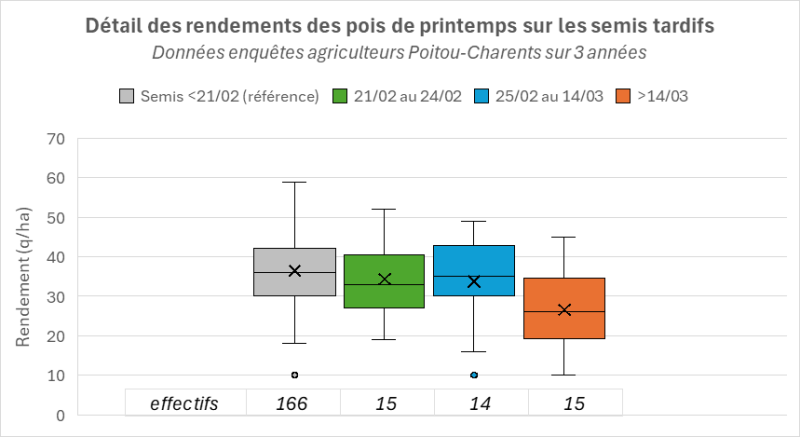
Terres Inovia's surveys of farmers' practices have enabled us to study the impact of sowing date on spring pea yields. Over the three years studied (2017, 2020 and 2023), a trend emerged: spring peas sown before the date of 01/31 tend to have higher yields than those sown after the date of 02/20. Late sowing reduces the median yield and increases its variability.
This drop in yield and variability in late sowing of spring peas can be explained by the risk of coulure at flowering and seed abortion, linked to exposure to water and heat stress at the end of the cycle.
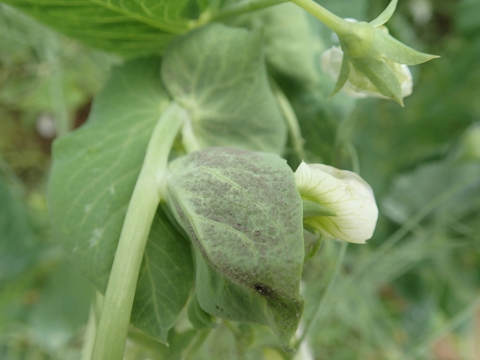
With this context of sowing in wet conditions, diseases will need to be carefully monitored in spring pea plots from the start of the campaign.
While most sowing will take place after the recommended sowing dates, there are still possibilities for success. First of all, unlike in years such as 2020, 2022 or 2025, the start of the campaign is starting with full reserves, which are necessary for good pea development at the beginning of the cycle, and in particular for successful nodulation, the key to potential. The risk of early water stress is lower than in other years.
Also, even though potential decreases and variability increases after the end of February, yields really start to drop from mid-March onwards.
In most situations, you can leave yourself the week of March 2 to 8 to judge your plot's capacity for drying out and bearing capacity. In which case, sow within the next 10-15 days if you judge that conditions are favourable for sowing.
In the case of plots that are not sufficiently drained, or in the event of a return of heavy rainfall, it is advisable to consider another crop, such as sunflower.
As pea seed keeps well, it is possible to store and reuse the seed investment for the following season.
Si la plupart des semis vont s’effectuer après les dates de semis recommandées, des possibilités de réussite sont encore envisageables. Tout d’abord, à la différence d’année tel que 2020, 2022 ou 2025, le début de campagne démarre avec des réserves pleines, nécessaires au bon développement des pois en début de cycle et notamment à la réussite de la nodulation, gage du potentiel. Le risque d’un stress hydrique précoce est plus faible que d’autres années.
Également, même si les potentiels diminuent et les variabilités augmentent passé fin février, on observe un réel décrochage des rendements à partir de mi-mars.
Dans la plupart des situations, vous pouvez vous laisser la semaine du 2 au 8 mars pour juger de la capacité de ressuyage et de portance de votre parcelle. Et auquel cas, semer dans les 10-15 prochains jours si vous jugez les conditions propices au semis.
Dans le cas de parcelles ne présentant pas une dynamique de ressuyage suffisante, ou en cas d’un retour de pluies conséquentes, il est recommandé d’envisager une autre culture telle que le tournesol.
La semence de pois se conservant bien, il est tout à fait possible de stocker et de réutiliser l’investissement semence pour la campagne suivante.
s.vera@terresinovia.fr
Bastien Remurier -
b.remurier@terresinovia.fr
SIA26: initial results for Cap Protéines+?
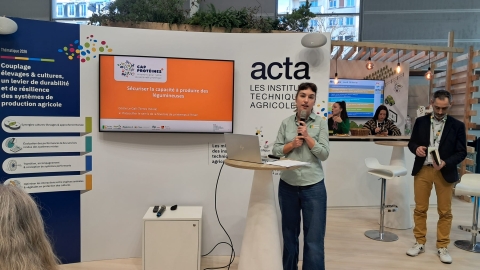
Ce programme qui s’appuie sur un consortium de 117 partenaires des filières végétales et animales, a présenté ses premiers résultats lors d’une conférence organisée sur le stand de l’Acta au Salon International de l’Agriculture, mercredi 25 février.
Ce programme qui s’appuie sur un consortium de 117 partenaires des filières végétales et animales, a présenté ses premiers résultats lors d’une conférence organisée sur le stand de l’Acta au Salon International de l’Agriculture, mercredi 25 février.
Démarré en 2024, le programme de recherche Cap Protéines+ a pour ambition d’acquérir des références technico-économiques, d’accompagner les acteurs des filières et de favoriser une appropriation massive des innovations et des connaissances existantes sur les légumineuses à graines et fourragères.
Chiffres clés
- Cinq actions coordonnées par Terres Inovia, Arvalis, Idele, Itavi et Ifip
- De 2024 à 2027
- Des subventions de 7,5 millions d’euros
- 114 partenaires
- Enjeu : sécuriser la production des légumineuses pour mieux la valoriser
Ce programme bénéficie d’un soutien important du Ministère de l’Agriculture, de l’Agro-alimentaire et de la Souveraineté alimentaire. « L’objectif est de doubler les surfaces de cultures riches en protéines à horizon 2030, ce qui implique de sécuriser la production et les usages en protéines. C’est pourquoi les actions du projet visent à aboutir à un maximum de résultats concrets dans les cours de ferme », a affirmé Pierre Chaetlon, représentant du ministère.
« La recherche est essentielle pour structurer la filière des légumineuses à graines pour mieux les valoriser auprès de nos agriculteurs car les enjeux d’avoir davantage de protéines végétales sur les exploitations est important pour favoriser la fertilité du sol tout en se donnant les moyens d’obtenir un rendement suffisant. C’est tout l’enjeu de Cap protéines+ »
Précocifier le semis de la féverole de printemps à l'automne en bio
Pour obtenir des variétés à faible teneur en vicine-convivine, Terres Inovia a évalué l’intérêt de précocifier le semis de la féverole de printemps à l’automne, avec la mise en place de 8 essais. « Le semis à l'automne a permis de réduire fortement les risques de stress thermiques comparativement à un semis de printemps. En revanche, il n'a pas permis de réduire les stress hydriques. Une sensibilité plus importante au froid pour les variétés de printemps mais sans pénalisation du développement et de la croissance sur la suite du cycle a également été constatée.
En outre, les variétés de printemps sont davantage capables de ramifier, et donc potentiellement de compenser la perte de la tige principale suite à des dégâts de gel », précise Cécile Le Gall, chargée d’études de Terres Inovia. Des premiers résultats encourageants qui attendent d’être confirmés lors d’une deuxième campagne d’essais.

Optimiser les process pour une meilleure valorisation des matières protéiques françaises
Un nouveau process a été travaillé pour optimiser la concentration de la protéine et la digestibilité des acides aminés pour les monogastriques dans le but de réduire notre dépendance aux tourteaux de soja d’importation. « Les premiers résultats d’essais permettent d’avoir une valorisation intéressante des profils aminés en volailles et porcs : le procédé PEP améliore considérablement la teneur en protéines », renchérit Isabelle de la Borde.
Des recherches ont aussi été effectuées pour mieux caractériser les variétés de lentilles et de pois chiche afin d’optimiser la cuisson. Une approche multicritère a été menée pour produire des connaissances sur la diversité génétique et pédoclimatique des graines, qu’elles soient sèches, trempées, cuites et appertisées. Des fiches de caractérisation de chaque variété seront prochainement disponibles pour les transformateurs.

L’autonomie protéique, un levier pour assurer la performance éco des exploitations
Des essais ont été réalisés pour tester l'impact d'une diminution de la complémentation azotée sur les performances zootechniques et économiques pour des agneaux en bergerie. Ils ont montré que cela n’avait pas d’impact sur la performance des agneaux et permettait de réduire la part d’alimentation azotée des animaux.
La filière porc a aussi testé l’insertion de protéagineux et de féverole, de tourteaux Expeller en filière courte (soja, colza et tournesol cultivées sur l’exploitation) et les tourteaux classiques en filière longue (colza et tournesol Hipro). Des expérimentations ont aussi été menées pour permettre aux agriculteurs d’être autonomes dans la formulation des rations par la mise à disposition d ‘un outil (PORFAL), l’utilisation de formules à bas protéiques et une alimentation multi-phase.
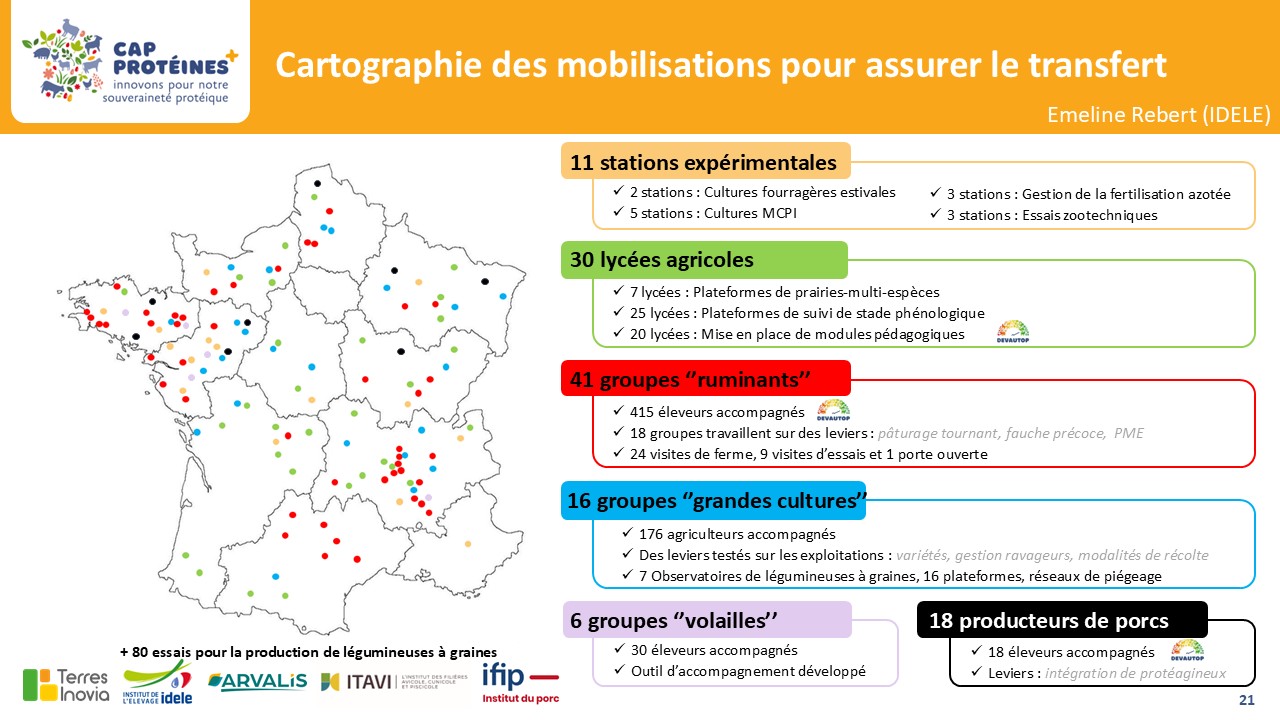
En outre, les références techniques ont pu être déployées aux conseillers et aux enseignants par des formations, des webinaires, des temps d’échange dédiés (comme les « cafés visios »), différents supports (chiffres-clés, observatoires, résultats d’essais…).
Co-concevoir un outil de formulation pour les éleveurs de volaille bio
Face au besoin des éleveurs d’être aidés pour formuler leurs rations, un outil est en cours de développement pour co-concevoir un outil utile et adapté permettant l'amélioration de l'autonomie des élevages de volailles bio par un collectif d’éleveurs, de conseillers et de chercheurs.
Structurer une filière territoriale de légumineuses à graines en Occitanie : FILEG
Le projet FILEG cherche à impulser une dynamique territoriale pour créer une filière à valeur ajoutée, de l’amont à l’aval. Par exemple, l’étude FALEB vise à créer des farines mixtes à base de légumineuses et (ré)inventer leurs usages dans les métiers de la boulangerie/pâtisserie artisanale. « Nous avons réussi à mettre autour de la table des acteurs qui ne seraient jamais croisés, comme les acteurs de la restauration collective et des chefs cuisiniers », précise Christophe Vogrincic, animateur de FILEG.

Nos autres actualités


Combining weed control methods for spring peas and field beans
With spring pea and faba bean sowing approaching, it's time to plan your weed control strategy according to the flora known to be present in the plot.
Les semis des pois et féveroles de printemps approchant, il est temps de prévoir votre stratégie de désherbage en fonction de la flore connue sur la parcelle.
Une application en prélevée : une solution sécurisante
Dans les situations de fortes infestations en dicotylédones concurrentielles (gaillet, renouées, matricaire) ou difficiles à maîtriser uniquement en post-levée (éthuse, arroche, renouée des oiseaux), une stratégie « tout en prélevée » offre un choix de produits plus large pour sécuriser la culture, mais reste plus onéreux.
La prélevée doit s’effectuer au plus près du semis, sur des semences recouvertes de terre et un sol rappuyé, afin de limiter les risques de phytotoxicité. Excepté dans les sols battants, un roulage est conseillé afin de bien recouvrir la graine avant toute intervention.
Un sol frais au moment du traitement et une légère pluviométrie dans les jours qui suivent sont les conditions idéales pour une bonne efficacité. Dans le cas de relevées d’adventices ou d’efficacité insuffisante (sol sec), un rattrapage en post-levée est possible.
Pour rappel, la féverole possédant moins de solutions de rattrapage en post-levée que le pois, la prélevée est importante pour assurer une bonne maîtrise des adventices.
Une stratégie post-levée seule : Pression faible et flore connue
Dans le cas de parcelles à faible infestation et/ou de flore connue, le choix d’une intervention unique en post-levée peut être suffisant. Veiller à intervenir sur des adventices jeunes (stade cotylédon à 2-3 feuilles), dans des conditions poussantes et en dehors de fortes amplitudes thermiques.
Certains programmes peuvent se fractionner afin d'augmenter l'efficacité contre certaines adventices. Espacer alors les deux interventions de 10-15 jours minimum.
Un programme de prélevée et post-levée
Un programme complet (pré+post) permet de maîtriser de très fortes infestations ainsi que des levées échelonnées d’adventices tout en maîtrisant le coût de son désherbage. Les adventices les plus difficiles à contrôler orientent le choix du ou des produits appliqués en prélevée.
Pour maîtriser les coûts, appliquer le produit de prélevée à une dose inférieure à la dose homologuée (3/4 de celle-ci), puis appliquer en post-levée sur des adventices jeunes des produits à faible dose.
Pour rappel, les différents produits à base de pendiméthaline, imazamox et bentazone ne sont pas mélangeables. Leur application dans un même programme en post-levée doit se faire en 2 applications – se référer aux délais de rentrée des différentes spécialités pour recomposer l’association initialement visée.
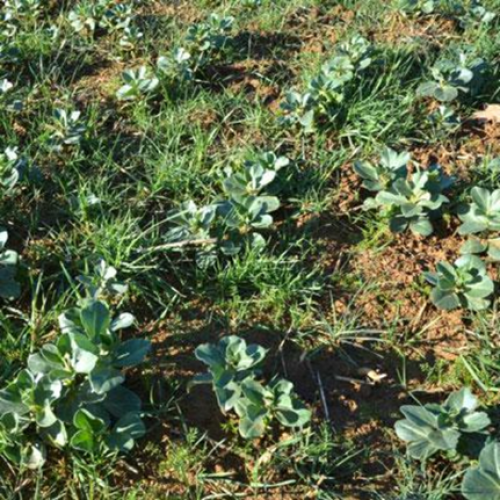
Exemple de programmes pour la féverole de printemps
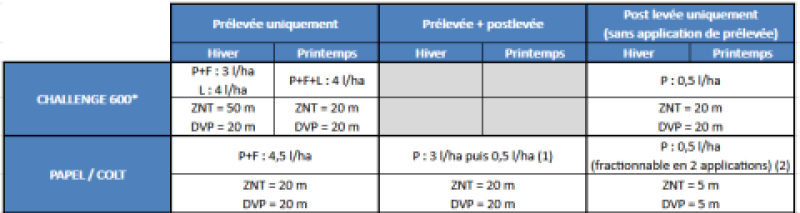
Exemples de programmes pour le pois de printemps
Rappel des règles d’utilisation de l’aclonifen (CHALLENGE 600 ou COLT/PAPEL) en pré et post-levée
*herbicide générique : CHANON, etc,..
P=pois
F=féverole
L=lupin
(1) : respecter un délai de 25 jours entre les 2 applications pour pois d'hiver, 15 jours pour pois de printemps
(2) : respecter un délai de 10 jours entre les 2 applications de postlevée
Gestion des graminées
Problématique montante dans les parcelles de protéagineux de printemps, la gestion des graminées constitue une difficulté majeure et ne doit pas être négligée. Les bases de pendiméthaline en prélevée telles que le NIRVANA S 3 l/ha et le PROWL 400 2l /ha présentent une efficacité modérée. Celle-ci peut être complétée par une association avec de l’aclonifen, Challenge 600 ou Colt à 2 l/ha.
Les anti-graminées foliaires peuvent être mobilisés en rattrapage de post-levée. Leur efficacité est extrêmement variable selon les situations de résistances des ray-grass/vulpin aux Fop et Dime.
Spectres d’action des produits sur pois
Spectres d’action des produits sur féverole
Désherbage mécanique : une solution efficace en conditions sèches
Avec des printemps parfois secs, le désherbage mécanique peut apporter une aussi bonne efficacité que certains programmes chimiques. Également, les stratégies mixtes associant prélevée chimique et post-levée mécanique sont des solutions efficaces si la météo est favorable. Elles sont moins onéreuses et faciles à mettre en œuvre, d’autant plus pour la féverole qui présente peu de solutions chimiques de rattrapage et se prête mieux que le pois au binage et à des passages mécaniques tardifs. Pour rappel, les interventions mécaniques gagnent en efficacité si elles s’effectuent avec 2 journées de beau temps avant et après.
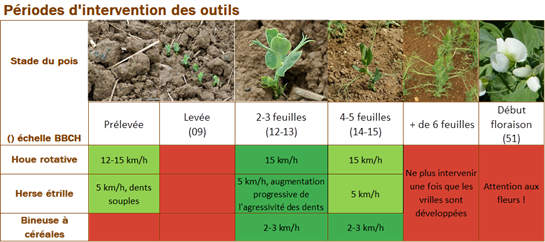
Pois de printemps : le désherbage en plein (herse étrille ou houe rotative) et la bineuse céréales sont possibles tant que les vrilles ne sont pas trop développées (4-5 feuilles max).
Avant la levée : un passage de herse étrille est possible, à l’aveugle, dès que la portance du sol est suffisante, sur des adventices jeunes et donc faciles à détruire.
A partir d’1 feuille : la houe rotative est la plus sélective sur les pois à ce stade. Elle est particulièrement adaptée aux sols limoneux. Son efficacité est liée au stade des adventices (fil blanc à 2 feuilles maximum).
A partir de 2-3 feuilles : effectuer un passage avec la herse étrille avant le stade 5 feuilles. Ne plus intervenir dès que les vrilles du pois sont développées ; les risques de pertes de plantes par arrachage sont élevés.
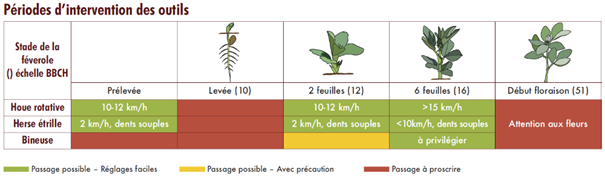
Féverole de printemps : les passages mécaniques peuvent s’opérer jusqu’à tard, en particulier pour la bineuse, tant que la hauteur du couvert le permet. Généralement, passé 6 feuilles, le risque de casse de tige augmente. Si ce stade est atteint, il faut donc bien raisonner les interventions. Aux stades antérieurs, la herse étrille peut présenter de bons résultats sur des adventices jeunes. La houe rotative ayant une efficacité moindre est à réserver plutôt aux sols limoneux qui valoriseront sa fonction d’écroûteuse. L’intérêt de la bineuse est de pouvoir intervenir sur des adventices plus développées.
Pour les féveroles semées à grand écartement (>45cm), la combinaison d’un herbicide localisé sur le rang avec un binage réalisé en différé quand les pédoclimatiques sont idéales présentera une très bonne efficacité pour une charge maîtrisée.
► Stratégies de désherbage mécanique ou mixte de la féverole
Opening Occitanie
l'Agence de l'Eau Adour Garonne, the European Union, the Occitanie region within the framework of a European Partnership for Innovation (PEI).
525 000 €
48 months Non NationalLes enjeux
Les producteurs de grandes cultures d’Occitanie doivent relever des défis techniques et environnementaux de taille, rendant indispensable la transition agroécologique de leurs systèmes de culture. Réussir une telle évolution requiert la mise en œuvre de projets agronomiques personnalisés, construits en collaboration avec leurs conseillers agricoles, visant à améliorer les performances de leurs systèmes de culture. Pour y parvenir, il est nécessaire que le conseil agricole s’appuie sur une démarche d’accompagnement spécifique.
Les objectifs
Le projet ambitionne de déployer la démarche d’accompagnement « Cap Agronomie », et de montrer aux conseillers et agriculteurs les bénéfices techniques, économiques et environnementaux qu’elle pourra générer pour les exploitations agricoles de grandes cultures, ainsi que pour le territoire d’Occitanie. C’est pourquoi le projet organise la formation de 6 conseillers de Chambres d’agriculture partenaires (Ariège, Aude, Haute-Garonne, Gers, Hautes-Pyrénées et Tarn-et-Garonne), qui mettront en œuvre la démarche auprès de 30 agriculteurs suivis de façon spécifique sur la durée du projet.
L’accompagnement consiste à prévenir l’apparition de facteurs limitant la production par une démarche d’anticipation fondée sur l’implantation des cultures, la fertilité des sols et l’évolution progressive des systèmes de culture.
Les résultats attendus
- Accompagner la transition agroécologique de 30 exploitations agricoles spécialisées en grandes cultures, localisées dans la Région Occitanie. Contribuer à la réussite de cette transition
- Réaliser la preuve de concept de la démarche « Cap agronomie » dans le contexte de production d’Occitanie : évaluer l’intérêt de la démarche pour les producteurs, et vis-à-vis des enjeux territoriaux
- Favoriser le déploiement à large échelle d’une démarche d’accompagnement innovante à la transition agroécologique des exploitations agricoles, visant à maintenir ou améliorer leurs performances techniques, économiques environnementales et sociales.
Le rôle de Terres Inovia

Coordinateur
- Pilotage du projet
- Transfert de la méthode d’accompagnement « Cap agronomie » aux conseillers de Chambres d’agriculture dans la cadre d’une formation action
- Accompagnement des conseillers à la mise en œuvre de la démarche auprès de 30 agriculteurs de la région Occitanie
- Valorisation et communication des résultats du projet
Do you have a question?
Contact our specialist who will respond promptly to your request.
These projects may be of interest to you
Here are some other projects dealing with the same themes.
Phosmet exit plan
Alternative operational strategies to phosmet withdrawal to reduce attacks and nuisance caused by autumn rapeseed pests.
-
Rapeseed
Pois d'hiver
Tournesol
Pois de printemps
Soja
Féverole d'hiver
Féverole de printemps
Lentille
Pois chiche
Lin d'hiver
Lin de printemps
Lupin d'hiver
Lupin de printemps
Cameline
Chanvre
Ravageurs
Fertilité et gestion durable des sols
CONCERTO
Concerted agro-ecological management of insect pests in field crops
Myco-Risk
Creation of a risk grid for Mycosphaerella in rapeseed
-
Rapeseed
Tournesol
Pois d'hiver
Pois de printemps
Soja
Féverole d'hiver
Féverole de printemps
Lentille
Pois chiche
Lin d'hiver
Lin de printemps
Lupin d'hiver
Lupin de printemps
Cameline
Chanvre
Job opportunities
M2ProLIV
Towards multi-functional protein ingredients obtained by moderate processing of lipid-rich plant co-products with health benefits
Matthieu Abella - m.abella@terresinovia.fr
15/10/2024 Agir pour la transition agroécologique Terres Inovia En cours NonCONCERTO
OFB
592 000 €
72 months Oui NationalLes enjeux
CONCERTO est un projet ancré dans le territoire des plateaux de Bourgogne, qui est en difficulté vis-à-vis de la gestion des insectes phytophages et est particulièrement sensible aux accidents climatiques en raison du faible potentiel des sols qui le composent.
L’approche territoriale proposée par le projet CONCERTO vise à atténuer les dégâts d’insectes phytophages sur l’ensemble des cultures en se passant d’insecticides.
L’action collective d’un groupe d’agriculteurs permet de mobiliser des leviers agroécologiques comme la lutte biologique par conservation ou des techniques de plantes pièges (intercultures pièges pilotée®).
Les approches collectives et paysagères sont particulièrement pertinentes dès lors que l’on souhaite influer sur l’abondance et la diversité des populations d’insectes, qu’ils soient ravageurs ou auxiliaires.
De plus, le projet CONCERTO dans lequel des fermes entières sont engagées, réaffirme la nécessité d’obtenir des systèmes rentables et multi-performants.
Il souhaite répondre à quatre enjeux majeurs pour les agriculteurs du territoire :
- La limitation des dégâts associés aux coléoptères ravageurs d’automne du colza
- La gestion des pucerons d’automne vecteurs de viroses sur les céréales à pailles
- La réduction des dégâts de bruches du pois et de la lentille
- L’amélioration de la fertilité des sols
Les objectifs
CONCERTO, qui s’inscrit dans la continuité des travaux du projet R2D2, visera à accompagner un groupe de producteurs dans la re-conception de leurs systèmes pour supprimer progressivement les applications d’insecticides sur l’ensemble du territoire. Il contribuera à l’atteinte des objectifs du plan ECOPHYTO.
La cible à long terme du projet, définie conjointement avec les agriculteurs est :
- Améliorer les performances des systèmes de culture incluant le colza
- Réduire progressivement les applications d’insecticides sur l’ensemble des cultures
- Réduire des applications d’herbicides
En plus de ces trois objectifs, le projet va travailler à :
- L’adaptation au changement climatique et l’atténuation de ses effets en renforçant la résilience des systèmes agricoles, notamment via le travail autour de l’implantation de haies et d’arbres isolés qui jouent un rôle clé dans le cycle de l’eau et permettent de créer des microclimats plus favorables à proximités des parcelles cultivées.
- La préservation de la biodiversité, en travaillant pour la création d’un maillage d’infrastructures écologiques fonctionnelles autour des parcelles et en renforçant la ressource florale à l’échelle du territoire.
Les résultats attendus
- Suivre le niveau de pression des ravageurs du colza et de la bruche du pois.
- Suivre les régulations biologiques des principaux coléoptères ravageurs du colza.
- Développer l’action collective territoriale pour gérer les insectes phytophages.
- Modifier les structures paysagères afin de favoriser les régulations biologiques selon les principes de la lutte biologique par conservation.
Le rôle de Terres Inovia
Coordinateur
- Animation du projet
- Co-conception et suivi du projet de territoire
- Acquisition et traitement des données issus des suivis scientifiques
- Accompagnement individuel et collectif des agriculteurs
- Expertise agronomique
Do you have a question?
Contact our specialist who will respond promptly to your request.
Our partners
Ces projets pourraient vous intéresser
Voici d'autres projets abordant les mêmes thématiques.
Herbi1&NoPhy
Experimenting with agroecological systems for pesticide use as a last resort
Nicolas Cerrutti - n.cerrutti@terresinovia.fr
01/01/2025 Eclairer les décisions stratégiques Terres Inovia En cours NonM2ProLIV
ANR
undisclosed
59 months Non NationalLes enjeux
L’enjeu de M2ProLIV est de faciliter la transition vers des systèmes alimentaires plus durables, plus sains et économiquement viables, tout en renforçant les capacités technologiques et scientifiques de la France dans ce domaine. Plus particulièrement, il répond à plusieurs enjeux :
- Améliorer la qualité nutritionnelle des aliments en proposant des alternatives aux protéines animales
- Réduire l’impact environnemental de la production alimentaire en se tournant vers les protéines végétales
- Valoriser les co-produits des industries de pressage d’oléagineux et de production de lipides de microalgues
- Développer des procédés pour obtenir des ingrédients protéiques fonctionnels et nutritionnellement intéressants
- Créer un tissu de collaborations interdisciplinaires entre instituts de recherche et partenaires industriels
Les objectifs
Les objectifs du projet M2ProLIV sont axés sur l'amélioration de la durabilité, de la qualité nutritionnelle et de la fonctionnalité des aliments protéiques à partir de ressources végétales :
- Étudier les procédés de fractionnement humide ou sec pour produire des fractions protéiques moins pures mais potentiellement plus fonctionnelles.
- Utiliser la fermentation solide ou la protéolyse enzymatique pour développer des extraits protéiques multifonctionnels, tels que des antioxydants et des émulsifiants.
- Produire des hydrolysats protéiques ayant des propriétés de chélation de métaux pour répondre aux carences en micronutriments, particulièrement en fer et en zinc.
- Comprendre comment les ingrédients naturels s'organisent et évoluent dans des systèmes alimentaires.
- Développer un itinéraire technologique applicable aux graines de chanvre décortiquées permettant de réduire la teneur en lipides à froid pour conserver les propriétés fonctionnelles des protéines.
Les résultats attendus
En développant des ingrédients protéiques multifonctionnels à partir de co-produits végétaux et en utilisant des procédés de transformation douce, M2ProLIV devrait contribuer à une alimentation plus durable et plus saine, mais aussi ouvrir de nouvelles opportunités pour l'industrie agroalimentaire en France.
Le rôle de Terres Inovia

Partenaire
- Acquisition de références sur les conditions de récolte et de séchage de la graine de chanvre :
- Taux de graines vertes
- Acidité de l’huile
- Teneurs en huile et en protéines
- Amélioration de l’extraction mécanique des graines de chanvre décortiquées.
- Caractérisation rhéologique de la graine de chanvre
- Travaux sur l’optimisation des profils de vis pour limiter l’échauffement tout en réduisant la teneur en huile.
- Production de co-produits : fourniture d’une gamme de tourteaux obtenus dans des conditions bien caractérisées pour définir les conditions optimales de production.
- Synthèse et diffusion des résultats
Do you have a question?
Contact our specialist who will respond promptly to your request.
Patrick Carré - p.carre@terresinovia.fr
01/01/2024 Eclairer les décisions stratégiques CIRAD En cours NonTwinFarms
ANR
4 991 289 €
48 Non NationalThe challenges
Originating in engineering, digital twins - virtual replicas of physical systems - have enabled advances in many sectors, driven in particular by the proliferation of sensors. Agriculture is no exception to this trend: on a farm scale, the combination of data from sensors and existing agronomic knowledge opens up promising prospects for supporting the agro-ecological transition, against a backdrop of increasingly stringent climate change.
In a tactical approach, a digital twin farm could help farmers adjust their decisions over the course of the campaign, depending on the condition of crops and/or animals, drawing on in situ sensors as well as external data such as satellite images. This would be particularly useful for reacting to increasingly unpredictable climatic contingencies.
From a strategic perspective, the digital twin would enable farmers to simulate the evolution of their system over the medium to long term, in order to anticipate the effects of different change scenarios.
TwinFarms aims to make these uses tangible and accessible in the field.
The objectives
Twinfarms aims to deploy digital twins at farm level to foster agro-ecological innovation. It will be based on nine demonstrators where the digital twins should provide added value to facilitate tactical or strategic choices.
Expected results
Create a data platform that collects, cleans, organizes and stores accurate data from sensors and other databases.
Establish specifications for digital twins, assess the quality of the twins produced, and anticipate future services to be provided to enhance the agroecological transition.
- Design physical, biological and mathematical models. Learn from temporal, heterogeneous, incomplete and irregularly sampled data, and generalize these models for various applications.
- Develop intuitive and efficient user interfaces to enable farmers to take advantage of digital twins. This includes specifying requirements, implementing prototypes and writing user guides.
The role of Terres Inovia
Partner
- Specification of farmers' needs and expectations with regard to digital twins
- Identification of data sources and existing models
- Participation in a use case: SYSTERRE
Do you have a question?
Contact our specialist who will respond promptly to your request.
These projects may be of interest to you
Here are some other projects dealing with the same themes.
Opening Occitanie
- Supporting the agro-ecological transition of 30 farms in Occitania
Herbi1&NoPhy
Experimenting with agroecological systems for pesticide use as a last resort
Julie Auque - j.auque@terresinovia.fr
Celia Pontet - c.pontet@terresinovia.fr
The taste of pulses" campaign to celebrate pulses
To mark World Pulses Day on February 10, the INCREASE project, in which Terres Inovia is a partner, is taking part in "The taste of pulses" campaign. The aim? Invite all citizens to share recipes and events dedicated to these species, rich in nutritional benefits and respectful of the environment.
To mark World Pulses Day on February 10, the INCREASE project, in which Terres Inovia is a partner, is taking part in "The taste of pulses" campaign. The aim? Invite all citizens to share recipes and events dedicated to these species, rich in nutritional benefits and respectful of the environment.
On February 10, as part of World Pulses Day, INCREASE is inviting people to mark the occasion by celebrating the versatility of pulses through shared meals featuring delicious legumes. Gathering around a table highlights how legumes such as beans, lentils, chickpeas and lupins connect people from different cultures, enriching our culture, our health and our planet.
Why are legumes synonymous with sustainable, healthy and delicious meals?
Legumes are nutrient-rich, climate-friendly crops that fix nitrogen in soils, reduce the need for artificial fertilizers, promote biodiversity and grow with less water than many other protein sources. By promoting more resilient farming systems, legumes play a key role in sustainable food production. Not only are they good for the planet, they are also essential to a healthy diet. Their versatility on the plate, from traditional stews to innovative vegetarian dishes, shows that sustainability, healthy eating and taste go hand in hand, making pulses indispensable to sustainable, affordable and inclusive eating worldwide.
Find inspiration and share it on The Taste of Pulses
INCREASE makes it easy to share a legume-based meal with family and friends: the "Taste of Pulses" campaign offers a growing collection of recipes from all over Europe, giving people the chance to share their favorite legume-based dish.
As World Pulses Day approaches, INCREASE is encouraging everyone to take action: register your pulse-related events and submit your favorite pulse-based recipes via the "The Taste of Pulses" website, to help showcase the diversity and creativity of pulses across Europe and inspire others to cook, share and celebrate pulses together!
Take part in the INCREASE citizen science experiment
The celebration of World Legume Day is also closely linked to the INCREASE citizen science experiment, in which participants can grow and document different bean varieties, thus contributing to scientific research and the conservation of agricultural biodiversity.
Good news: there's still time to sign up and take part in this hands-on research! Enthusiasts, gardeners, gourmets and curious minds can register for the 2026 edition of the INCREASE citizen science experiment until February 28, 2026 via the INCREASE CSA app. No specialized equipment is required, just a love of legumes, a smartphone and a space to grow. Participants receive a selection of various bean seeds, learn hands-on about plant characteristics, document their observations using the app, and can share seeds and cooking recipes with other citizen scientists across Europe.
Come and join us! Grow beans, share the taste of legumes and join a community shaping a more sustainable food future together.
More information

Grass weed management: what levers are used by growers?
As part of the GRAMICOMBI project, a survey of 32 farmers has just been carried out to gain a better understanding of the obstacles to farmers' adoption of grass weed management levers.
As part of the GRAMICOMBI project, a survey of 32 farmers has just been carried out to gain a better understanding of the obstacles to farmers' adoption of grass weed management levers.
The GRAMICOMBI project was launched as part of the PARSADA program. Spearheaded by Terres Inovia, its aim is to develop combinations of levers for integrated grass weed management and to deploy them on a national scale.
To find out what hinders the adoption of agronomic levers for better grass weed management, a survey was carried out among farmers. " It was carried out as part of the Objectif Cultures Propres (OCP) network in Bourgogne Franche Comté, which aims to assess the effectiveness and feasibility of combining grass management levers at the cropping system level, by monitoring and implementing an action plan for five years on 32 farmers' plots ", explains Victor Fleury, development engineer at Terres Inovia. The network is run by nine partners: Terres Inovia, Arvalis, Alliance BFC, the departmental Chambers of Agriculture of the BFC region and the Tart-le-Bas experimental farm.
Highly heterogeneous adoption of levers
During the survey, each farmer ranked different grass management levers, according to their feasibility, in one of four categories: achievable, possible, restrictive and impossible.

The results show a high degree of heterogeneity in the adoption of levers. " Some practices are already well integrated into cropping systems, such as the application of glyphosate before sowing, diversification of chemical weed control and border maintenance ". On the other hand, some levers are less widely used, despite their recognized agronomic value: the combination of staggered sowing dates, diversification with mechanical weeding and cleaning of harvesting tools offers considerable scope for progress. Lastly, others, such as the introduction of an Intermediate Energy Crop (CIVE), pollarding and the recovery of chaff, are generally perceived as difficult to integrate into current systems.
Economic and technical obstacles
The main obstacles are economic: access to specific equipment, lack of outlets, investment costs and uncertain profitability. The adoption of new grass weed management levers also comes up against technical trade-offs: ploughing, for example, is often seen as a lever of last resort in the event of technical impasse. Similarly, the choice of variety is often prioritized for disease resistance or yield potential, to the detriment of covering power. " The lack of technical references, consensus on the effectiveness of certain levers and feedback from experience also hinders their adoption. The example of covering varieties is a good illustration of this difficulty, with effectiveness perceived as highly variable depending on the context ". Finally, certain obstacles are very specific: working time and site organization for mechanical weeding, recourse to service provision, soil type, plot distribution, etc.
The survey results show that many grass weed management levers are still under-utilized by farmers. While some are hampered by structural or economic obstacles, others require technical support for the farmer, reinforced references and adaptation to the context of each farm. This is precisely the aim of the PARSADA GRAMICOMBI project, led by Terres Inovia, which includes the OCP network: to remove the barriers to adoption and promote a coherent combination of grass weed management levers across the entire cropping system.
Peas and field beans: seed treatments available to protect them
Since the withdrawal of WAKIL XL in 2021 and two campaigns with a derogatory use for this speciality until 2023, protein seeds have been without specific protection against mildew. What has happened since then? What solutions are now available to protect peas and faba beans?
Depuis le retrait du WAKIL XL en 2021 et deux campagnes avec un usage dérogatoire pour cette spécialité jusqu’en 2023, les semences de protéagineux sont sans protection spécifique face aux mildious. Que s’est-il passé depuis ? Quelles solutions sont désormais disponibles pour protéger les pois et féveroles ?
Les mildious du pois (Peronospora pisi) et de la féverole (Peronospora viciae) sont deux pathogènes distincts qui peuvent occasionner des pertes de pieds à la levée et donc impacter le peuplement voire le rendement. Les agents de la fonte des semis sont quant à eux plus nombreux (genres Pythium, Fusarium, etc.) et peuvent être communs à ces deux cultures. Enfin, l’aphanomycès est un pathogène spécifique du pois protéagineux et particulièrement du pois de printemps, qui peut avoir un réel impact sur le rendement de la culture en entraînant la pourriture du système racinaire et ainsi la perte de pieds.
Combiner les leviers
A ce jour, aucune solution de traitement de semences n’est disponible pour lutter contre l’aphanomyces. Des règles simples de choix de parcelle en fonction de différents critères permettent d’éviter les situations à risque (outil Eva de Terres Inovia). Des variétés de pois de printemps plus tolérantes ont par ailleurs été inscrites et sont conseillées dans les parcelles faiblement contaminées pour sécuriser les rendements. Elles permettent d’envisager la culture du pois de printemps sur des parcelles à pression faible à modérée. Enfin, Terres Inovia poursuit l’évaluation de solutions de traitements de semences pour compléter la stratégie de gestion.
À la suite de l’interdiction de l’usage en plein champ du WAKIL XL, les pois et les féveroles avaient perdu leur unique solution de traitement de semences alors disponible. Avec son large spectre, le WAKIL XL permettait de sécuriser l’implantation de ces deux cultures en ayant une action à la fois anti-mildiou via le métalaxyl-M mais aussi une action anti-fonte des semis via le fludioxonil et le cymoxanil. Depuis 2021, le seul traitement de semences autorisé sur pois et féveroles était le PREPPER, à base de fludioxonil (voir encadré). Ce dernier n’a aucune action contre les mildious mais montre une efficacité contre les agents de la fonte des semis (Fusarium et Ascochyta).
Depuis 2023, une augmentation de la présence de mildiou a été observée sur pois protéagineux dans les réseaux BSV. L’augmentation constatée concerne les attaques primaires (c’est-à-dire à la levée de la culture) et montre bien la présence du pathogène dans les parcelles, où il peut se conserver jusqu’à huit ans. En moyenne 4,6 % de parcelles ont été déclarées touchées par du mildiou entre 2011 et 2023 (utilisation du WAKIL XL autorisée) contre 16 % en moyenne pour 2024 et 2025 (moyennes pondérées). Sans avoir de volonté d’explication statistique, ces chiffres mettent en avant une tendance sur les dernières années (figure 1) et le besoin d’une solution de gestion performante de cette maladie.
PREPPER : un usage limité
Attention, depuis 2025, Certis-Belchim a fait retirer l’usage de la spécialité PREPPER sur féveroles et ne cautionne plus cet usage. Il reste cependant disponible sur pois protéagineux et les autres cultures bénéficiant déjà d’une AMM.
Une dérogation pour un traitement de semences anti-mildiou
La demande de dérogation 120 jours (art53 REG 1107/2009) déposée le 2 juillet 2025 par Terres Univia et Terres Inovia au niveau des services du ministère de l’Agriculture – avec le soutien de Corteva – a reçu un avis positif.
La spécialité commerciale LUMISENA, traitement de semence efficace contre le mildiou, bénéficie donc d’un usage dérogatoire pour la campagne 2026 (Graines protéagineuses*Trt Sem*Champignons (pythiacées)). Les semences traitées sont utilisables du 15/11/2025 au 15/03/2026 (120 jours) uniquement pour le pois protéagineux et la féverole (printemps et hiver).
Retrouvez tous les articles des éditions d'Arvalis & Terres Inovia infos ici : https://www.terresinovia.fr/fr/actualites/consultez-le-dernier-numero-darvalis-terres-inovia-infos-6
Pensez à vous inscrire à nos formations dédiées :
Anne Moussart - a.moussart@terresinovia.fr