

Automatically generated translation
In the region, spring pea sowing has been particularly delayed due to unfavorable weather conditions. Here are a few points to remember about late sowing.
To date, spring pea sowing has not yet started in Poitou-Charentes. This week's more favorable weather conditions will enable plots to dry out again and sowing to start in the first week of March, depending on soil type.
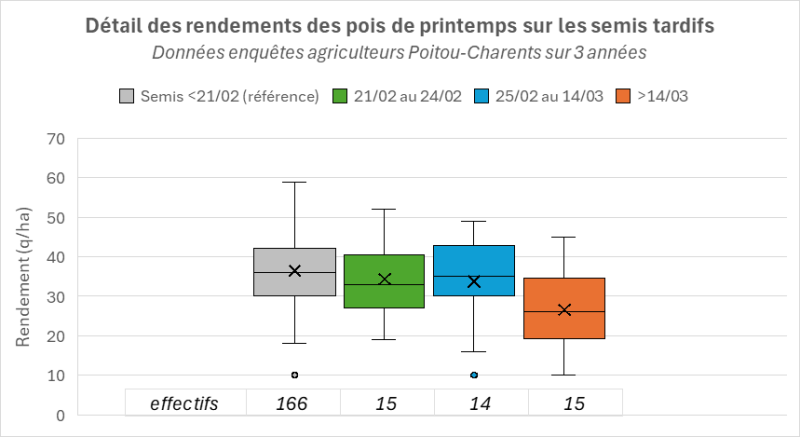
Terres Inovia's surveys of farmers' practices have enabled us to study the impact of sowing date on spring pea yields. Over the three years studied (2017, 2020 and 2023), a trend emerged: spring peas sown before the date of 01/31 tend to have higher yields than those sown after the date of 02/20. Late sowing reduces the median yield and increases its variability.
This drop in yield and variability in late sowing of spring peas can be explained by the risk of coulure at flowering and seed abortion, linked to exposure to water and heat stress at the end of the cycle.
With this context of sowing in wet conditions, diseases will need to be carefully monitored in spring pea plots from the start of the campaign.
While most sowing will take place after the recommended sowing dates, there are still possibilities for success. First of all, unlike in years such as 2020, 2022 or 2025, the start of the campaign is starting with full reserves, which are necessary for good pea development at the beginning of the cycle, and in particular for successful nodulation, the key to potential. The risk of early water stress is lower than in other years.
Also, even though potential decreases and variability increases after the end of February, yields really start to drop from mid-March onwards.
In most situations, you can leave yourself the week of March 2 to 8 to judge your plot's capacity for drying out and bearing capacity. In which case, sow within the next 10-15 days if you judge that conditions are favourable for sowing.
In the case of plots that are not sufficiently drained, or in the event of a return of heavy rainfall, it is advisable to consider another crop, such as sunflower.
As pea seed keeps well, it is possible to store and reuse the seed investment for the following season.
Si la plupart des semis vont s’effectuer après les dates de semis recommandées, des possibilités de réussite sont encore envisageables. Tout d’abord, à la différence d’année tel que 2020, 2022 ou 2025, le début de campagne démarre avec des réserves pleines, nécessaires au bon développement des pois en début de cycle et notamment à la réussite de la nodulation, gage du potentiel. Le risque d’un stress hydrique précoce est plus faible que d’autres années.
Également, même si les potentiels diminuent et les variabilités augmentent passé fin février, on observe un réel décrochage des rendements à partir de mi-mars.
Dans la plupart des situations, vous pouvez vous laisser la semaine du 2 au 8 mars pour juger de la capacité de ressuyage et de portance de votre parcelle. Et auquel cas, semer dans les 10-15 prochains jours si vous jugez les conditions propices au semis.
Dans le cas de parcelles ne présentant pas une dynamique de ressuyage suffisante, ou en cas d’un retour de pluies conséquentes, il est recommandé d’envisager une autre culture telle que le tournesol.
La semence de pois se conservant bien, il est tout à fait possible de stocker et de réutiliser l’investissement semence pour la campagne suivante.