
Automatically generated translation
It is essential to consider the entire crop rotation when planning to maximize the chances of success for camelina as a summer catch crop. Therefore, its introduction must be carefully planned and anticipated from the very start of the main crop’s cultivation.
Selection criteria
- Early-harvested main crop (winter barley, winter peas, etc.)
- Choose legumes to avoid the need for fertilization
- Avoid fields with a high-risk spring herbicide program
- Prioritize weed-free fields
What is the main crop?
The first criterion is to choose a crop that is harvested early, allowing camelina to be planted between June 20 and July 10, to ensure harvest before the end of October. The main candidate crops are therefore winter peas or winter barley, but other early-harvested crops may also be suitable: dry peas, garlic, onions…
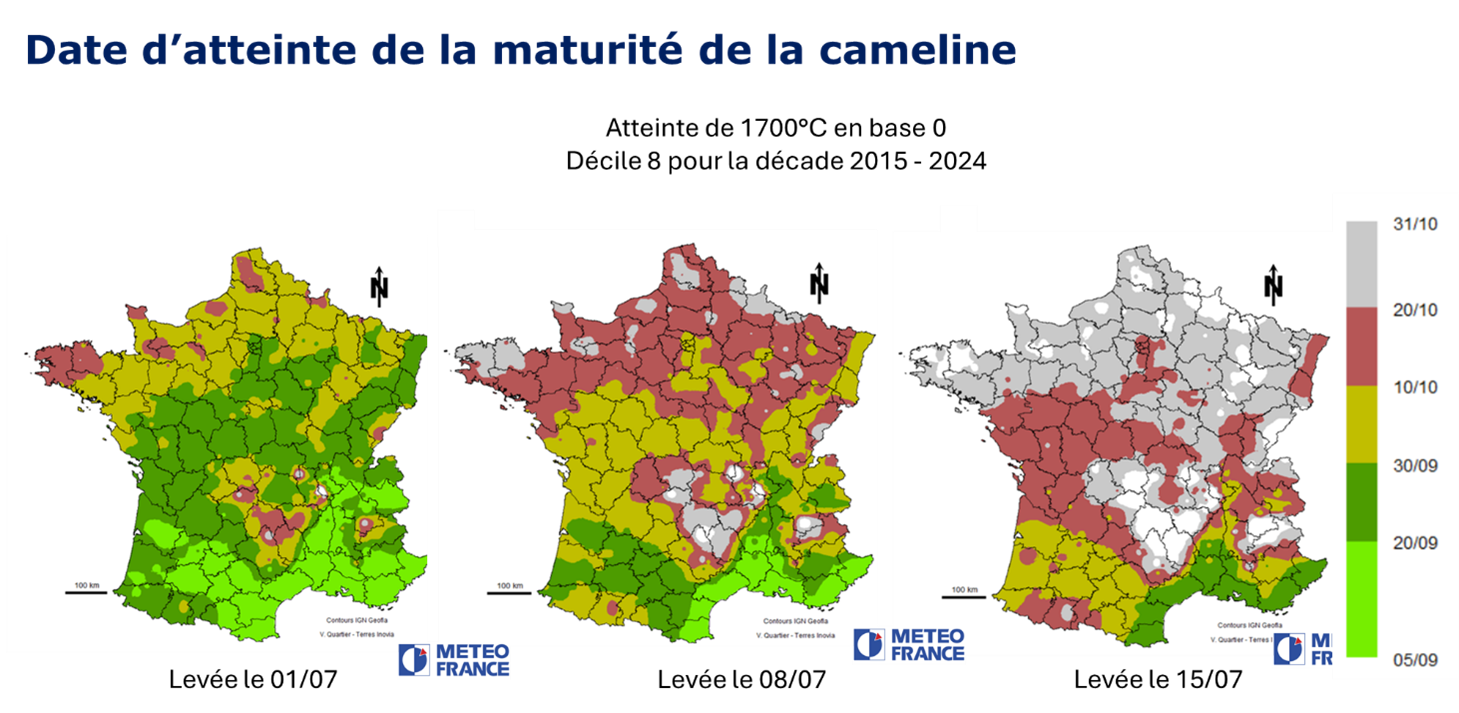
The map below, which shows the maturity date for very short-cycle varieties based on different emergence dates, illustrates the importance of early sowing. For example, for a July 1 emergence, camelina reaches maturity before October 10 throughout France, whereas for a July 8 emergence, it reaches maturity after October 10 in northern France, and for a July 15 emergence, it reaches maturity after October 20 in nearly half of northern France.
Planting camelina after a legume (such as winter peas) is particularly beneficial because it allows farmers to limit or even eliminate the need for nitrogen fertilization, thereby reducing the operational costs of the crop rotation system.
Focus on the herbicide program for the main crop
Camelina grown as a summer catch crop is susceptible to the residual effects of certain herbicides, primarily those in Group 2 (ALS1 inhibitors), including sulfonylurea herbicides such as metsulfuron, mesosulfuron, etc., as well as imazamox (applied to winter peas). It also appears to be sensitive to Group 14 herbicides (PPO2 inhibitors such as bifenox) and those in Group 32 (solanacyl diphosphate synthase inhibitors, such as aclonifen, applied to winter peas).
There is therefore a risk of phytotoxicity (leaf discoloration, plant loss, etc.) for camelina when these herbicides are applied in the spring to the main crop; this risk is even greater under dry conditions, in cases of late application, and when there is little or no tillage between the harvest of the main crop and the planting of camelina. Nevertheless, the effects of these herbicides can vary depending on various factors (precipitation, soil type, tillage, application date and rate, etc.) and remain poorly understood and quantified today.
Weed pressure on the plot
Once well-established, camelina is a crop that competes effectively with weeds. Nevertheless, in the field, weed pressure remains one of the main limiting factors for camelina grown as a summer catch crop; it is therefore essential to utilize every possible strategy to manage weeds effectively.
It is recommended to select a weed-free plot at the time of sowing. If weeds are present at the time of the main crop harvest and direct seeding is desired, a glyphosate application may be useful for managing weeds prior to sowing.
1ALS: acetolactate synthase
2PPO: protoporphyrinogen oxidase
Our other articles

-
Rapeseed
Tournesol
Féverole d'hiver
Féverole de printemps
Soja
Pois d'hiver
Pois de printemps
Lentille
Pois chiche
Lin d'hiver
Lin de printemps
Lupin d'hiver
Lupin de printemps
Cameline
Chanvre
Implantation
Récolte
Ravageurs
Choix variétal
Watch the recordings of the Terres Inovia 2026 webinars
-
Rapeseed
Tournesol
Pois d'hiver
Pois de printemps
Soja
Féverole d'hiver
Féverole de printemps
Lentille
Pois chiche
Lin d'hiver
Lin de printemps
Lupin d'hiver
Lupin de printemps
Cameline
Chanvre
Diversifier son système de culture
Syppre Berry and Picardie Platforms: Terres Inovia Shares Its Latest Results
Publications on camelina