
Automatically generated translation
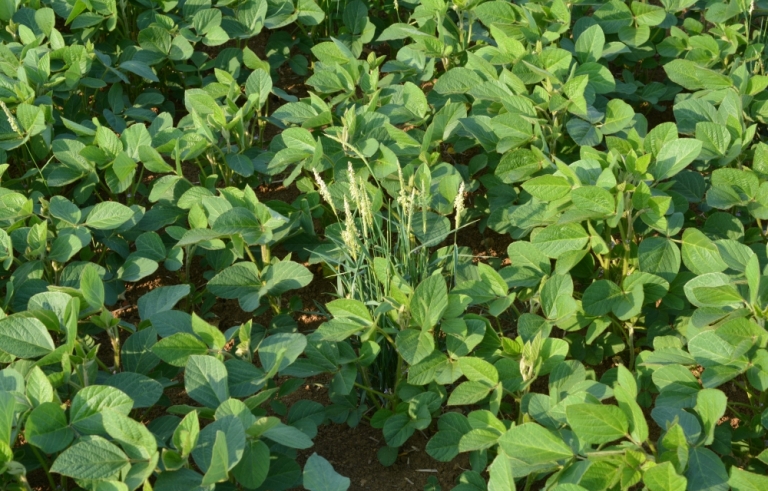
Common ragweed grows primarily in spring crops, due to a life cycle that is synchronized with those crops. While effective herbicide solutions exist, they must be supplemented with agronomic measures to limit its establishment in the long term.
Two agronomic measures stand out for their effectiveness:
- Introducing winter crops helps break the ragweed life cycle (since they have different growth schedules). However, it is essential to destroy any seedlings that emerge during the summer intercrop. Planting two consecutive winter crops further enhances the effectiveness of this strategy.
- Delaying the sowing of the spring crop (e.g., soybeans), combined with the false sowing technique, is also an effective strategy. This practice involves stimulating seed germination before destroying them, either chemically (using glyphosate) or mechanically, while minimizing soil disturbance during operations to prevent new seeds from being brought to the surface.
Trials conducted in 2016 in Deux-Sèvres showed that delaying sowing from May 2 to May 20, combined with a false sowing followed by chemical destruction, reduces ragweed emergence in soybeans by 64%. Similar results have been observed more recently in sunflowers.
What herbicide solutions are available for ragweed?
Early pre-emergence weed control is essential to limit competition early in the growing season. Among the available options, Proman (Inigo/Soleto), which contains metobromuron, offers the most significant efficacy.
This treatment must be supplemented with a post-emergence application, either of imazamox alone or a combination of imazamox and bentazone, to optimize weed control, limit damage to soybeans, and prevent the buildup of weed seed banks.
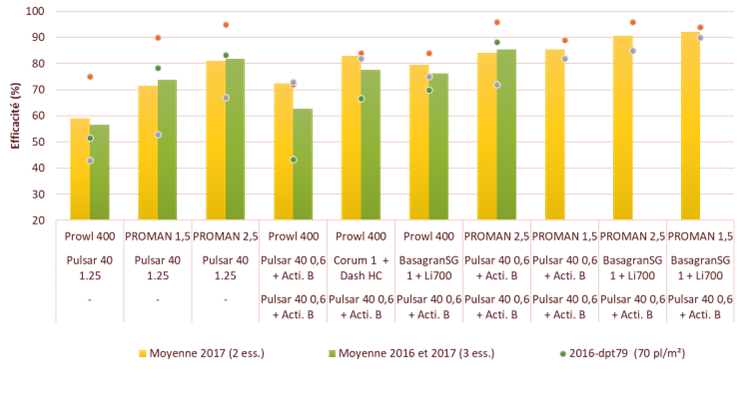
Trials conducted by Terres Inovia between 2016 and 2017 highlighted:
the benefits of splitting Pulsar 40 applications post-emergence, rather than a single application at 1.25 L/ha at the 3–4 leaf stage;
the complementary nature of bentazone and imazamox in two treatments.
The use of metobromuron in the pre-emergence stage also helps reduce selection pressure. In this context, increasing the dose of Proman (from 1.5 to 2.5 L/ha) does not provide any additional benefit when Pulsar 40 is split and combined with an adjuvant.
Alternating active ingredients and their modes of action helps limit the risk of ragweed developing resistance to imazamox at this time. The use of metobromuron in the pre-emergence treatment also contributes to the goal of reducing selection pressure.
Recommended soybean program
To optimize the cost-effectiveness ratio while minimizing the risk of lack of selectivity on well-drained soils, Terres Inovia recommends a combined strategy:
- As a pre-emergence treatment, Proman can be applied at 1.5 L/ha, with the dosage adjustable between 1 and 2 L/ha depending on soil type, in accordance with the label. Be sure to consult the label.
- For post-emergence treatment, an initial application can be made at the 2–3 true-leaf stage using Basagran at 1 kg/ha with a surfactant or Corum at 1 l/ha. Eight to ten days later, a follow-up treatment with Pulsar 40 at 0.625 l/ha combined with a vegetable oil (Actirob B 1 l/ha) completes the control.
A strategy relying solely on two applications of Pulsar 40 at 0.625 L/ha with a surfactant is also feasible. Results show that Basagran and Corum offer equivalent performance when used as the first treatment.