

Automatically generated translation
Intense competition from weeds, particularly summer grasses, requires careful management of soybean herbicide programs to ensure yield potential. Given the limited range of available solutions, combining active ingredients provides a solid foundation for effective weed control. A post-emergence treatment will enhance efficacy by targeting emerging grasses.
Tax Collection: Collaborating for Better Management
The main active ingredients available for pre-emergence application are pendimethalin (Prowl 400), pethoxamid (Successor 600), and DMTA-P (Isard, under a 120-day exemption). Other substances, such as metobromuron or clomazone, can supplement these programs, but their contribution is limited to the rates that can be used on soybeans. Furthermore, certain technical constraints must be taken into account. Pendimethalin and metobromuron may pose a risk of reduced selectivity on well-drained soils when rates exceed 1.5 L/ha.
For pre-emergence application, the use of Isard at 0.7 L/ha is a standard treatment for major summer grasses and offers a broad spectrum of control against certain broadleaf weeds such as nightshade or ragweed. Increasing the dose to 0.9 L/ha improves the consistency of control. Combining DMTA-P with Atic Aqua or Proman at 1 L/ha enhances weed control and provides initial control of goosefoot and knotweed. In more complex weed situations, particularly where bindweed is present, the pre-emergence partner’s rate should be increased to 1.5 L/ha, except on highly permeable or heavily compacted soils. Replacing the Isard base with Successor 600 at 1.5 L/ha is possible within this strategy but appears slightly less effective against foxtail and barnyard grass. Adding Centium CS at 0.3 L/ha improves the consistency of control.
The Importance of Post-Emergence Foliar Application
Soybeans, which provide little ground cover early in the growing season, tend to become overrun with grass weeds. A post-emergence treatment is therefore often necessary to control these new weeds. Imazamox (Pulsar 40 or Davai), in addition to its broad spectrum of activity against broadleaf weeds, effectively controls certain summer grasses, unlike bentazone. If control is insufficient, a follow-up treatment with a foliar grass herbicide remains possible and effective. It is recommended to rotate modes of action to limit the risk of resistance.
Pre-emergence (L/ha) | Post-emergence (L/ha) | Average efficacy on panic grass, foxtail, and barnyard grass (%) | Program cost (€/ha) |
ISARD 0.7 + PROMAN 1.5 | PULSAR 40 0.8 + ACTIROB B 1 | 90 | 102 |
SUCCESSOR 600 1.5 + CENTIUM 36 CS 0.3 | 85 | 96 | |
ISARD 0.7 + ATIC AQUA 1.4 | 95 | 94 | |
ISARD 0.7 + PROMAN 1 | 90 | 88 | |
ISARD 0.7 + ATIC AQUA 1 | 92 | 84 | |
SUCCESSOR 600 1.5 | 77 | 68 | |
ISARD 0.7 | PULSAR 40 1 | 85 | 60 |
Challenging situations
Certain situations remain particularly complex. Perennial grasses consistently require the use of foliar grass herbicides, as pre-emergence solutions and imazamox are insufficient. Regarding winter grasses, and particularly ryegrass, the development of herbicide resistance makes the effectiveness of foliar grass herbicides and imazamox unpredictable. Under these conditions, current registered pre-emergence programs, such as pendimethalin or pethoxamid used alone, are clearly insufficient. The choice should be a DMTA-P formulation at 0.9 L/ha, possibly supplemented with pendimethalin or metobromuron.
Common ragweed: Recommended treatment plan
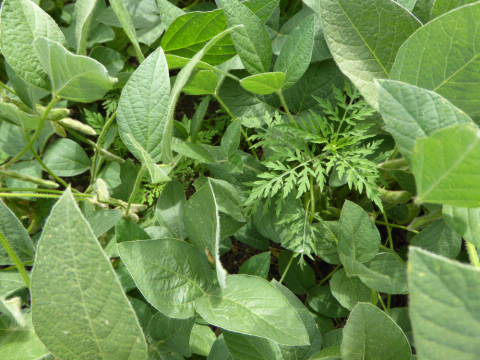
To optimize the cost-effectiveness of ragweed control, a combined strategy is recommended. For pre-emergence application, Proman at 1.5 L/ha offers the best efficacy. This application should be followed by a first treatment at the 2- or 3-true-leaf stage with Basagran at 1 kg/ha or Corum at 1 L/ha. Eight to ten days later, a follow-up treatment with Pulsar 40 at 0.625 L/ha combined with a vegetable oil (Actirob B at 1 L/ha) completes the control.
Binage : un précieux atout
En complément des programmes herbicides, le binage est un précieux atout pour combiner les leviers et sécuriser la gestion des adventices. Il peut être réalisé à partir de 3 feuilles (1ère feuille trifoliée du soja) jusqu’à la limite du passage du tracteur. Cette large période d’intervention permet d’intervenir sur des flores difficiles avec des stades d’adventices plus développées en offrant de bons niveaux d’efficacité sur l’inter-rang.