

Automatically generated translation
At the Salon International de l'Agriculture, a conference organized by Arvalis on the Acta stand on Tuesday February 24 provided an update on the progress of grass management projects in which Terres Inovia is actively involved.
It's a widely shared observation: " Farmers are facing difficulties in managing grasses due to the increasing resistance of species to active substances and the withdrawal of certain molecules. To help them adapt, we need to find operational alternatives ", said Jean-Marc Schwartz, President of Arvalis.
A clear picture of the difficulties encountered by farmers
A survey of 80 organizations (cooperatives, traders, chambers of agriculture) in the field between 2024 and 2025 shows the presence of ryegrass and vulpine grass throughout the country. While the historical hotbeds in the Centre and South of France remain, others are appearing in the North and East.
An online survey of 1,398 farmers also revealed that 72% of respondents are experiencing grass weed control problems that are having an impact on their production. Ryegrass and vulpine dominate as problem species, with 55.3% of mentions.
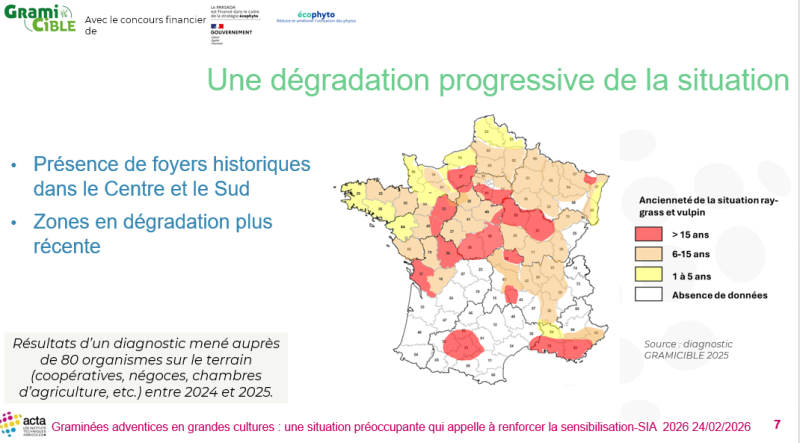
What explains this worrying situation? The development of resistance and the reduction in the number of active substances available, crop rotations that are too short and difficult climatic conditions are all cited in the diagnosis. Not to mention the fact that certain sectors suffer from natural constraints, such as clay or hydromorphic soils, and that farmers may lack the time to implement complex agronomic practices involving a combination of levers. Mechanical weeding, for example, is perceived as costly, time-consuming and technically demanding.
Grass management: focus on three projects
The implementation of operational alternatives to control these grasses is therefore necessary, with an approach tailored to the specific conditions of each farm. This is the aim of the projects led by Terres Inovia and Arvalis: Gramicombi, Gramicible and Parad. " Transfer and support is the main challenge. That's why the two main lines of work are, on the one hand, to improve knowledge of existing actions through an awareness-raising and information plan, and on the other hand, to seek new solutions through medium- and long-term solution-finding projects ", explains Franck Duroueix, head of Terres Inovia's Inputs, Biocontrol and Integrated Crop Protection Unit.
These three projects cover a broad spectrum of research: physical control (robotics, mechanical, mixed or two-way weeding, thermal) and rational chemical control (localized spraying), service plants (competitive plants), diagnostic methods and risk analysis (weed biology, diagnostic kit, resistance maps, etc.), genetics, auxiliaries and biological regulation (covering power, impact of mechanical weeding on auxiliaries) and agronomic practices (prophylactic levers, border management, system redesign).
Gramicible
- Budget: 3.9 million euros
- Shared diagnosis, deployment and appropriation of operational solutions
- Project led by Arvalis with 17 partners
Gramicombi
- Budget of 3.4 million euros
- Prophylaxis, lever combinations, systems trials and farmer networks
- Project managed by Terres Inovia with 15 partners
Parad
- Budget of 7.5 million euros
- Multi-sector and all-weed project and prospective actions on weed control methods (robotics, etc.)
- Project led by INRAE with 18 partners
A communication plan on the various means of control
As part of the Gramicible project, 83 trials were carried out. The results will be published in a series of leaflets at the end of the project.
A three-phase communication campaign will also be launched in the near future. The first will be to raise awareness among farmers and advisors who have little or no knowledge of the problem and the range of possible solutions, with :
- An online quiz with 15 questions to help them identify the levers they can use to improve their weed control strategy.
- Practical information sheets on solutions that can be implemented immediately
- A brochure compiling the simplified diagnosis, methods for starting an action plan, and sheets on each solution to help you find those best suited to your situation.
- A series of videos to cover different production contexts and enable everyone to find an example close to their own situation.
- Maps showing the presence and age of grass weeds and a series of four national articles.