
Automatically generated translation
Flowering has begun or is expected to begin shortly in fields of spring peas, spring field beans, and lentils, depending on the growing region. While green aphids have been confirmed in most pea fields, an assessment of the infestation level should be conducted as flowering approaches. Additionally, monitoring for pea leafrollers using pheromone traps begins at this stage.
Green pea aphids and black broad bean aphids
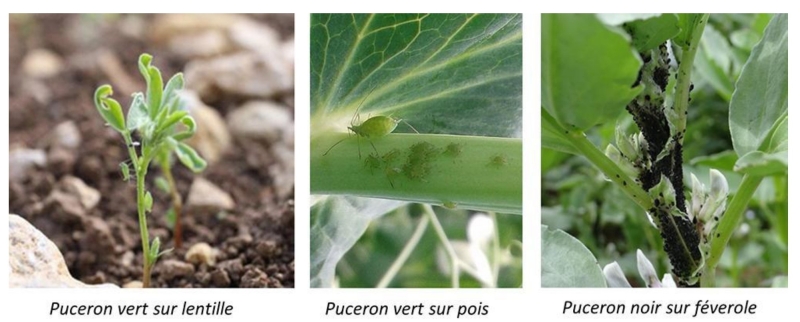
The green pea aphid (Acyrthosiphon pisum) frequently infests peas and lentils. It is much rarer on fava beans. It can be identified by its green, sometimes pink, color and its large size; it often hides in flower buds and under leaves. This aphid falls easily from plants when they are shaken. Feel free to place a white sheet of paper beneath the peas and lentils to better observe and count them.
The black bean aphid (Aphis fabae) primarily affects faba beans. This aphid colonizes plants by forming long clusters (agglomerations of several aphids at least 1 cm long).
In addition to sucking sap, aphids can transmit viruses. These viral diseases are particularly harmful because they infect plants at early stages or on stressed plants. Once flowering begins, the risk of viral disease decreases, but direct damage from feeding—such as the abortion of flower buds and young pods—must still be considered.
Action thresholds vary depending on the crop, growth stage, and aphid species. The products to be applied vary depending on the stage and crop, but before taking any action, be mindful of the presence of beneficial insects (ladybugs, hoverflies, etc.) that can help control aphid populations in cases of light infestations, as well as the weather: indeed, humid conditions are not conducive to aphid development. In any case, do not rush and try to assess the risk of aphid population growth. When an infestation begins, aphid distribution is not uniform. It is therefore advisable to make observations at different points, particularly at the edges and in the center, to assess the pressure and its progression.
The availability of KARATE K and MAVRIK JET (a combination of pirimicarb and a pyrethroid) will be reduced following the discontinuation of production and the end of their commercialization. The pirimicarb in these formulations was translaminar and could act via vapor, which made it effective against “hidden” aphids even when foliage was dense. Pyrethroids are not translaminar and will not be effective against “hidden” aphids. The active ingredient in TEPPEKI/AFINTO is flonicamid, which is translaminar and has upward migration; it can act on “hidden” aphids but will be less effective than pirimicarb-based solutions in cases of dense foliage due to the absence of a vapor effect.
Warning. KARATE K and MAVRIK JET were not approved for use on dry lentils. The use of TEPPEKI is limited to a single application on peas, faba beans, or lentils.
Thresholds and solutions based on growth stages and crop for aphid control
Growth Stages | Peas | Field beans | Lentils |
6 leaves - before flowering begins | If at least 5–10 aphids per plant | If at least 10% of plants have aphids | |
Save flonicamid (TEPPEKI or AFINTO) for reapplication during flowering if pyrethroids are ineffective or if infestation occurs during flowering | |||
From the start of flowering to the end of flowering +10–15 days (2) | If at least 20 aphids per plant | If at least 20% of plants have galls (1) |
|
(1) A colony of aphids is defined as a group of about ten individuals. However, when this colony grows to include several dozen or hundreds of individuals clustered on the stems and forms a black spot of at least 0.5 cm², it is referred to as a “sleeve.”
(2) Comply with regulations regarding the protection of bees and other pollinating insects during flowering
(3) Do not use adjuvants or oil on peas, faba beans, lupins, and lentils with TEPPEKI or AFINTO.
The pea leafroller
The pea moth is a gray moth whose caterpillar affects the quality of pea seeds. The insect is also found in lentils, but with little impact. Its caterpillar, which is white with a black head, has a short “wandering” stage. It moves around to enter a pea pod, where it nibbles on the seeds.
The decision to implement protection against the moth is based on observing flight dynamics through the use of a sex pheromone trap that captures males. This is a delta trap equipped with a sticky pad and a pheromone capsule to be placed in the field (at least 10–15 m from the edge) downwind of the prevailing wind from the start of flowering. A single capsule is sufficient for the season. Handle the capsule with gloves to avoid compromising its attractiveness.
Check the trap weekly and keep a running tally of the number of captures. If the count exceeds 100 pea aphids, protection is recommended for crops intended for human consumption and seed production. Once the count exceeds 400, protection is also recommended for crops intended for animal feed. Protection should be reapplied after 8–10 days if the thresholds are reached again. Monitor until the end of flowering plus 8 to 10 days.
Control should be based on a pyrethroid with a flowering label.
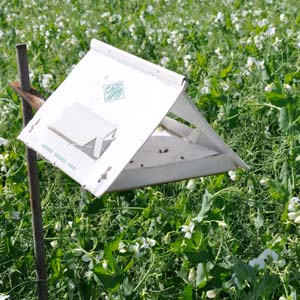
Trap for monitoring leafroller activity
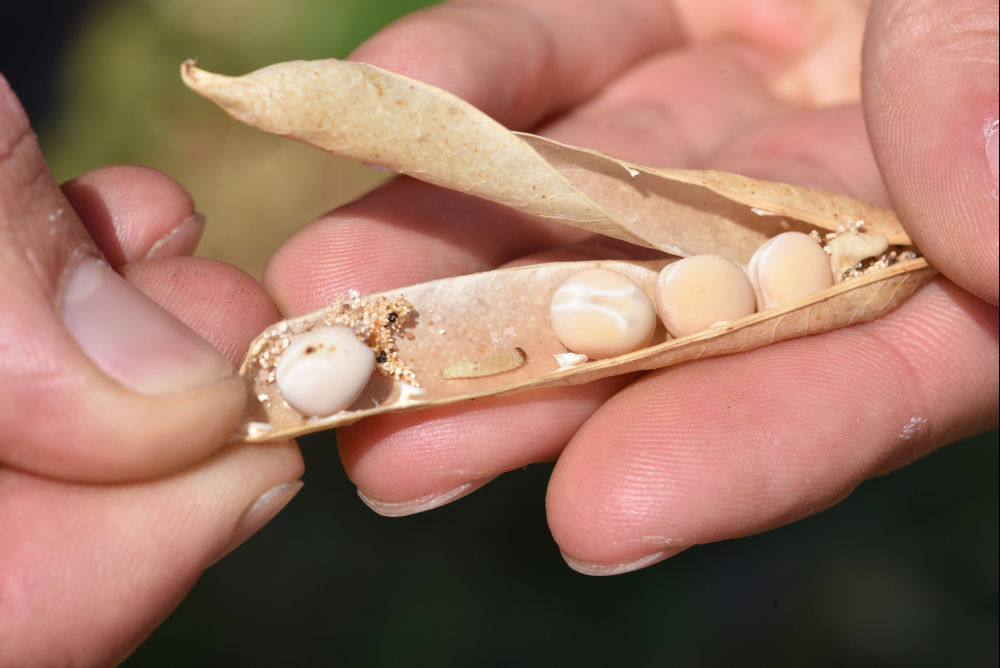
Caterpillar eating pea seeds
The Bruches
The weevil is a beetle that lays its eggs on the pods. The larvae develop inside the seeds and emerge after harvest, boring holes in the seeds, which lose quality and germination capacity, potentially causing certain batches to be downgraded depending on the intended market. Each crop has its own specific weevil.
Historically, the field bean and lentil weevils are the most widespread across the country. The pea weevil is more localized in southern France. However, with warm, dry springs, the insect is regularly observed in the northern half of France.
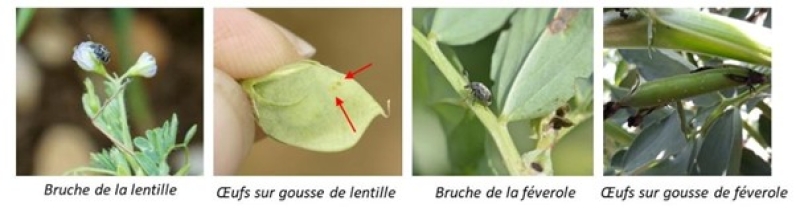
In peas and faba beans, insecticide protection targeting adults is rarely effective and not widely used due to the length of the risk period, which extends from the young pod stage (2 cm on the first fruiting node) until the end of flowering plus 10 days (a single application of lambda-cyhalothrin is permitted by regulation during flowering). This application requires a large volume of water (at least 200 L/ha) to penetrate the canopy. While this application helps limit the risk, it does not always guarantee that certain quality thresholds required for human consumption, for example, will be met. Efficacy is further reduced if temperatures are high during flowering. However, if temperatures remain cool for at least 10–15 days at the start of pod formation, a treatment can help control populations.
For lentils, no treatment is currently authorized. Control of weevils is primarily preventive, carried out at the silo level and during on-farm storage.
Any treatment should be applied starting at the young pod stage (2 cm) and when daily maximum temperatures are 20°C or higher for at least two consecutive days (the weevils are active at this time). In this case, use a volume of at least 200 to 300 L/ha to ensure good penetration of the spray into the vegetation and to reach the weevils moving through the canopy.
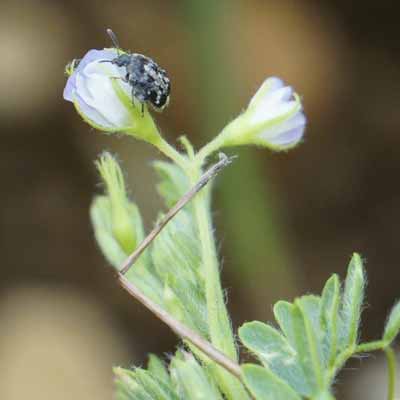
Bruche de la lentille
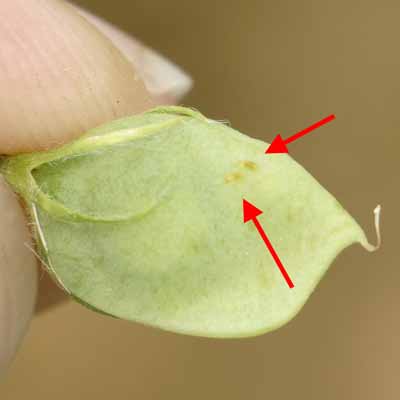
Œufs sur gousse de lentille
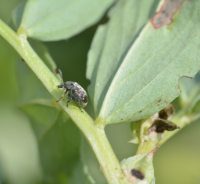
Bruche de la féverole
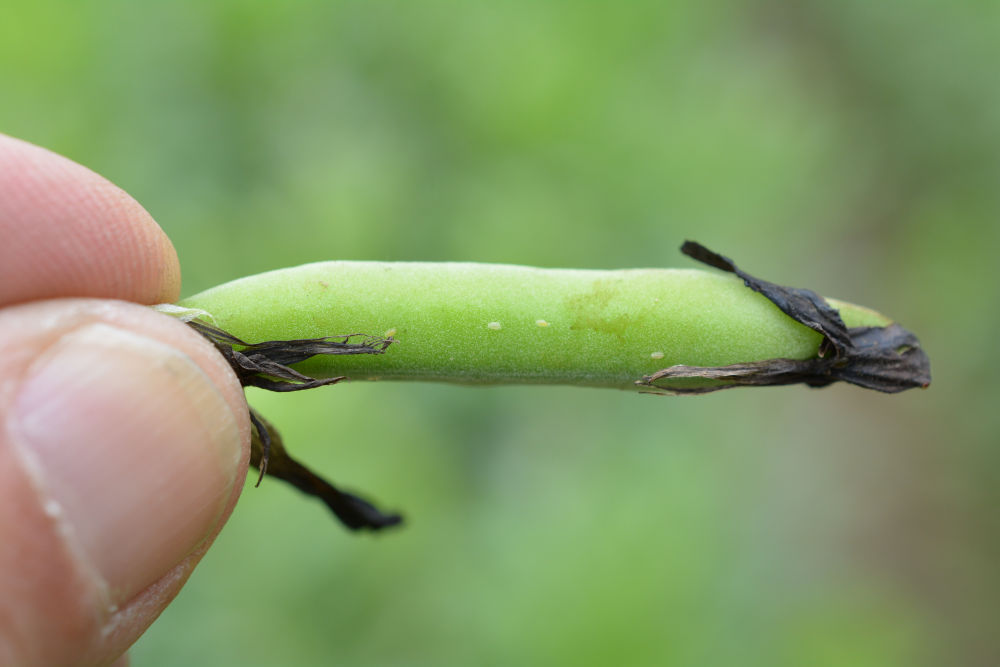
Œufs sur gousse de féverole
Protecting bees and other pollinating insects during the flowering season
The SPe 8 statement specifies the following conditions: hazardous to bees. To protect bees and other pollinating insects, do not apply during flowering; or, according to older marketing authorizations (MA), do not apply during flowering or during periods of exudate production. Application is permitted for uses bearing the labels "use permitted," "use authorized during flowering when bees are not present," or, for older marketing authorizations, the labels F (flowering), PE (exudate production), and FPE (flowering + exudate production).
The decree of November 20, 2021, sets the application times during flowering: within 2 hours before sunset and within 3 hours after sunset.
Blends
Mixing pyrethroids and triazoles during the flowering period or when exudates are being produced is strictly prohibited. If both treatments must be applied to the same plot, a minimum interval of 24 hours must be observed between applications, and the insecticide must be applied first (the so-called “mixture” decree of June 12, 2015).