

Automatically generated translation
Launched by Terres Inovia in 2023, this decision-making tool features a new module that enables users to simulate projected harvest dates based on the year’s weather data, thereby providing more accurate forecasts. It will be available starting in June.
Although it is the final stage of the growing season, harvesting remains a critical step in maximizing the technical and economic returns of sunflower cultivation. If carried out under poor conditions, too early, or too late, it can undo all the efforts made throughout the growing cycle.
Harvest at the optimal stage
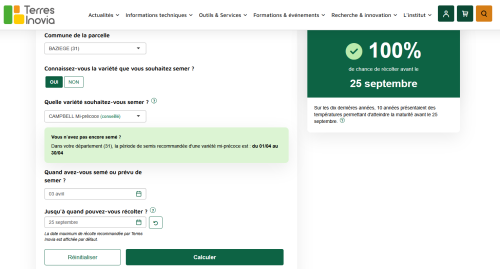
Because the profitability of sunflower cultivation depends on the planting stage, the OAD tool “When to Sow and Harvest” allows users to estimate the sunflower harvest date based on the variety chosen, the sowing date, and the geographic location. It thus complements the technical support and decision-making assistance provided by Terres Inovia to growers.
Simulations that can be performed using weather data from the current campaign year
Launched by Terres Inovia in 2023, this tool is getting a makeover this year with a major update: the inclusion of annual weather data in the calculation of the harvest period.
The 2026 version of the OAD thus includes two new modules. The first, available now on the Terres Inovia website, is based on frequency-based weather data from the past ten years. A streamlined interface displays the probability of harvest on a given date, based on the scenario entered by the user.
Available next June, the second module allows for simulations to be run during the growing season. Weather data from the current year—from planting through the date the calculation is performed—is incorporated by the tool into the calculation of a projected harvest window. The projection is consequently more accurate, adjusted according to the year’s weather conditions.
Il est crucial d’engager l’opération lorsque la plante atteint un stade optimal. Une récolte à sous-maturité rendra plus difficiles les conditions d’intervention, et tout particulièrement le réglage du matériel. Des frais de séchage très souvent élevés, car corrélés au coût de l’énergie, pourront être imposés aux producteurs. A l’inverse, un battage à sur-maturité peut générer des pertes liées à l’égrenage, à la déprédation, aux maladies et surtout un manque à gagner substantiel dès lors que l’humidité s’effondre par rapport à la norme de commercialisation (9%).