

Automatically generated translation
Weather conditions favorable for planting during the first half of April
Just like last year, weather conditions in early April allowed for sunflower planting during the optimal sowing period across the entire North & East region. The first planting operations began in Bourgogne-Franche-Comté as early as Easter weekend (April 4, 5, and 6), before expanding the following week to Lorraine, Champagne-Ardenne, and Hauts-de-France.
The lack of rain made it easier to access the fields but also complicated soil preparation. Due to the lack of moisture, soil work was sometimes difficult, with the formation of clods that made sowing more challenging. In some cases, this led to poor soil-seed contact and uneven emergence, conditions more conducive to pest attacks (slugs, birds).
The mild temperatures following sowing allowed for rapid emergence in most cases. It should be noted, however, that some plantings in dry soil resulted in later emergence. Rainfall during the first weekend of May was therefore particularly anticipated in several regions, where the water deficit was beginning to be felt.
Bird damage was generally limited
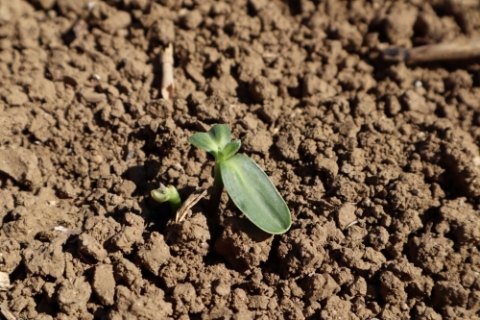
This year, bird damage to sunflowers has remained generally limited. A few localized attacks have been reported in certain areas, with, more rarely, more severe incidents that have led to entire fields being ravaged. Overall, however, the frequency and intensity of the damage appear to be significantly lower than in the previous two growing seasons.
Conditions favorable to establishment, combined with rapid emergence, allowed the sunflowers to quickly move past their period of vulnerability to birds. As a result, the majority of fields are now largely unaffected.
An aphid infestation, quickly brought under control by the return of the rains
Since last week, the first green plum aphids (Brachycaudus helichrysi) have been reported in some sunflower fields. This arrival is particularly early, as the sunflowers are currently at the 2- to 6-leaf stage for the earliest-planted crops and fields. Winged individuals, which have a high potential for dispersal, have also been observed.
At this stage, no leaf curling has been observed. The risk therefore remains limited, especially since the rainfall over the weekend and early this week is helping to contain these initial infestations and slow their spread.
This early presence nevertheless underscores the importance of regular monitoring of fields. The action threshold is set at 10% of curled plants, regardless of the sunflower’s growth stage prior to flower bud formation.
In addition to monitoring aphids, it is essential to consider the presence of beneficial insects: ladybugs, lacewings, hoverflies, and parasitoids are valuable allies in regulating aphid populations. Since these beneficial insects generally arrive later than the aphids, it is important not to intervene too early, in order to give them time to establish themselves and perform their regulatory function.
If insecticide treatment is nevertheless necessary, three products are currently approved for use. Please note that the availability of Karate K and Mavrik Jet is limited following the discontinuation of production and the end of their marketing. Mavrik Smart will therefore remain the only available solution.