
Automatically generated translation
Soybeans require careful planting to reach their full potential. From plot selection and soil structure to planting date, spacing, density, and inoculation, every factor counts in ensuring rapid, uniform emergence and promoting strong root development.
Choose a suitable plot
The selection of the plot must meet certain conditions to satisfy the requirements of soybeans:
- Avoid soils that are too calcareous (>10% active calcium carbonate), as they cause iron chlorosis. If chlorosis is detected early, an iron foliar spray can effectively remedy the situation.
- Adequate water supply is essential for soybean production. Under water-limited conditions, yield and protein content may be significantly reduced.
- Select plots that are free of weeds.
Ensure rapid germination
Thorough soil preparation is essential to ensure optimal root development and achieve rapid, uniform emergence. The soil must have good structure at depth to allow for deep root growth, thereby promoting the uptake of soil nutrients (minerals and water). Methods such as plowing or deep tillage with a tine implement are possible and should be adapted to local soil and climate conditions. A well-aerated and finely textured seedbed will ensure good soil-seed contact and rapid emergence. Soil preparation also helps facilitate the establishment of the symbiotic relationship between nitrogen-fixing bacteria and the plants. Furthermore, a leveled soil surface will facilitate the harvesting of lower pods. Indeed, yield losses caused by unharvested lower pods can amount to as much as 4.5 q/ha. Thus, if stones are present, rolling the soil with a roller may be considered after sowing.
Soybeans’ hardiness and moderate susceptibility to slugs make them particularly well-suited to simplified tillage practices, including no-till and strip-till. These practices are feasible if the soil has good structure.
The right time to plant
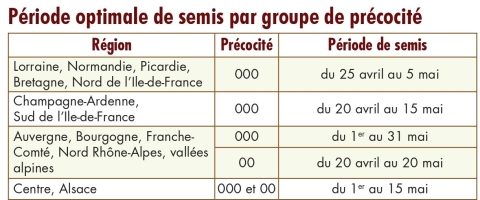
The sowing date depends on the variety’s maturity and weather conditions. Sowing in warmed soil is crucial to ensure rapid germination. The technical institute recommends that the soil temperature reach 10°C at a depth of 5 cm.
In the northern and eastern regions, only varieties from groups 000 and 00 are suitable. Optimal sowing periods are determined based on the region and the maturity group.
Adjust the spacing
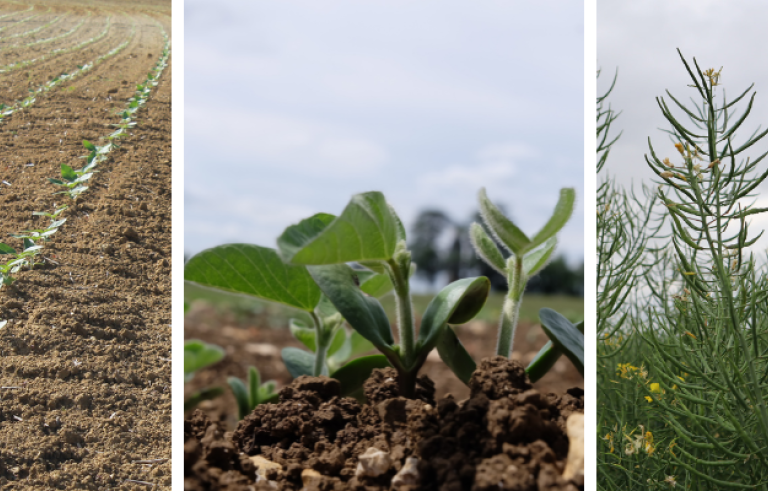
Using a precision seeder will ensure more uniform emergence and allow for mechanical weeding of the field. Spacing should be adjusted according to the maturity group: 18 to 30 cm for group 000 and 18 to 50 cm for group 00. When sowing with a grain drill, opt for narrow spacing (15 cm) to ensure better ground coverage.
In situations where there is a risk of Sclerotinia, opt for a wider spacing to allow for better aeration of the crop canopy.
Adjust the seeding depth and density
Regardless of the type of seeder used, seeds should be planted 2 cm deep for early sowing in cold, compacted soil. For later sowing in warm, dry, or cloddy soil, aim for a deeper planting depth of 3–4 cm.
Two factors must be considered when choosing the seeding rate: the maturity group and the plot’s water management.
In cases of water stress, potential yield loss can be offset by increasing plant density. Adjust the plant density to achieve a target of 400,000 plants per hectare for Group 00 varieties and 500,000 for Group 000 varieties.
However, be careful not to exceed the recommended planting densities: this would lead to competition among plants for water and increase the risk of disease and lodging.
Inoculate to ensure the development of nodules
Rhizobia, which are naturally absent from European soils, must be added either directly to the seeds or via microgranules incorporated into the seedbed.
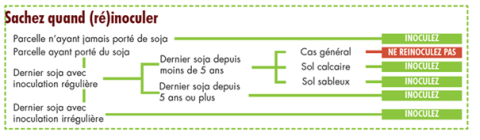
For inoculants containing live bacteria, the time interval between inoculation and sowing must be observed to prevent a loss of viability. Also, be sure not to expose the inoculated seeds to extreme temperatures or light. Once sown, soil-seed contact and moisture will promote nodulation.