

Automatically generated translation
Planting of spring crops is already well underway, particularly for corn and sunflowers. Next up will be soybean planting, which must be planned well in advance to ensure proper establishment and a satisfactory yield. Here’s a look at the six key points to keep in mind.
1. Choosing the right plot: sufficient water availability and suitable soil for high-yielding soybeans
First and foremost, the choice of plot is critical and must take into account soil type and irrigation options. Soybeans can be grown without irrigation in deep (RU > 120 mm) and intermediate soils, but this carries an increasingly higher risk as the effects of climate change become more pronounced. Shallow soils (RU 80 mm) can support soybean cultivation provided there is access to irrigation. Like corn, soybeans have similar water requirements, estimated at 430 mm for a yield of 35 q/ha; therefore, water availability is crucial when selecting a plot.
To help you choose a crop based on your soil type and irrigation practices, see the comparative table of the technical and economic performance of summer crops by soil type and water availability by clicking here.
Other criteria to consider when selecting a field. Special attention should also be paid to soil characteristics, disease history, soybean history, and weed flora.
- The soil’s ability to warm up quickly: an advantage that will allow soybeans to get off to a fast start. Risks associated with fungal attacks (Pythium, Rhizoctonia, and other Fusarium species) are reduced here, unlike in cold or compacted soils where such attacks are more common.
- The field’s history of Sclerotinia must also be taken into account to limit risks.
- Plots that have previously grown soybeans have an advantage, as they are already colonized by the specific bacteria essential for nitrogen fixation. In these situations, nodulation is facilitated.
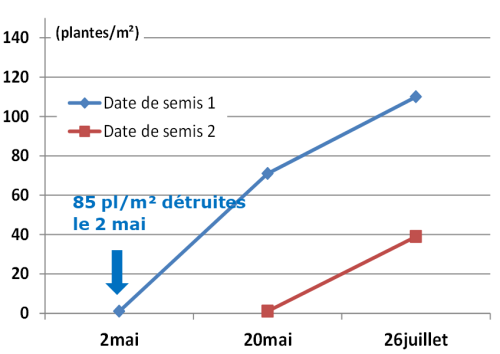
The practice of false seeding and delaying the planting date is an effective strategy in cases of high ragweed pressure on the plot. Delaying the planting date and destroying seedlings can reduce ragweed pressure by 64% (in control plots). (See Figure 1)
Crop rotation history must also be taken into account. It is recommended to include soybeans in a balanced rotation, avoiding growing them for more than two consecutive years on the same field. This practice helps limit the pressure of diseases such as Sclerotinia and optimizes weed management.
2. Soil preparation: the cornerstone of successful soybean cultivation
The success of soybean cultivation depends on careful soil preparation tailored to the conditions of the field. Well-structured soil allows for simplified techniques such as no-till planting, while compacted soil requires deeper tillage to promote aeration and root development. The goal is to create a fine, level seedbed that ensures good seed-to-soil contact without promoting the formation of surface crusts. It is also essential to maintain an aerated structure in the top 15 centimeters of soil to promote symbiosis between soybeans and nitrogen-fixing bacteria. Good porosity facilitates the establishment of these bacteria and ensures effective nodulation, which is essential for soybean nutrition and nitrogen self-sufficiency. In clay soils, cracking can improve water infiltration. Finally, all operations must be carried out on dry soil to avoid compaction and preserve soil structure.
3. Seed inoculation: precautions to take
An inoculum is a delicate biological product; please take precautions: After purchase, the inoculum must be stored in a cool place away from light to maintain its quality. Sow within the timeframe specified for the product after opening the inoculum packet.
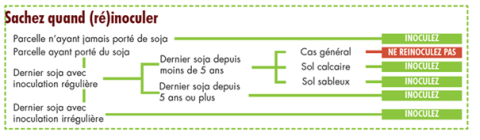
No nitrogen at planting! In addition to product quality, nodulation is often subject to two limiting factors: water deficiency and excess mineral nitrogen in the soil, the latter of which inhibits nodulation. Therefore, adding nitrogen at planting is not recommended, as it prevents nodules from forming and functioning.
For more information:
4. Sowing date, variety maturity, and soil and climate conditions: the three key factors for ensuring a successful harvest
The goal is to ensure a successful harvest under favorable conditions, taking into account the risk of a wet late season.
- Southwest, Southeast: exercise caution with Group II varieties. Prioritize April sowing in the warmest areas of Occitanie or southern Lot-et-Garonne, where late-season conditions allow for harvests without significant concerns.
- For departments under stronger oceanic influence, the Pyrenean foothills, or colder areas, Group I varieties will be better suited for traditional sowing dates through early May. In the event of later sowing in these areas, it will be safer to use a Group 0, or even 00 for the Dordogne and northern Gironde, where the return of wet conditions at the end of the growing season can disrupt harvesting operations starting in late September.
- Auvergne-Rhône-Alpes: Early maturity group 00 is best suited for this region; standard sowing dates in early May should be targeted. Depending on altitude, climate, and soil type, different maturity groups may be selected. In high-altitude areas or under continental climates, the earliest maturity group varieties (000) should be prioritized to avoid overly late harvests, which may be affected by rainy spells. Along the Rhône Valley, the Mediterranean climate allows for a greater diversity of maturity groups, with varieties from group 0, or even group I, in the southern part of the region (Montélimar area), where the late season conditions make it possible to plan harvests without too much concern.
5. Seeding rate: account for losses during emergence
Seeding rate must take into account the germination rate and seeding conditions to estimate losses, as well as water availability throughout the growing season.
A germination test is strongly recommended when using farm-saved seed. If the germination rate is less than 80%, increasing seeding rates may prove incompatible with a precision planter. In these situations, it is preferable to use grain planters, blocking one out of every two seed tubes, to achieve optimal plant density.
Other factors affecting emergence rates, such as soil type, tillage practices, or the risk of soil pest attacks, influence emergence rates and must be taken into account when adjusting seeding rates.

6. Planting spacing and optimal sowing conditions: critical factors
Sowing, a critical stage in the planting process, must be carried out under optimal conditions. To ensure rapid and uniform emergence, the soil temperature must reach at least 10°C in the top 5 cm within 24 to 48 hours after sowing. Below this temperature, germination may be impaired. A sowing depth of 2 to 4 cm is ideal for ensuring good emergence while minimizing the risk of seed desiccation. Row
spacing also plays an important role and must be adapted to the variety and soil moisture conditions. Varieties in Groups 0, I, and II tolerate spacings of 25 to 60 cm, with later-maturing varieties exhibiting better branching capacity. A spacing of 80 cm is feasible for Group I, although less optimal.
Trials by Terres Inovia (2014–2016) show that 60 cm is the most effective spacing, particularly under irrigated conditions where soybeans better realize their potential. This advantage is even more pronounced in deep soils or those with good water supply.
Finally, to limit the risk of Sclerotinia, it is advisable to use row spacings of at least 50 cm to improve canopy aeration and reduce conditions favorable to the disease.
See also: Optimizing Planting Density to Maximize Yield and Profitability