

Automatically generated translation
With unstable weather conditions, delayed flowering, and a large influx of pollen beetles, some rapeseed crops in the region are under serious threat: Take stock of the at-risk situations and the steps you can take right now
Background in the Auvergne-Rhône-Alpes region
The condition of rapeseed crops varies widely across the region depending on the area, with some areas (particularly in the Allier department) showing crops that have been particularly hard hit since the fall by various factors (damage from adult and larval flea beetles, damage from terminal bud weevils, waterlogging/excess moisture, and delayed nitrogen uptake at the end of winter due to poor growing conditions). In this context, the early and significant arrival of pollen beetles is leading in some cases to concerning situations in terms of damage.
This is especially true since flowering, which marks the end of the period of susceptibility to pollen beetles, is slow to begin (due to the return of sub-freezing temperatures and precipitation last weekend). The sunny days this week and forecast through Saturday are nevertheless favorable for pollen beetle activity in the afternoon.
Action thresholds based on the condition of the rapeseed and its growth stage
The end of the risk period is considered to have been reached at stage F1 (50% of plants with at least one open flower)
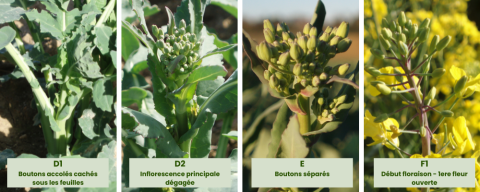


Control strategy: Keep the population at a tolerable level by using appropriate pesticides
The strategy for controlling pollen beetles aims to keep the population at a tolerable level (rather than eradicating it) so that flowering can begin without significant delay and the crop’s compensatory mechanisms can function to their fullest potential. Rapeseed has significant compensatory capabilities. When the crop is vigorous, it can withstand even severe attacks by pollen beetles.
Pollinator beetles are resistant to pyrethroids ending in “-in” (lambda-cyhalothrin, deltamethrin, cypermethrin, etc.). Tau-fluvalinate and etofenprox are two pyrethroids that avoid rapid metabolism by pollen beetles and retain their efficacy.
Active ingredients effective against melon aphids:
- Etofenprox (TREBON, 30EC, UPPERCUT 0.2 l/ha)
- Tau-fluvalinate (MAVRIK SMART, TALITA 0.2 L/ha)
In cases where both pollen beetles and rapeseed stem weevils are present at the action threshold, prioritize the use of solutions based on etofenprox, ensuring strict adherence to the application guidelines for the corresponding insecticide products.
Recommendations for use
- Spray volume, optimal at around 200 L/ha: to optimize the effectiveness of an insecticide spray, it is recommended to use a “normal” volume, avoiding excessively low volumes below 100 L/ha.
- Application conditions are important: sprayer settings, weather conditions, and characteristics of the product being applied.
- Bee protection: Dangerous to bees (SPE8 statement): To protect bees and other pollinating insects, do not apply during flowering and/or during exudate production, except for uses bearing the bee-safe labels F, PE, or FPE. In case of late application (e.g., stage E with the appearance of the first flowers), it is essential to use effective solutions with a bee exemption: MAVRIK SMART, TREBON 30EC (maximum application stage BBCH61) Note: these applications are subject to a regulation governing application times: within 2 hours before sunset and within 3 hours after sunset.
Prudent use of these solutions is essential. Read the labels and available documentation carefully and follow the usage recommendations.
Your regional contact:
Alexandra DENOYELLE (a.denoyelle@terresinovia.fr) – Regional Development Engineer – Auvergne-Rhône-Alpes and Provence-Alpes-Côte d’Azur