11,30,34,48,66
Sunflower pre-seeding preparation: a crucial stage for establishment
Preparing the plots before sowing is already a key step towards obtaining a robust sunflower. The main challenge this year will be to prepare the soil in good moisture conditions.
Preparing the plots before sowing is already a key step towards obtaining a robust sunflower. The main challenge this year will be to prepare the soil in good moisture conditions.
There are two major issues to consider when carrying out seedbed preparation operations:
1-Preserve soil structure
On clay soils, the structural state of the soil must not be degraded by seed preparation operations. In late winter, deep tillage should be avoided. Only in conditions of perfect drainage at working depth, which should be extremely rare this year, can clay soils be cracked and aerated.
For silty soils, deep cracking or ploughing may be necessary, even late in the season, just before sunflower sowing.
2-Get a seedbed with at least as much fine soil as clods, to ensure good soil-seed contact.
Caution: too many passes can result in excess fine soil, which can be detrimental in soils prone to capping or erosion.
Raisonner le type d’outils, ainsi que le nombre de passages est indispensable
La préparation des parcelles en sortie d’hiver s’appuie sur 2 piliers :
- Travailler des sols ressuyés, à consistance friable sur tout le profil travaillé. C’est le cas si les mottes, pétries dans la main, s’émiettent sans coller et donnent de la terre fine. Cette règle fondamentale invite à réaliser des observations très régulières de la consistance du sol, sur toute la profondeur de travail envisagée. Cela semble particulièrement crucial après l’hiver très pluvieux que nous venons de connaitre, afin de déclencher les opérations de reprise dès que les premiers créneaux favorables se présenteront (la fenêtre risque d’être courte cette année), et d’être prêt à semer dès le début du mois d’avril.
Le choix et les conditions d’utilisation des outils de travail du sol.
Outre l’état du sol au moment de l’intervention, ces deux autres critères s’avèrent déterminants pour réussir la préparation au semis.
- Privilégier les outils à dents non animés pour préparer le lit de semences. Si 2 passages sont envisagés, le 1er peut être réalisé à 10-15cm de profondeur, sans rouleau pour favoriser le réchauffement du sol. Le 2ème passage à 6-8cm aura pour objectif principal de niveler et d’affiner
- Combiner les outils pour limiter le nombre de passages
- Lutter contre la compaction du sol, en utilisant des équipements de type roues jumelées ou pneus basse pression. En l’absence de tels équipements, vérifier et adapter la pression des pneumatiques.
Dans quel cas réaliser des faux semis printaniers ?
Sur des flores printanières et estivales qui lèvent tôt en saison comme l’ambroisie, la renouée liseron, le xanthium ou même un peu plus tardivement le datura, le faux-semis peut s’avérer efficace pour réduire les infestations dans le tournesol.
Le faux-semis consiste à réaliser un travail superficiel du sol assez tôt en saison pour faire lever les adventices, bien rappuyé avec un rouleau et positionné de préférence avant une pluie. 1 à 3 semaines après, on détruira ces levées, soit chimiquement dans les situations où le glyphosate est autorisé, soit mécaniquement, en veillant à remuer le sol le moins possible pour éviter de provoquer de nouvelles germinations. Cette stratégie s’accompagne souvent d’un décalage de la date de semis du tournesol de 15 à 20 jours, nécessaire à la réalisation de cette chaine d’interventions.
Attention, des semis tardifs de tournesol, au-delà du 1er mai, peuvent pénaliser les résultats de la culture. Un compromis est donc à trouver entre bénéfices retirés du faux-semis, et risques occasionnés pour le tournesol. Ce décalage de la date de semis est à réserver aux situations où il est prioritaire d’alléger la pression exercée par les flores dites « problématiques », car difficiles à détruire et exerçant une forte concurrence sur la culture (ambroisie, renouée liseron, tournesol sauvage, xanthium).
Vos contacts régionaux
- Quentin LAMBERT (q.lambert@terresinovia.fr) – Ingénieur régional de développement – Occitanie
Quentin LEVEL (q.level@terresinovia.fr) – Ingénieur régional de développement – Ex-Aquitaine, Gers, Hautes-Pyrénées - Alexandra DENOYELLE - Terres Inovia (a.denoyelle@terresinovia.fr) - Auvergne Rhône-Alpes et Provence Alpes Côte d'Azur
Stem weevils and budworms: monitoring and control on 2 fronts
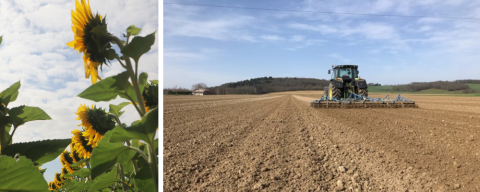
At the end of a record number of rainy days, the clear skies and sudden, exceptional rises in temperature at the end of February were conducive to the drying out of the best-filtered plots and the advancement of the rapeseed stage, but also to major flights of stem weevils and leaf beetles. While current priorities are focused on nitrogen inputs at the end of winter, we must not neglect to monitor and control these two insects, which this year appear at the same time.
Rapeseed stem weevils can cause stem bursts, which penalize yield components, particularly in dry years. Egg-laying disrupts sap flow, making plants sensitive to subsequent stresses and limiting their ability to compensate. Hydric stress or an attack by another pest in spring on an oilseed rape previously weakened by stem weevil are thus more damaging. Control methods are still effective, but the positioning of the intervention is crucial to guarantee the effectiveness of the protection.
Peak of flights possibly reached at the end of February, on rapeseed at sensitivity stage
Southwest
As the weather warmed up at the beginning of the month, the first flights of stem weevils, mainly on cabbage but also on rapeseed, took place in the Occitanie and ex-Aquitaine regions, but at generally low levels on rapeseed crops still in vegetation recovery or early bolting. The drop in temperatures and return of rain over the following days were unfavorable to the intensification of flights and egg-laying activity by females.
The return of clear skies and exceptional temperatures over the last few days have been favorable to significant weevil flights, with the probability of captures and presence in plots currently reaching its peak, on oilseed rape crops in full bolting, mostly at D1-D2 stages (source: BSV Occitanie-Nouvelle Aquitaine), and for some weakened by excess winter water and lack of nitrogen when vegetation resumes.

As a general rule, it is advisableto intervene 8 - 10 days after the first "significant" captures, or ideally at the regional flight peak (consult the BSV for the date of the flight peak at regional level). In fact, the mere presence of the pest in the crop constitutes a nuisance threshold. The aim is to intervene when as many insects as possible are in the plot, and before egg-laying begins.
With the flight peak probably underway, an intervention could be launched in the week of March 02 to 09 to effectively control stem weevil populations, subject to a drop in catches within the BSV network next week.
Insecticide solutions still effective
The success of chemical control depends on the positioning of the intervention and the persistence of action. To date, Terres Inovia has not observed any decline in efficacy in the field. Monitoring results show no worrying emergence of resistance.
DECIS PROTECH 0.33 L/ha and KARATE ZEON 0.075 L/ha are effective in reducing rapeseed stem weevil damage (reduction in the number of deformed and/or shattered stems).
TREBON 30 EC is comparable to these references. In the case of late infestation and presence of budworms, it is also effective against the latter.
SHERPA 100 EW and CYTHRINE MAX are slightly behind. MAVRIK SMART, on the other hand, is inferior to the references on stem weevil and should be reserved for possible control of meligethes between stages D1 and E-F1.
Caution: TREBON 30 EC and MAVRIK SMART should be reserved for possible control of meligethes between stages D1 and E-F1.
Meligèthes: Vigilance is essential
A sudden and massive arrival
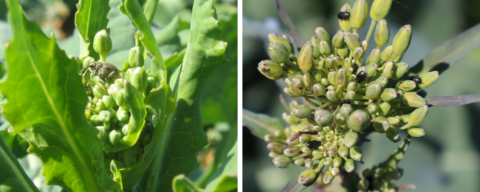
The exceptionally warm weather and sunny spells of the past few days have been very favorable to insect flights, including the meligèthe, which can easily be caught in tanks or observed in plots, particularly on the most advanced rapeseed plants. The beetle is above all a pollinator. Its diet is based on pollen. However, when flowers are still at bud stage, they perforate them to reach the stamens, which can damage the pistil and lead to abortion. The risk of losses is all the greater when the buds are small; but as soon as the flowers are open, the pollen is free to access, and the nuisance generally becomes nil and treatment unnecessary. Females lay eggs in the buds during flowering, but this does not damage the plant.
Visit your plots to assess the condition of your colza and the presence of the beetle
The more vigorous and healthy the crop, the more it can withstand the presence of budworms, even if they are abundant. On the contrary, the more stunted, stressed or constrained the crop, the more susceptible it will be to attack. Observing the condition of the rapeseed is therefore just as important as observing the pest.
Here are a few rules to bear in mind when characterizing the risk of meligèthes on rapeseed:

- Rapeseed fertilization: what to do if the soil is too wet Observe plots from the D1 stage (BBCH50), corresponding to the appearance of clustered buds still hidden under the leaves, to the F1 stage (BBCH60), corresponding to the first flowers opening on half the plants. At the D1 stage, when flower buds are present and still hidden under the terminal leaves, beetles are more difficult to observe. You need to take the time to analyze the area of leaves surrounding the buds. At stage D2 (BBCH53) and E (BBCH57), the buds are fully visible and the larches are easier to spot.
- Counting at the edges or on the tallest plants is not representative of the situation. It is advisable to count on 4 x 5 or 2 x 10 consecutive plants; then calculate an average or a % per plant to be compared with the thresholds mentioned in the table below, taking into account the crop's ability to compensate.
- Avoid trap plants if present.
- Vigilance must now be maintained through regular plant counts, in order to determine where you stand in relation to the thresholds.
- Vigilance is also essential in situations where a tall, very early variety (e.g. ES Alicia or DK Exavance) is mixed. This practice enables us to control certain weak to moderate attacks, but does not rule out monitoring! In the event of heavy attacks, beyond the thresholds indicated below on the plants of interest, control of the populations of meligèthes may be justified.

Control strategy: maintain the population at a tolerable level using appropriate specialties
The aim of the control strategy is to maintain the population at a tolerable level (and not to eradicate it), so that flowering can start without major delays, and so that compensation can be expressed to the full. Rapeseed has considerable capacity for compensation. When the crop is vigorous, it can withstand even heavy attacks by beetles.
Meligethes are resistant to "-ine" pyrethroids (lambda-cyhalothrin, deltamethrin, cypermethrin, etc.). Tau-fluvalinate and etofenprox are 2 pyrethroids that escape rapid metabolism by meligethes and retain their potential efficacy.
Active substances effective on meliger beetles :
- Etofenprox (TREBON,30EC, UPPERCUT 0.2 l/ha)
- Tau-fluvalinate (MAVRIK SMART, TALITA 0.2 l/ha)
In case of concomitant presence of meligethes and rapeseed stem weevils at the intervention threshold, give preference to the use of Etofenprox-based solutions, taking care to respect the conditions of use of the corresponding insecticide specialties.
Recommendations for use
Optimum spray volume of around 200 l/ha: to optimize the effectiveness of insecticide spraying, it is advisable to work at "normal" volumes, avoiding low volumes of less than 100 l/ha.
The context in which spraying is carried out is important: sprayer settings, climatic conditions, characteristics of the product applied.
Protection of bees: Dangerous for bees (phrase SPE8): to protect bees and other pollinating insects, do not apply during flowering and/or exudate production periods, with the exception of uses benefiting from the F, PE, or FPE bee label. In the event of late application (e.g. E stage with first flowers appearing), it is imperative to use effective solutions which benefit from a bee exemption: MAVRIK SMART, TREBON 30EC (use-by stage BBCH61). Please note: these applications are subject to a decree governing application times: 2 hours before sunset and 3 hours after sunset.
Reasonable use of these solutions is essential. Read labels and available documentation carefully, and follow recommendations for use.
Your regional contacts
- Alexandra DENOYELLE (a.denoyelle@terresinovia.fr) - Regional Development Engineer - Auvergne Rhône-Alpes and Provence Alpes Côte d'Azur
- Quentin LAMBERT (q.lambert@terresinovia.fr) - Regional Development Engineer - Occitanie
- Quentin LEVEL (q.level@terresinovia.fr) - Regional Development Engineer - Ex-Aquitaine, Gers, Hautes-Pyrénées
Winter beans: Intense and early disease pressure as soon as winter emerges
The wet and relatively mild conditions of January were favorable to the early and rapid development of leaf diseases in winter faba bean crops in the South-West of France, mainly Botrytis, but also Ascochytosis (formerly Anthracnose) to a lesser extent. In the most severe cases, and in situations where destruction was not initially planned, the question may arise of maintaining the plot and choosing a replacement crop.
The wet and relatively mild conditions of January were favorable to the early and rapid development of leaf diseases in winter faba bean crops in the South-West of France, mainly Botrytis, but also Ascochytosis (formerly Anthracnose) to a lesser extent. In the most severe cases, and in situations where destruction was not initially planned, the question may arise of maintaining the plot and choosing a replacement crop.
A few reminders about disease recognition
Botrytis
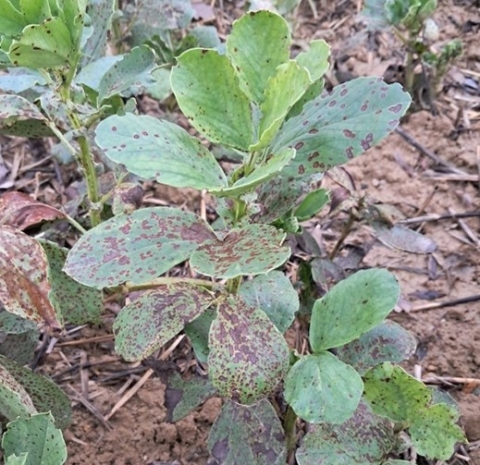
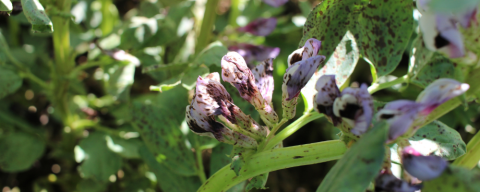
Botrytis is a very common aerial disease of winter beans, caused by the fungus Botrytis fabae. Symptoms are evenly distributed throughout the plot, and take the form of numerous small brown spots that spread and merge as the disease develops. Eventually, the disease causes defoliation and flower blight. It appears particularly in early and/or densely-sown plots.
Weather conditions at the start of the year were particularly favorable to the development of the disease, especially on plots sown early (mid-October) and/or in valley bottoms heavily exposed to recent excess water. The first symptoms are also visible on plots sown later (during November). In these circumstances, the risk of damage is already very high.
(Area of Auch (32) on 02/02/2026 - Photo credit: Terres Inovia)
Ascochytose:
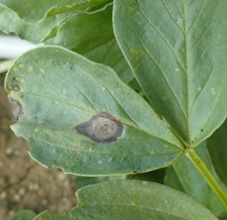
Bien moins fréquente que le Botrytis, l’Ascochytose, anciennement appelée Anthracnose, est provoquée par le champignon Ascochyta fabae. Lorsque les températures sont fraîches (10-15°C) et l’humidité est élevée, elle apparaît en foyers dans la parcelle, caractérisée par des taches brun cendré peu nombreuses avec des points noirs au centre (pycnides). Elles évoluent le plus souvent en « coulures » au pourtour brun-noir. Avec le temps, le centre des taches s’éclaircit et se nécrose allant parfois jusqu’à trouer les feuilles. Sur les tiges, des lésions du même type mais plus allongées peuvent se développer et provoquer des cassures.
Cette maladie est notamment transmise par la semence. Pour limiter au maximum l’inoculum primaire, l’utilisation de semences saines et le traitement des semences sont primordiaux. Le traitement de semences PREPPER (Fludioxonil) est disponible et donné efficace contre l’Ascochytose, mais il n’a pas été évalué contre ce pathogène par Terres Inovia à ce jour.
La majorité des variétés de féverole d’hiver présente un bon comportement vis-à-vis de cette maladie.
(Ascochytose sur féverole d’hiver - Crédit photo : Terres Inovia)
La Cercosporiose
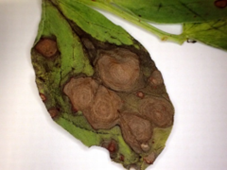
La Cercosporiose (Cercospora zonata) provoque des lésions sombres avec une zonation concentrique sans ponctuations noires. Elles apparaissent précocement à la base du couvert et évoluent généralement peu. Cette maladie est peu fréquente et peu nuisible.
(Rouille sur féverole d’hiver - Crédit photo : Terres Inovia)
La Rouille
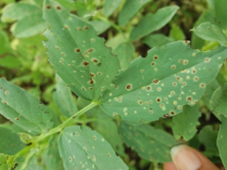
La rouille (Uromyces fabae) est une maladie fréquente et très préjudiciable sur féverole. Elle se développe sur le feuillage sous la forme de pustules brun-rouge auréolées d’un anneau plus clair. Lorsque les conditions climatiques sont très favorables (temps chaud >20°C et humide) la rouille peut recouvrir, parfois de manière rapide et fulgurante, la totalité des feuilles voire des tiges, provoquant un dessèchement prématuré des plantes.
Elle peut entraîner jusqu’à 50 % de pertes de rendement (25 à 40 q/ha) lorsque l’attaque est précoce et importante, et qu’aucun traitement n’est réalisé.
(Rouille sur féverole d’hiver - Crédit photo : Terres Inovia )
Comment agir si la maladie est déjà présente ?
Aller observer les parcelles pour estimer le risque de forte nuisibilité Botrytis
Dans ce contexte d’arrivée précoce des maladies sur féverole d’hiver, il convient d’aller observer très rapidement les parcelles assolées pour estimer le niveau d’infestation actuel, et par extension la nuisibilité potentielle. Pour ce faire, il sera nécessaire de réaliser les observations suivantes, sur 5 à 8 placettes de 5 pieds représentatives de la parcelle :
- La densité de peuplement (nombre de pieds/m²)
- L’état sanitaire des pieds sur chaque placette (% de surface foliaire avec symptômes de maladie pour ce qui est du Botrytis, présence de taches pour ce qui est de l’Ascochytose)
En fonction de la densité de peuplement et de la part de surface foliaire touchée par le Botrytis, il est possible d’estimer à priori le risque de nuisibilité significative (> 30%) pour le rendement final de la culture. Terres Inovia a élaboré un tableau d’aide à la décision pour savoir où votre parcelle se situe vis-à-vis du risque Botrytis.

Cette estimation est à réaliser dès maintenant dans le Sud-Ouest. L’expérience nous montre qu’il y a une corrélation entre présence de la maladie en sortie d’hiver et nuisibilité pouvant atteindre jusqu’à 30% de potentiel de rendement à la récolte.
Intervenir lorsque les conditions seront propices ou retourner la parcelle ?
Pour ce qui est du Botrytis, les interventions fongicides n’ont pas d’effet curatif sur la maladie. Du fait de l’impossibilité d’intervenir immédiatement en parcelle, il conviendra de sérieusement penser à procéder au retournement des parcelles déjà fortement infestées (> 15% de surface foliaire avec symptômes dès à présent).
Pour les autres cas, notamment pour les semis tardifs (à partir de la mi-novembre, début décembre), il sera généralement possible de patienter et d’intervenir dès la fin-février ou début mars, lorsque les conditions météorologiques et la portance des sols seront plus favorables. Afin d’adapter au mieux la stratégie fongicide au contexte épidémiologique de l’année, Terres Inovia présente dans son Guide Culture divers exemple de programmes fongicides, qu’il est possible de retrouver ici.
En cas de retournement de la parcelle, le choix de la culture de remplacement dépendra, entre autres, des programmes de désherbage appliqués en entrée d’hiver. Voici un tableau récapitulatif des espèces implantables au printemps et des délais de semis à respecter en fonction des spécialités herbicides employées en début de campagne.

Vos contacts régionaux
- Quentin LAMBERT (q.lambert@terresinovia.fr) – Ingénieur régional de développement – Occitanie
- Quentin LEVEL (q.level@terresinovia.fr) – Ingénieur régional de développement – Ex-Aquitaine, Gers, Hautes-Pyrénées
Measure your biomass at the end of winter to optimize your nitrogen inputs in spring
Conditions at the start of the campaign enabled good overall development of rapeseed crops, where these did not suffer from poor planting conditions. In order to estimate the amount of nitrogen to be applied in the spring, it is important to measure the biomass of the rapeseed at the beginning and at the end of the winter.
Conditions at the start of the campaign enabled good overall development of rapeseed crops, where these did not suffer from poor planting conditions. In order to estimate the amount of nitrogen to be applied in the spring, it is important to measure the biomass of the rapeseed at the beginning and at the end of the winter.
Weighing in at the end of winter
The rise in temperatures over the past week will enable the colza plants to start growing again, after a vegetative rest and a melting of biomass at the start of winter, following successive drops in temperature between late November and early January. It's now time to start weighing the colza plants, in order to determine the quantities of nitrogen to be applied before and/or during bolting, depending on the situation.
Biomass estimation method
Weighing is carried out on 2 to 4 1m² plots, cutting the colza at ground level for a good estimate of its above-ground biomass. The sampling method varies according to rapeseed spacing (see table opposite).
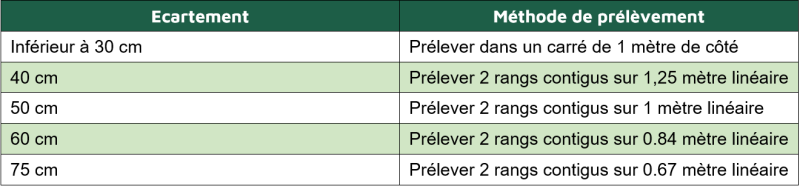
In plots with heterogeneous rapeseed, it is recommended to take 4 samples, at different representative locations in the plot, avoiding the edges. The average value will then be used to calculate the forecast dose.
To avoid any measurement bias, particularly when sampling in rainy weather or heavy dew, it is advisable to shake the plants well to remove any drops of water from the leaves and any clumps of earth from the base of the stem.
To help you
Take a look at this tutorial
Other tools to calculate nitrogen doses directly
Today, there is a wide range of operators offering spatialized nitrogen advisory services for rapeseed, based on image processing. They enable farmers who so wish to modulate inputs within the plot, either with a system controlled on the fertilizer spreader, or by modulating manually by large zones in plots presenting different states of growth. Among them, 4 products are the subject of a partnership agreement with Terres Inovia:
- Farmstar (Airbus, Arvalis)
- Agro-rendement (Wanaka/Agroptimize - Geosys)
- PRECIFert Azote (Precifield)
- Rapeseed Balance Sheet by Abelio (Abelio)
To facilitate field estimates, 2 smartphone applications, ImageIT (Yara France) and Crop-Analyser (Visio-Crop), are partnered with Terres Inovia. Biomass is estimated from conventional photographs, whose processing and interpretation are adjusted by the height of vegetation, to be entered before image processing.
For more information on alternative methods for estimating biomass and forecasting nitrogen doses for rapeseed , click here.
Calculating the forecast dose: Beware of overestimating requirements!
The Réglette azote colza® can be used to determine the total dose to be applied, based on a number of factors: rapeseed biomass, yield objective for the plot, soil type, organic fertilizer application, type of previous crop and, if applicable, the use of gelatinous legumes.
In order not to overestimate the crop's needs, and thus avoid unnecessary and costly over-fertilization, particularly in a context of high nitrogen fertilizer prices compared to rapeseed sales prices, it is advisable to first set a reasonable yield objective. To do this, calculate the average yield of the last 5 rapeseed crops on the plot or comparable plots, removing the lowest and highest values: this is the Olympic average.
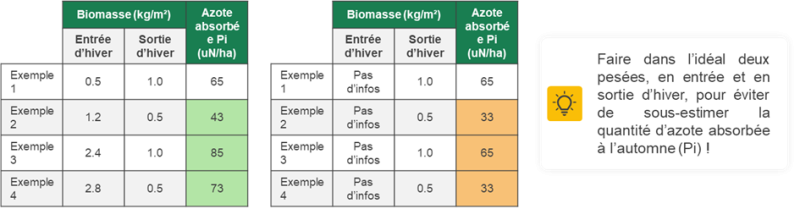
Given the temperature conditions at the start of this winter, rapeseed crops in the South-West have lost more biomass than in previous years, when in some years they never really stopped growing and developing. So, in addition to estimating your yield target, you need to take into account the nitrogen absorbed in the autumn, by estimating biomass at the start of the winter (between 800g and 1.2 kg/m² on average, depending on the plot) or by processing satellite images taken between mid-November and early-December. The risk of not taking into account the nitrogen absorbed in the autumn, when the rapeseed has "melted" over the winter, is also an overestimation of the doses to be applied in the spring, by underestimating the quantities absorbed previously (see examples opposite).
Split your inputs according to the total dose to be applied
By dividing up the doses, you can adjust them to the plant's needs.
For low-growth oilseed rape crops, an early first application is recommended as soon as vegetation starts to grow again, as it is necessary to support the start of vegetation, as small plants have few reserves and cannot easily access nitrogen from the soil due to their weak root system.
On the other hand, for fast-growing rapeseed, it's advisable to wait until bolting before applying nitrogen; the remobilization of reserves accumulated in the plant's organs will be sufficient to ensure good vegetation recovery.
In all cases, do not apply more than 100 kg/ha of nitrogen at any one time.

Your regional contacts :
- Alexandra Denoyelle (a.denoyelle@terresinovia.fr) - Auvergne-Rhône-Alpes & Provence-Alpes-Côte d'Azur
- Quentin Level (q.level@terresinovia.fr) - Southern New Aquitaine, Gers, Hautes-Pyrénées
- Quentin Lambert (q.lambert@terresinovia.fr)- Occitanie