

Automatically generated translation
Conditions at the start of the campaign enabled good overall development of rapeseed crops, where these did not suffer from poor planting conditions. In order to estimate the amount of nitrogen to be applied in the spring, it is important to measure the biomass of the rapeseed at the beginning and at the end of the winter.
Weighing in at the end of winter
The rise in temperatures over the past week will enable the colza plants to start growing again, after a vegetative rest and a melting of biomass at the start of winter, following successive drops in temperature between late November and early January. It's now time to start weighing the colza plants, in order to determine the quantities of nitrogen to be applied before and/or during bolting, depending on the situation.
Biomass estimation method
Weighing is carried out on 2 to 4 1m² plots, cutting the colza at ground level for a good estimate of its above-ground biomass. The sampling method varies according to rapeseed spacing (see table opposite).
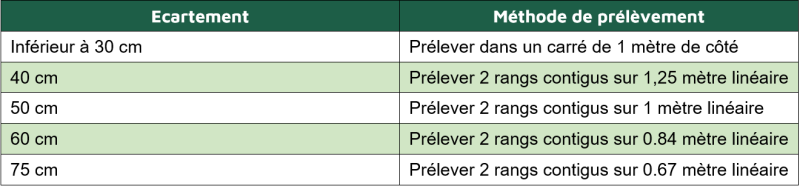
In plots with heterogeneous rapeseed, it is recommended to take 4 samples, at different representative locations in the plot, avoiding the edges. The average value will then be used to calculate the forecast dose.
To avoid any measurement bias, particularly when sampling in rainy weather or heavy dew, it is advisable to shake the plants well to remove any drops of water from the leaves and any clumps of earth from the base of the stem.
To help you
Take a look at this tutorial
Other tools to calculate nitrogen doses directly
Today, there is a wide range of operators offering spatialized nitrogen advisory services for rapeseed, based on image processing. They enable farmers who so wish to modulate inputs within the plot, either with a system controlled on the fertilizer spreader, or by modulating manually by large zones in plots presenting different states of growth. Among them, 4 products are the subject of a partnership agreement with Terres Inovia:
- Farmstar (Airbus, Arvalis)
- Agro-rendement (Wanaka/Agroptimize - Geosys)
- PRECIFert Azote (Precifield)
- Rapeseed Balance Sheet by Abelio (Abelio)
To facilitate field estimates, 2 smartphone applications, ImageIT (Yara France) and Crop-Analyser (Visio-Crop), are partnered with Terres Inovia. Biomass is estimated from conventional photographs, whose processing and interpretation are adjusted by the height of vegetation, to be entered before image processing.
For more information on alternative methods for estimating biomass and forecasting nitrogen doses for rapeseed , click here.
Calculating the forecast dose: Beware of overestimating requirements!
The Réglette azote colza® can be used to determine the total dose to be applied, based on a number of factors: rapeseed biomass, yield objective for the plot, soil type, organic fertilizer application, type of previous crop and, if applicable, the use of gelatinous legumes.
In order not to overestimate the crop's needs, and thus avoid unnecessary and costly over-fertilization, particularly in a context of high nitrogen fertilizer prices compared to rapeseed sales prices, it is advisable to first set a reasonable yield objective. To do this, calculate the average yield of the last 5 rapeseed crops on the plot or comparable plots, removing the lowest and highest values: this is the Olympic average.
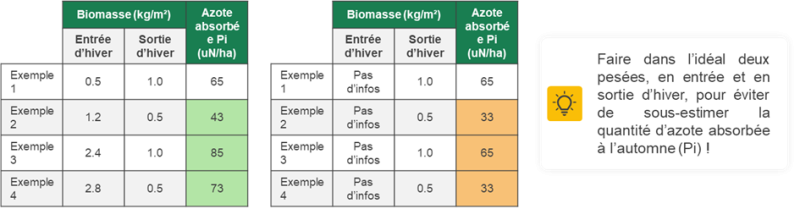
Given the temperature conditions at the start of this winter, rapeseed crops in the South-West have lost more biomass than in previous years, when in some years they never really stopped growing and developing. So, in addition to estimating your yield target, you need to take into account the nitrogen absorbed in the autumn, by estimating biomass at the start of the winter (between 800g and 1.2 kg/m² on average, depending on the plot) or by processing satellite images taken between mid-November and early-December. The risk of not taking into account the nitrogen absorbed in the autumn, when the rapeseed has "melted" over the winter, is also an overestimation of the doses to be applied in the spring, by underestimating the quantities absorbed previously (see examples opposite).
Split your inputs according to the total dose to be applied
By dividing up the doses, you can adjust them to the plant's needs.
For low-growth oilseed rape crops, an early first application is recommended as soon as vegetation starts to grow again, as it is necessary to support the start of vegetation, as small plants have few reserves and cannot easily access nitrogen from the soil due to their weak root system.
On the other hand, for fast-growing rapeseed, it's advisable to wait until bolting before applying nitrogen; the remobilization of reserves accumulated in the plant's organs will be sufficient to ensure good vegetation recovery.
In all cases, do not apply more than 100 kg/ha of nitrogen at any one time.

Your regional contacts :
- Alexandra Denoyelle (a.denoyelle@terresinovia.fr) - Auvergne-Rhône-Alpes & Provence-Alpes-Côte d'Azur
- Quentin Level (q.level@terresinovia.fr) - Southern New Aquitaine, Gers, Hautes-Pyrénées
- Quentin Lambert (q.lambert@terresinovia.fr)- Occitanie