
Grass weed management: what levers are used by growers?

As part of the GRAMICOMBI project, a survey of 32 farmers has just been carried out to gain a better understanding of the obstacles to farmers' adoption of grass weed management levers.

As part of the GRAMICOMBI project, a survey of 32 farmers has just been carried out to gain a better understanding of the obstacles to farmers' adoption of grass weed management levers.

The GRAMICOMBI project was launched as part of the PARSADA program. Spearheaded by Terres Inovia, its aim is to develop combinations of levers for integrated grass weed management and to deploy them on a national scale.

To find out what hinders the adoption of agronomic levers for better grass weed management, a survey was carried out among farmers. " It was carried out as part of the Objectif Cultures Propres (OCP) network in Bourgogne Franche Comté, which aims to assess the effectiveness and feasibility of combining grass management levers at the cropping system level, by monitoring and implementing an action plan for five years on 32 farmers' plots ", explains Victor Fleury, development engineer at Terres Inovia. The network is run by nine partners: Terres Inovia, Arvalis, Alliance BFC, the departmental Chambers of Agriculture of the BFC region and the Tart-le-Bas experimental farm.

Highly heterogeneous adoption of levers

During the survey, each farmer ranked different grass management levers, according to their feasibility, in one of four categories: achievable, possible, restrictive and impossible.

The results show a high degree of heterogeneity in the adoption of levers. " Some practices are already well integrated into cropping systems, such as the application of glyphosate before sowing, diversification of chemical weed control and border maintenance ". On the other hand, some levers are less widely used, despite their recognized agronomic value: the combination of staggered sowing dates, diversification with mechanical weeding and cleaning of harvesting tools offers considerable scope for progress. Lastly, others, such as the introduction of an Intermediate Energy Crop (CIVE), pollarding and the recovery of chaff, are generally perceived as difficult to integrate into current systems.

Economic and technical obstacles

The main obstacles are economic: access to specific equipment, lack of outlets, investment costs and uncertain profitability. The adoption of new grass weed management levers also comes up against technical trade-offs: ploughing, for example, is often seen as a lever of last resort in the event of technical impasse. Similarly, the choice of variety is often prioritized for disease resistance or yield potential, to the detriment of covering power. " The lack of technical references, consensus on the effectiveness of certain levers and feedback from experience also hinders their adoption. The example of covering varieties is a good illustration of this difficulty, with effectiveness perceived as highly variable depending on the context ". Finally, certain obstacles are very specific: working time and site organization for mechanical weeding, recourse to service provision, soil type, plot distribution, etc.

The survey results show that many grass weed management levers are still under-utilized by farmers. While some are hampered by structural or economic obstacles, others require technical support for the farmer, reinforced references and adaptation to the context of each farm. This is precisely the aim of the PARSADA GRAMICOMBI project, led by Terres Inovia, which includes the OCP network: to remove the barriers to adoption and promote a coherent combination of grass weed management levers across the entire cropping system.

Graminées adventices
Maitrise des adventices Rapeseed Tournesol Pois de printemps Soja Féverole d'hiver Féverole de printemps Lentille

Controlling weed in chickpea: act early to be effective

Chickpea is a slow-growing crop in the first part of the cycle, right up to the start of flowering, which is conducive to inter-row weed infestations. At present, a strategy based on a pre-emergence application is essential to ensure acceptable efficacy. This can be followed by a post-emergence application, depending on the flora.

Application de la prélevée

Selon les conditions climatiques, la levée du pois chiche peut être relativement longue. Toutefois, il est conseillé de ne plus appliquer d’herbicides dans les quelques jours qui précèdent la levée afin d’éviter tout risque de phytotoxicité. Le positionnement de la prélevée au plus près du semis est donc à privilégier. L’humidité dans les premiers centimètres du sol conditionnera l’efficacité de ces herbicides racinaires dans les semaines qui suivent l’application. Pour leurs larges spectres, deux stratégies sont privilégiées : Prowl 400 2l/ha + Challenge 600 2l/ha ou Nirvana S 1,8 à 2l/ha (voir tableau ci-dessous). Attention, dès cette camapagne, le Prowl 400 n’est plus utilisable sur les pois chiches semés avant le 01/02.

Antidicotylédones en post-levée : deux spécialités commerciales disponibles

Le Challenge 600 peut être utilisé en post levée (à 0,5 l/ha), sous conditions d’une impasse de cette spécialité commerciale en prélevée. Il doit être appliqué tôt, au stade 2-3 feuilles du pois chiche sur des adventices jeunes (2-3 feuilles maximum). ONYX (Pyridate 600 g/l) apporte un bénéfice net sur la postlevée avec une efficacité régulière sur datura, repousses de tournesol, morelle et renouées. Comme le Challenge, il doit être appliqué tôt, à partir de 2 feuilles (et jusqu’à 8 feuilles) sur des adventices entre 2 et 4 feuilles. Une application par an et fractionnable en 2x 0,75l/ha. Un effet dose est constaté sur datura, morelle, renouées et matricaire (1,5 l plutôt que 0,75 ou 1 l). 


(1) Utilisation possible seulement si semis réalisé après le 01/02.
(2)    En fonction du type de sol, moduler la dose de Nirvana entre 1,5 et 2 l/ha maximum. Déconseillé dans les sols sableux.
(3)    Si Challenge 600 non utilisé en prélevée
(4)    Renouées en relais d’une prélevée efficace uniquement
(5)    Fractionnement à 7-10 jours d’intervalle
(6)    Non couvert par les firmes

Voir le tableau complet des herbicides en fin d'article


Désherbage mécanique

En complément ou en substitution, des solutions de désherbage mécanique sont possibles et montrent chez certains producteurs des efficacités tout à fait acceptables. 

  • Un passage d’herse étrille « à l’aveugle » en post semis prélevée sera profitable, puis de nouveau en végétation, à partir du stade 3-4 feuilles (le pivot des plantes est alors assez développé pour ne pas être arraché par l’outil). En adaptant la vitesse et l’agressivité, le passage de herse étrille est possible dès 1 feuille.
  • Un passage de bineuse dans l’inter-rang est possible, si l’implantation est réalisée au semoir monograine, à partir du stade 4-5 feuilles (en veillant à ne pas recouvrir les plantes).

Le déclenchement des passages mécaniques se fera selon la levée des adventices (privilégier des interventions sur adventices jeunes), le stade de la culture (voir tableau ci-dessous) et les conditions météorologiques (intervenir toujours par temps séchant : sol bien ressuyé et pas de pluie annoncée dans les jours suivants, afin d’éviter le repiquage des adventices ou la mise en germination de nouvelles graines).

Dans nos essais, en situation de printemps humide, écartement à 60 cm, nous avons pu constater qu’une stratégie basée uniquement sur l’utilisation de la herse étrille en début de cycle à 1-2 feuilles, n’a pas donné satisfaction. De même, une stratégie basée uniquement sur du binage à partir de 4 feuilles ne permet pas une efficacité comparable à une stratégie combinant les deux outils : Herse étrille à 1-2 feuilles puis binage à partir de 3-4 feuilles, stratégie qui pour le coup a présenté de bons résultats en expérimentation. La météo de l’année et la diversité de la flore dans la parcelle ont une grande influence sur les résultats.

Désherbage mécanique du pois chiche, réglages et possibilités de passage en fonction du stade de la culture et du choix de l'outil.

Désherbage mixte

Allier chimique et mécanique prend tout son sens, d’autant plus pour une culture mineure où les solutions disponibles sont peu nombreuses et ne permettent pas toujours de répondre à toutes les flores rencontrées. En situation sèche au semis ou pluvieuse au printemps par exemple, une stratégie tout en prélevée peut s’avérer insuffisante : inefficacité de la prélevée ou re-salissement au printemps. On peut alors adopter, en substitution ou complément de la prélevée, une stratégie avec herbicide de post-levée appliqué à 3-4 feuilles en combinaison avec un ou plusieurs passages de bineuse à partir de 4-5 feuilles. L’application de la post-levée sera considérée en fonction des levées d’adventices. Cette stratégie donne de bons résultats en flore simple à moyenne (dans notre essai 2023 : renouée liseron, mercuriale, véronique des champs et ray-grass). 

Implantation Levée Phase végétative Entire France Maitrise des adventices Désherbage Pois chiche Partiel Quentin Lambert & Gwénola Riquet - Terres Inovia

Propyzamide: conditions are favourable

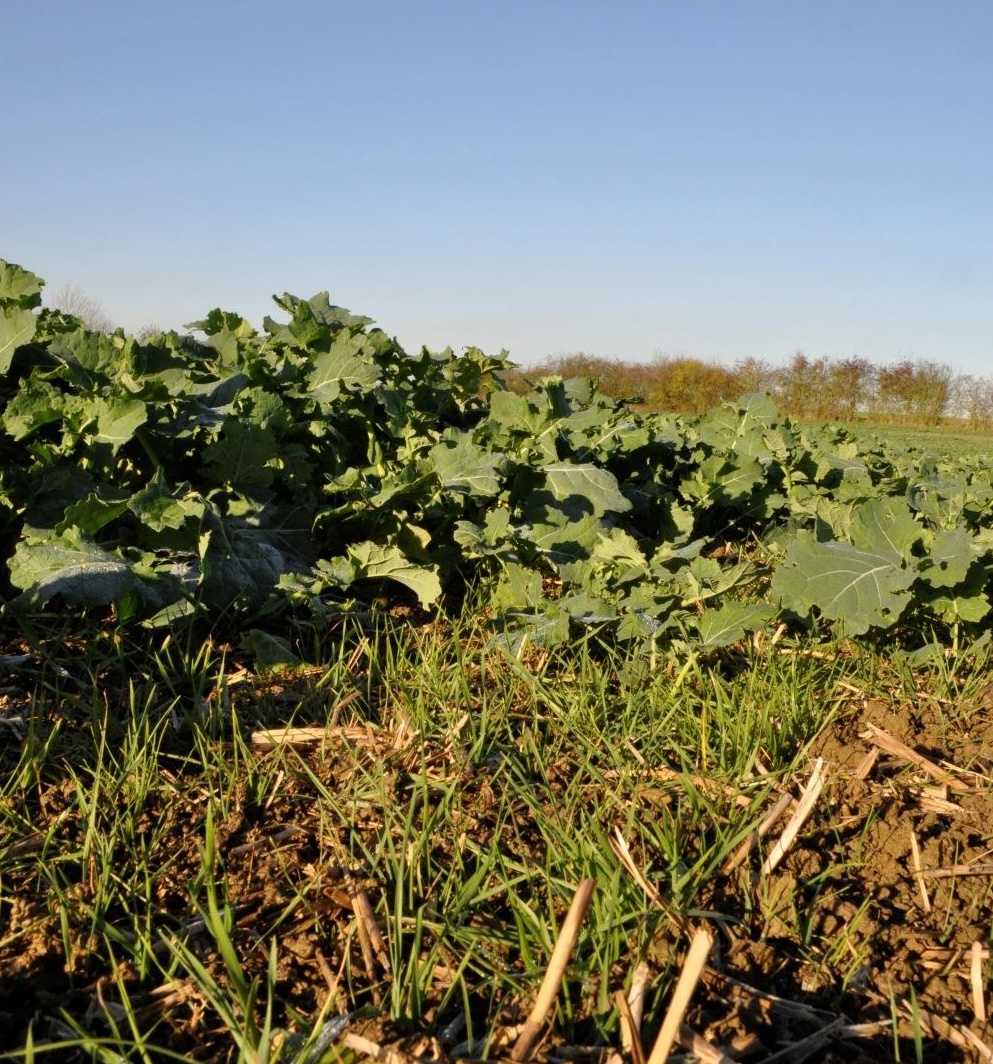
The sharp drop in temperatures combined with satisfactory soil humidity in the North-East zone means that propyzamide can now be applied to manage grassy weeds in rapeseed crops.

Propyzamide (KERB FLO and generic products) is an essential herbicide molecule for managing weeds in rape plots heavily infested with grasses, particularly when these are resistant to other active ingredients. Propyzamide has a systemic root action on ryegrass, vulpine, cereal regrowth (especially wheat), bromegrass, wild oats (especially winter wild oats), bluegrass, vulpie and bentgrass.

Good usage practices

Certain application conditions are essential to optimize efficacy and preserve the molecule's durability:

  1. Only one application of propyzamide at 750 g/ha per season, from early November to late December on rapeseed.
  2. Do not apply to water-saturated soil, to avoid run-off and reduced efficacy.
  3. Aim for application on cool, moist soil. Efficacy depends on soil humidity. Temperatures below 10°C are strongly recommended to ensure persistence of action.

Experimental results show that the application of propyzamide-based products is not very sensitive to biomass, and this should not call into question the optimum period. Due to the foliar broadleaf control action of aminopyralid, IELO / YAGO / BIWIX / DITOP products must be applied within a rain-free period. Applications made too late (beyond November) will lack broadleaf control efficacy.

Mixing herbicide + insecticide: how to proceed?

It's always tempting to save a pass by combining herbicide and insecticide. But this is sometimes a bad economy.

First of all, it's important to consider the need for insecticides. As a reminder, the indicative risk threshold is 5 larvae per plant for well-developed colza and 2 to 3 larvae per plant for small colza or poorly established colza with nitrogen hunger.

In areas with strong resistance to pyrethroids (SKDR sector), the MINECTO GOLD + propyzamide mixture is strongly discouraged by the Institute for accounting and efficacy reasons. MINECTO GOLD must be combined with an oily adjuvant (such as ACTIROB). The presence of oil causes propyzamide to flocculate, greatly reducing its effectiveness. Furthermore, Minecto Gold should be applied when temperatures are mild and larvae are active, to maximize its effectiveness. Propyzamide, on the other hand, is applied in cold weather.

Similarly, in sectors not affected by strong resistance and still using pyrethroids to control flea beetle larvae, it is often preferable to carry out the interventions separately. Indeed, even if in practice the propyzamide + pyrethroid mixture is still possible, the optimum conditions for applying the insecticide (mild temperatures) differ from those for the herbicide (cool temperatures).
Automne Hauts-de-France Bourgogne-Franche-Comté Great East Lorraine, Alsace and Haute-Marne Désherbage Maitrise des adventices Rapeseed Non Mathys MIQUET (m.miquet@terresinovia.fr)