

Automatically generated translation
The wet, rainy conditions at the end of winter, which this year follow a winter period marked by significant melting of rapeseed in the South-West following episodes of cold and frost, are slowing down or even penalizing the crop's recovery on two counts: a lack of practicability of plots, preventing nitrogen and sulfur inputs, and excess water that can cause asphyxia or even fermentation of the root system. This raises the question of the fertilization strategy to adopt for late returns to the field and, in certain situations (flooded valley bottom plots, hydromorphic soils, low-filtering plains, etc.), the maintenance of certain plots.
Adapting fertilization practices to the condition of the colza at harvest time
Reduce the total nitrogen dose only in plots severely affected by excess water.
In most situations, the colza plants were well established and developed at the start of winter. Although excess water over the past few weeks has prevented the application of nitrogen at the start of vegetation, the condition of the colza (deep roots, high autumn biomass) is not a limiting factor for an unhindered recovery. In this context, the forecast spring nitrogen doses can be maintained. The only question is how to divide up the doses.
On the other hand, for plots where excess water stagnates on the surface (lower slopes, flooded or saturated non-drained plains, hydromorphic soils), penalizing the recovery of colza, it is important to adapt the fertilization strategy on a case-by-case basis:
For plots that were initially poorly developed in autumn (poor planting, early pest damage, etc.) and faced with significant excess water, we may consider lowering their yield potential, and by extension the total dose to be applied in spring. Oilseed rape crops with poorly developed root systems in autumn and damaged by excess water will be less able to compensate for biotic stress (pest attacks, disease, soiling) and abiotic stress (water stress) in spring. To avoid making investments that will probably not pay off at harvest, it is advisable to control operating costs as much as possible, especially fertilizer costs, which are generally the heaviest for the crop.
For plots where the rapeseed has been well established (homogeneous, dense stand, low soil contamination, high biomass in autumn, little pest damage), it is advisable to monitor its progress over the next few days. The likelihood of a smooth recovery is much greater, which means that, barring exceptional circumstances, it is not necessary to revise the forecast doses downwards.
Fractionate inputs to support the recovery and guarantee nitrogen nutrition right up to flowering
As soon as plots are ready for use again, and if weather conditions are favorable, we recommend adapting the 3-spray nitrogen strategy for the weakest colza plants, with a moderate first spray of 30 to 40 uN to enable the plant to support its growth. A final application of 40 NU should be reserved for the E stage (separated buds). The remainder can be applied at stages D1-D2 (buds together). In this case, there's no point in supporting the recovery with a substantial input from the outset, as the rapeseed's absorption capacity is limited!
For the most healthy rapeseed (> 1 kg/m² at winter's end) and/or well-established plants already at C2 (visible internodes) or even D1 stage, an initial application of around 60-70 uN should be made when the plots are passable. There's no need to hurry with these colza crops, whose good rooting guarantees a good capacity to absorb nitrogen from the soil. The balance can be applied between the D2 and E stages.

Don't forget sulfur
Rapeseed is a very demanding crop in terms of sulfur. The risk of deficiency is much greater in difficult years, when there is a lot of excess water in the autumn and at the end of winter. Consequently, we must not neglect sulfur fertilization of the crop, preferably with sulfate fertilizers (ammonium sulfate, sulfur ammonium nitrate, etc.) for a total of 75 units to be applied at the beginning of bolting (Stages C2-D1).
A reminder of the effects of excess water on rapeseed metabolism
In certain situations (hydromorphic soils, flooded plots, saturated soils with poor filtration, poorly established and/or poorly developed fall rape crops) where rape crops are "completely at a standstill", the question of turning over and replacing the crop may arise. Here are a few reminders about the effect of excess water on rapeseed activity, and the importance of making a detailed diagnosis of the plots concerned before making any decisions.
Excessive water can affect the metabolic activity of oilseed rape on two levels:
Root asphyxia
When soil oxygen levels fall below 10%, nitrogen uptake is blocked, penalizing nitrogen nutrition and, by extension, plant growth.
Fermentation of the root system
In the prolonged presence of water, rapeseed roots ferment, leading to an accumulation of ethanol in the leaves. As ethanol accumulates, photosynthesis, and by extension growth, is affected (the leaf takes on a brown to red color). If the accumulation becomes too great, foot loss is observed.
Aggravating factors
These phenomena are exacerbated by low biomass levels at winter's end, combined with poor plant establishment (rooting depth 15 cm, "forked" or "bent" pivots), the origin of which is soil structure problems, and sometimes basic fertilization. Soiling and autumn pest damage (flea beetle larvae and/or terminal bud weevils) are also factors limiting the compensation and recovery capacity of oilseed rape crops, particularly when they are underdeveloped in autumn.
So, depending on the growth and development dynamics of the rapeseed in autumn, its rooting quality, the state of soiling of the plot, the damage caused by autumn pests and the speed at which the soil dries out, the effects of excess water on recovery capacity, and by extension on yield potential, can be very different from one plot to another.
Maintain or turn over? A decision not to be taken lightly!
In certain situations where the colza does not seem to be recovering, the question arises as to whether the plot should be maintained or turned over. While the decision is straightforward in extreme cases (where the plot is intact or, on the contrary, shows heavy root necrosis), it is much more delicate in intermediate situations, depending on the percentage of the plot concerned and, above all, the evolution of the symptoms.
Diagnose each plot carefully to determine whether it should be maintained
First of all, it's important to assess the impact of turning the plot over in relation to maintaining the crop: the investment already made, regulatory aspects, the potential and feasibility of the replacement crop, depending on the herbicides used.
To assess the relevance of turning over a plot, you need to estimate the rapeseed's capacity to compensate, its fresh biomass (green weight expressed per m²) and the density of the stand, as well as any aggravating factors (hydromorphy, weediness, poor rooting, pest damage, heterogeneous stand, etc.). There's no point in leaving poor colza in plots that are likely to get dirty quickly in spring, and whose yield potential is very limited.
Here are a few points of reference to help you decide whether or not to keep plots where suspicions persist:
1. Plant stand
Depending on soil type, from 5 to 10 healthy, well-distributed plants/m², with controlled weediness, turning over the plot is not recommended.

2. Root health
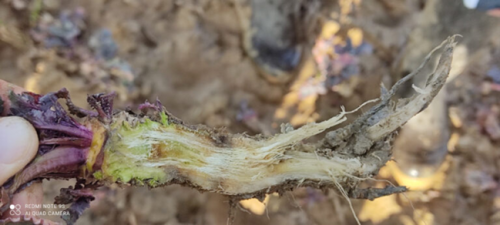
To observe root necrosis, roots must be taken and cut longitudinally to identify the affected areas. If root necrosis is too severe, the plant's survival is seriously compromised. Depending on climatic conditions (particularly the return of a rainy period), necrosis may evolve. It is therefore advisable to regularly check the progress or stagnation of necroses in lightly to moderately impacted plots to confirm the diagnosis.
| Longitudinal section of a healthy rapeseed root | Longitudinal section of a necrotic rapeseed root |
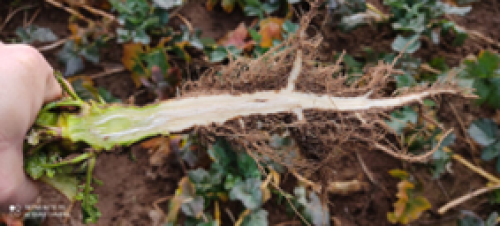
| 
|
3. Percentage of plot affected by damage
In order to consider turning, the surface area affected by heavy necrosis must be sufficient to justify new expenses (operating costs and passage costs). If the surface area affected represents only a few percent of the plot, the decision will be made to maintain the crop in the area, but it will be necessary to be vigilant about weed infestation at the end of the cycle, particularly grass infestation. Weed management should be considered during intercropping and in the following crop.
4. Level of infestation with flea beetle larvae or terminal bud weevils
This is an aggravating factor in the presence of root necrosis.
In all cases, the stress tolerance and compensatory capacities of rapeseed in spring are likely to be limited in situations where root systems are damaged by excess water. This must be taken into account when planning spring fertilization!
Replacement crops
When turning over a plot and replacing a crop, it is important to take into account the history of herbicide specialties used in autumn/winter, in order to adapt the choice of species. Click here for a table of possible replacement crops after turning over an oilseed rape plot, depending on the weed control program used.
Your regional contacts
- Quentin LAMBERT (q.lambert@terresinovia.fr) - Regional Development Engineer - Occitanie
- Quentin LEVEL (q.level@terresinovia.fr) - Regional Development Engineer - Ex-Aquitaine, Gers, Hautes-Pyrénées