

Automatically generated translation
The European ClieNFarms project, aimed at reducing greenhouse gas emissions on farms, came to a close with a symposium in Brussels on November 20. Terres Inovia helped eight farms in the Grand Est region to implement low-carbon levers as part of this work, led by INRAE.
To kick-start the transition to low-carbon agriculture, ClieNFarms was born out of a European consortium of 14 countries to study and test climate change mitigation levers over four years (2022-2025) in 20 study territories, including five in France. Led by INRAE, the project has mobilized 13.5 million euros and has been co-financed by Green Deal Europe, partner countries outside the EU and partner organizations.
Eight pilot farms supported by Terres Inovia
The technical institute was one of 33 partners involved in this vast European Union-wide project.
In addition to interactions with the Syppre Champagne platform and the Terrasolis Farm Bas Carbone space, which were mobilized as experimental study grounds to provide references, Terres Inovia accompanied eight pilot farms in the Grand Est region from 2023 to 2025.
Working with advisors from cooperatives or chambers of agriculture, farmers explored several strategies with mitigation potential : controlling and reducing industrial nitrogen fertilizers, mobilizing nitrogen-fixing crops such as peas, lentils or soybeans, modifying the types or forms of fertilizers used, increasing the surface area and biomass of non-harvested cover crops, the proportion or quantity of crop residues returned to the soil, etc.
The application of specific levers in each case resulted in a net reduction in emissions of 1.12 teqCO2/ha/year for the Grand Est region.
The Label Bas Carbone method deployed in the field
During these four years of experimentation, we were able to study ways of reducing greenhouse gas (GHG) emissions and increasing the sources of long-term soil carbon storage.
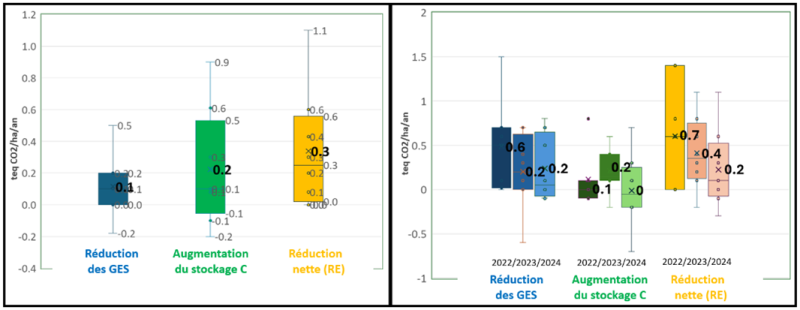
Emissions reductions on the 8 pilot farms estimated using the Label bas carbone Grandes cultures method, on the left with the levers defined by each farmer and projected over 5 years, on the right with their implementation over three years of monitoring (net reduction = reduction in GHG emissions + increase in soil carbon storage).
Analysis of individual results and comparisons with the carbon footprints of other farmers in the region enriched discussions among the group of farmers and advisors. " The variability of GHG emission reductions per hectare and per year highlights the complexity of the dynamics at play, depending on the soil and climate context, the initial cropping system, and the scale and combination of the levers used ", explains Anne Schneider, Terres Inovia's research manager, who was involved in the project to coordinate actions in this French study area. Mathieu Dulot, a development engineer based in Châlons-en-Champagne, acted as a relay in the field, facilitating exchanges with advisors from three chambers of agriculture in the Grand Est region and Scara.
A net reduction in GHG emissions
An extrapolation study was also carried out to assess the potential of the levers in field crops if applied on a territorial scale (in this case, north-eastern France).
In each context defined as homogeneous, ambitious and feasible levers were applied. In the Grand Est region, fifteen cropping systems were defined and characterized by their initial carbon footprint, representing the reality of what has been done in recent years on 80.4% of the region's arable land.
The study showed that application of the specific levers in each case resulted in a net reduction in emissions of 1.12 teqCO2/ha/year for the Grand Est region (and 0.98 for the Hauts-de-France region), i.e. a higher average reduction than that assessed for the pilot farms.
For an effective and significant impact on a territory, the integration of climate change mitigation levers must be part of a global and coordinated agro-ecological transition approach, where risks and benefits are shared between agricultural players, from upstream to downstream, from decision-makers to businesses. " Deploying the low-carbon transition requires coordinated, cross-business support: this observation is unanimously shared by the multi-stakeholder group from Hauts-de-France and Grand Est, which met twice as part of the ClieNFarms project ," continues Anne Schneider.