News

Filtres

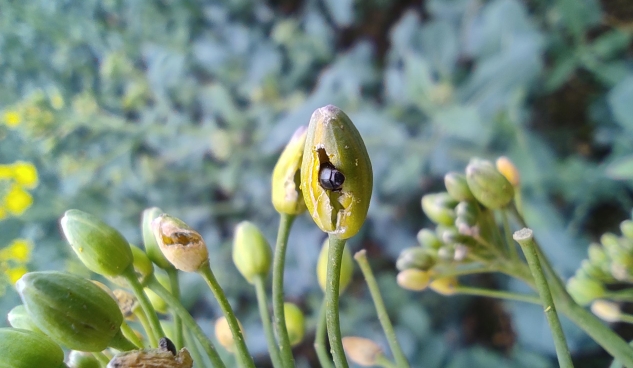
Most rapeseed crops are currently at the E to F1 growth stages. Milder weather could reignite flea beetle activity, as the first flowers are now visible in nearly two-thirds of the fields.
Following an early and nearly widespread arrival of the pest in late February, threats persist in fields with slow growth or in sheltered areas (valleys, wooded edges)
This year, flea beetle larvae are weakening the crop and reducing its resilience. Weevil pressure frequently exacerbates the situation.
Many fields have already been treated against weevils, but a follow-up treatment may be warranted as long as flowering has not clearly begun. Conversely, on healthy rapeseed that has passed the E-F1 stage, the risk of damage quickly becomes negligible, making insecticide treatment unnecessary.
At this time, treatments must remain strictly targeted at plots with confirmed risk, using solutions based on tau-fluvalinate or etofenprox. Apply under favorable conditions (sufficient humidity, limited wind, avoid hot hours) with a water volume > 200 L/ha and strictly outside foraging periods, in accordance with current regulations.

Jean Lieven - j.lieven@terresinovia.fr

Six new varieties have been submitted for inclusion in the French Catalogue in 2025.
You can view the characteristics of these varieties on MyVar

11 March 2026

Several varieties of rapeseed are currently available for use in mixtures of 5 to 10% with a variety of interest.

These varieties, known as "meligethes traps," are recognized for their earlier flowering.

To help you make your choice, Terres Inovia evaluated four trap varieties at a number of locations in 2025. 

Download the summary on MyVar

11 March 2026

The return of good weather in the North & East sector will allow the spring protein crop sowing period to begin. Here are a few reminders from Mathys Miquet to help you succeed in this stage.
Video produced as part of the Protéisol project.
 

Watch the video on YouTube