

Le 35ème Carrefour de la Sélection du Tournesol SELEOPRO, organisé par Terres Inovia avec le soutien de Sofiprotéol, s’est tenu le 6 février dernier. Il a permis d’échanger sur les travaux de recherche sur le tournesol qui présentent un intérêt pour la sélection et la filière.
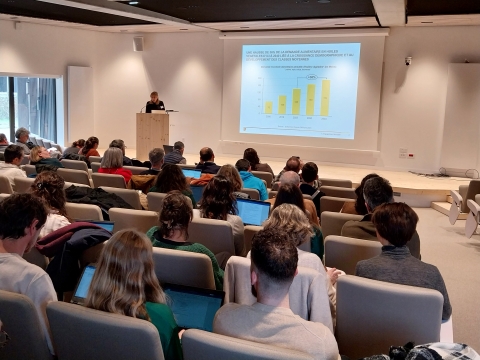
Quelles avancées de la recherche permettent d’améliorer la sélection du tournesol ? Quels sont les enjeux à venir pour cette culture en France ? Tels étaient les sujets du Carrefour de la Sélection du Tournesol, qui s’est déroulé le 6 février sur le site de l’Inrae Auzeville (31).
Il a réuni 70 participants, parmi lesquels de nombreux représentants des sélectionneurs de tournesol opérant en France ainsi que des acteurs de la recherche publique et de la filière oléoprotéagineuse.
Il était animé cette année par Martine Leflon, responsable du département Génétique et Protection des cultures de Terres Inovia, et animatrice de la commission tournesol de SELEOPRO.
En savoir plus sur SELEOPRO
Gestion des bioagresseurs à l’honneur
Une large part des échanges a porté sur la présentation de travaux de recherche sur la gestion des maladies et de l’orobanche avec :
• Une présentation du projet Optimildiou (Plant2Pro) et ses suites, par Alexandra Legendre (Inrae, LIPME) portant sur le développement de marqueurs moléculaires pour identifier différentes races du mildiou, maladie majeure du tournesol. Cette équipe envisage de continuer d’exploiter le séquençage des génomes de ce champignon pour développer de nouveaux marqueurs.
• La présentation de deux projets en cours sur l’interaction entre la plante parasite Orobanche cumana et le tournesol. L’une des présentations portait sur le décryptage du dialogue moléculaire de la germination des graines d’Orobanche cumana (Projet STIGO - ANR) par Elena Dangla (Inrae / Innolea). L’autre portait sur l’étude de l’effet des cultures intermédiaires multi-services (CIMS) pour lutter contre la plante parasite (Projet COTAGENE– PlantAlliance) par Thibault Roudaire (Inrae).
Claire Ortega (Terres Univia) et Raphaëlle Girerd (Sofiprotéol) ont dressé un état des lieux concernant la production, les marchés et le positionnement stratégique industriel dans la filière tournesol.
Des travaux sur l’impact du changement climatique et sur l’adaptation du tournesol
Plusieurs présentations ont également fait écho aux enjeux du changement climatique. Le sujet a été introduit par Raphaëlle Girerd avec la restitution d’une étude sur l’impact du changement climatique sur la culture du tournesol en France, et s’est poursuivi avec :
• Une étude en cours portant sur l’impact potentiel des variétés de tournesol pour l’attractivité des pollinisateurs en conditions de stress hydrique (Projet Heliopollen – Seleopro) par Olivier Catrice (Inrae, ASTR)
• La présentation par Nicolas Langlade du projet européen Hélex , coordonné par Inrae. Ce projet qui débute réunit 18 partenaires économiques et scientifiques, avec un financement Horizon Europe. Il a pour objectif principal d’employer des espèces extrêmophiles d'Helianthus sauvages, le genre regroupant le tournesol et le topinambour, pour accélérer la création de variétés de tournesol plus résistantes aux impacts du réchauffement climatique, notamment la sécheresse et les températures élevées.
Le Carrefour a enfin permis à Marie-Claude Boniface et Nicolas Langlade (Inrae) de faire un point d’étape sur le matériel généré et les actions à venir dans le projet HeliaWild, soutenu par SELEOPRO, et visant au développement et au maintien des ressources génétiques utiles pour la sélection du tournesol.
The 35th Carrefour de la Sélection du Tournesol SELEOPRO, organised by Terres Inovia with the support of Sofiprotéol, was held on 6 February. It provided an opportunity to discuss sunflower research of interest to breeding and the industry.
What advances have been made in research to improve sunflower breeding? What are the future challenges for this crop in France? These were the topics of the Sunflower Breeding Forum, held on 6 February at the Inrae Auzeville site (31).
It was attended by 70 participants, including many representatives of sunflower breeders operating in France, as well as players from public research and the oilseed industry.
Martine Leflon, head of Terres Inovia's Genetics and Crop Protection department and chair of SELEOPRO's sunflower committee, was this year's moderator.
Spotlight on pest and disease management
Much of the discussion focused on research into disease and broomrape management:
- A presentation of the Optimildiou project (Plant2Pro) and its follow-up, by Alexandra Legendre (Inrae, LIPME) on the development of molecular markers to identify different races of downy mildew, a major sunflower disease. This team plans to continue exploiting the sequencing of the genomes of this fungus to develop new markers.
- The presentation of two ongoing projects on the interaction between the parasitic plant Orobanche cumana and sunflowers. One of the presentations concerned the deciphering of the molecular dialogue of Orobanche cumana seed germination ( STIGO project - ANR) by Elena Dangla (Inrae / Innolea). The other was a study of the effect of multiservice intermediate crops (MSICs) in controlling the parasitic plant ( COTAGENE-PlantAlliance project) by Thibault Roudaire (Inrae).
Claire Ortega (Terres Univia) and Raphaëlle Girerd (Sofiprotéol) gave an overview of production, markets and strategic industrial positioning in the sunflower sector.
Work on the impact of climate change and sunflower adaptation
A number of presentations also focused on the challenges of climate change. The subject was introduced by Raphaëlle Girerd, who reported on a study into the impact of climate change on sunflower cultivation in France:
- An ongoing study into the potential impact of sunflower varieties on the attractiveness of pollinators under water stress conditions (Heliopollen - Seleopro project) by Olivier Catrice (Inrae, ASTR).
- Presentation by Nicolas Langlade of the European Hélex project, coordinated by Inrae. This project, which is just getting under way, brings together 18 economic and scientific partners with Horizon Europe funding. Its main aim is to use extremophilic species of wild Helianthus, the genus that includes sunflowers and Jerusalem artichokes, to speed up the creation of sunflower varieties that are more resistant to the impacts of global warming, particularly drought and high temperatures.
Lastly, Marie-Claude Boniface and Nicolas Langlade (Inrae) gave a progress report on the material generated and future actions in the HeliaWild project, supported by SELEOPRO and aimed at developing and maintaining genetic resources useful for sunflower breeding.